
Recognition in a Second
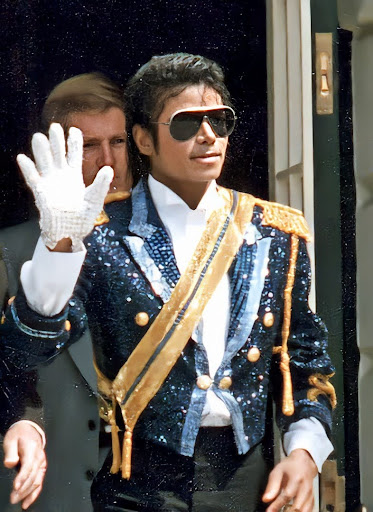
A single white glove.
A black fedora, tilted just enough.
A silhouette that does not need a name.
Few images in fashion and popular culture achieve this level of immediate recognition. With the recent release of the Michael Jackson biopic Michael (2026), his visual identity has once again come into sharp focus. Some looks do more than define an era; they settle into collective memory and become part of a shared visual language.
At that point, the question shifts. Not whether a look is iconic, but whether something so recognizable can ever truly belong to someone.
When Style Becomes Identity
Certain figures do not simply wear clothes. They construct a visual identity so deliberate that every element serves a purpose.
Michael Jackson’s style was never incidental. The rhinestone glove, for instance, was designed to make his hand movements visible in large stadiums. His trousers were intentionally cut above the ankle to reveal white socks, drawing attention to the precision of his footwork. His military jackets, often heavily embellished, gave structure and presence to his silhouette.
Taken individually, these elements are ordinary. Taken together, they form something far more distinctive.
Jackson himself often described his clothing as a form of “armor.” Not protection in a literal sense, but a way of shaping how he would be seen. Over time, this visual consistency transformed his wardrobe into something closer to a signature than a style.
The same can be said of Audrey Hepburn’s black dress in Breakfast at Tiffany’s or Karl Lagerfeld’s monochrome uniform. These looks are not protected logos, yet they behave like them. They signal identity, authorship, and influence without the need for explicit branding. In that sense, they occupy a unique space between fashion, image, and intellectual property.
The Legal Question: Can a Look Be Protected?
From a legal perspective, the answer is more complex than intuition might suggest.
Intellectual property law does not protect aesthetics in the abstract. It protects defined elements. A logo may be registered as a trademark. A specific garment design may be protected under copyright if it meets originality thresholds. A person’s name, likeness, and image may be protected under rights of publicity.
What the law does not protect is a general “look” or visual impression.
An iconic style is often a combination of elements rather than a single identifiable creation. It is precisely this composite nature that makes it powerful culturally, but difficult to capture legally.
The Limits of Protection
The difficulty becomes clearer when breaking down the elements themselves.
A glove is not protectable. A fedora is not exclusive. A military-style jacket, taken individually, belongs to a long history of design references. Even a silhouette, unless fixed in a very specific and original form, is unlikely to meet the threshold for protection.
Yet when these elements are combined, repeated, and associated with a single individual, they become unmistakable.
This exposes a structural limitation in intellectual property law. The law is designed to protect what is fixed, defined, and registrable. Cultural identity, by contrast, is fluid. It evolves, circulates, and is constantly reinterpreted.
What makes this limitation even more striking is that not all elements of an iconic identity are purely aesthetic. In some cases, they are engineered.
Michael Jackson himself held a U.S. patent (No. 5,255,452), granted in 1993, for a system of specially designed shoes that allowed him and his dancers to lean forward beyond their center of gravity during performances of Smooth Criminal. The mechanism relied on a heel slot that could lock into a retractable stage peg, creating the illusion of defying gravity.
This distinction is telling. While the visual identity associated with the movement cannot be owned in a traditional sense, the mechanism that made it possible can. The law may struggle to protect a look, but it has long been equipped to protect invention.
The result is a gap between recognition and ownership.
Inspiration, Homage… or Exploitation?
Fashion has always relied on reference. Designers borrow from archives, artists reinterpret past figures, and cultural symbols are continuously revisited.
In many cases, this is perceived as homage. A performance referencing Michael Jackson is understood as a tribute. A stylist recreating a classic silhouette may be engaging in cultural dialogue.
However, the line becomes less clear in commercial settings.
When a recognizable aesthetic is used to sell a product, the question shifts from influence to appropriation. Not necessarily in a moral sense, but in terms of economic value. If a look carries cultural weight tied to a specific individual, who benefits from its reuse?
The law offers partial answers, but it falls short of capturing the full reality.
The Role of the Estate
After an artist’s passing, control over their image and intellectual property does not disappear. It is consolidated.
The Estate of Michael Jackson offers a striking example of how posthumous rights can be structured, monetized, and actively enforced. Since his death in 2009, the estate has generated over $3.5 billion in revenue, driven by a carefully managed portfolio that includes music rights, image rights, trademarks, and merchandising assets.
This is not passive stewardship. The estate has consistently taken steps to protect and expand these rights. It has engaged in litigation to challenge unauthorized uses, including disputes involving tribute productions and digital platforms. At the same time, it has strategically licensed Jackson’s likeness and brand across industries, from music distribution to commercial partnerships and, more recently, film production.
Legally, this control is largely grounded in the right of publicity, which allows estates to regulate the commercial use of a person’s name, image, and persona. In parallel, trademark protections have been secured for various categories, extending the Jackson brand into areas such as apparel and collectibles.
Yet even this level of control has its limits. A well-known dispute with the Internal Revenue Service over the valuation of Jackson’s image at the time of his death illustrates how difficult it can be to quantify cultural capital within a legal framework. More fundamentally, while an estate can control the commercial exploitation of a persona, it cannot fully contain its aesthetic influence.
The look continues to circulate, referenced, reinterpreted, and reproduced across fashion and performance. In that sense, influence operates on a different scale than ownership.
Ownership vs Influence
In the end, the question of ownership does not have a straightforward answer.
Legally, certain elements can be protected. Names, images, and specific designs can be controlled, licensed, and enforced. But the broader visual identity, the part that makes it look instantly recognizable, remains difficult to claim.
Culturally, however, attribution is rarely ambiguous.
We may not be able to define ownership in strict legal terms, but recognition operates differently. It attaches itself to memory, to repetition, and to influence.
Some looks are not owned. They are remembered.
References
- McCarthy, J. Thomas. The Rights of Publicity and Privacy. 2nd ed., Thomson Reuters.
- Estate of Michael Jackson. Licensing and Brand Management Overview. (General industry sources and public records).
- Breakfast at Tiffany’s. Costume design by Hubert de Givenchy.
- Karl Lagerfeld. Chanel archives and personal branding materials.
- Fact Check: Here’s the Patent Michael Jackson Used for His “Smooth Criminal” Lean. Yahoo Entertainment. https://www.yahoo.com/entertainment/fact-check-heres-patent-michael-140000472.html
- Stout. The Value of Michael Jackson’s Intellectual Property After His Death. https://www.stout.com/en/insights/video/value-michael-jacksons-intellectual-property-after-his-death
FASHION LAW JOURNAL INSIDER
Join designers, brand founders and fashion lawyers who get the biggest brand battles, IP fights and career moves in fashion law, straight to their inbox.