

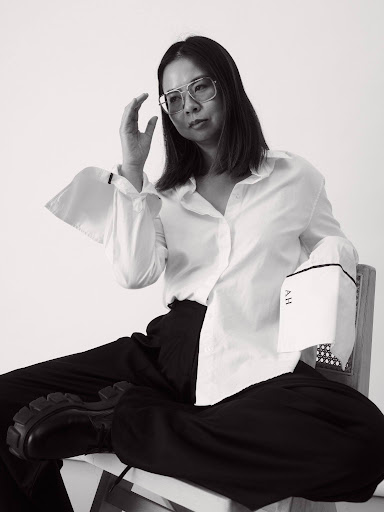
Before ANNA QUAN became the cult Australian fashion label worn by celebrities worldwide, including Kendall Jenner, Margot Robbie and Anne Hathaway, founder Anna Hoang was a law and journalism student trying to break into fashion.
On paper, law and fashion seem to belong in two different worlds. Law is built on hierarchy, precision and precedent. Fashion is built on desire, excitement and taste. But each, in its own way, is a closed world with its own language, gatekeepers and unspoken rules.
For Hoang, fashion did not present itself as a clear career path. “Until you are in it, unless you have access to it, or your family knows someone, or your parents know someone, it does not feel like a traditional career path,” she tells me. “It is quite opaque to people who are not already in it.”
I caught up with Hoang to discuss the law degree before the label, the making of ANNA QUAN, and the discipline behind a brand that appears effortless.
FLJ Insider Pro is open: live fashion law jobs and internships, five career guides and two roadmaps. Early bird USD 12/month. See what's inside
 On Studying Law
You studied law and journalism before moving into fashion. What initially drew you to law?
I kind of fell into it. It was a good base to learn about the world. If you want to be a writer, understanding how the world is structured is helpful. That was something else I was interested in. I thought law would be exciting because you would meet new people and do different things.
Was there a point where you realised that if you wanted to pursue fashion instead of law, you had to do it then, rather than later?
My husband was the one who said, “If you really want to pursue this, you have to do it now, because the money is going to get too good if you do not. You will go into the job, the money will become too good, and you will never come back and do the thing you want to do.”

Did your legal background shape the way you approached building the brand?
Building the brand was more about articulating and building out product and a brand feeling. I do not think that came from studying law or becoming a solicitor. It came more from life experience. I knew I wanted to create a brand that filled a gap for me and made me feel creatively fulfilled.
On Breaking into Fashion
 How did you begin to research how to get into fashion?
I was in the third year of my law degree, and I thought to myself, “I really want to do this”. I was not sure what I would do once I finished law, but I knew I had always been drawn to fashion.
I started applying for fashion internships while I was in law school, but people would say, “No, you are not right. You do not have the training.” Then someone who very kindly rejected me said, “You should go and do this course. This is the course you study if this is what you want to do.”
That started the process. It was research 101: what is the course, what are the requirements, how do you get in, how many people do they accept, what other courses are available, and how do they compare?
How did you get into the fashion design course?
You could not just enrol. You had to be selected. The process involved a portfolio submission, a drawing exam, a design exam and an interview. The first threshold was the portfolio. If they liked the portfolio, you were selected to sit the exam.
The exam had two parts. One was drawing, where you had to sketch what you saw. The second was to design a winter look and a summer look. Everyone was given the same fabrics to look at and touch, and then you had to go back and sketch a winter look and a summer look.
After that, you did the interview. They would decide how you had performed in the other assessments, talk to you, and decide whether they thought you had potential.
How did you feel going through that process?
Firstly, I could not draw. Before I could even properly consider applying, I did drawing classes for a whole year. There were thousands of people applying for fewer than 100 places. At the time, it was very competitive to get in. It was not like going to a private fashion college where you pay money and get a diploma. It was selective. You could not pay your way in.
It was more competitive than law school.
They needed to identify that you were a member of their tribe. Fashion can be very tribal. It is not a meritocracy. Marks mean nothing. Having a high ATAR means nothing.
You could have a great portfolio, a great drawing, and a great design on paper, but if they did not think you were part of their tribe, you were not going to get in.
What do you mean when you say, “fashion can be very tribal”?
I think you had to know and get to know the right people, and understand who would be assessing you. For me, I had already been studying with one of the teachers who was one of the core decision-makers. He had seen a lot of my drawings over the year because he had been training me for the exam.
On leaving stability behind
 What did it feel like stepping away from the more conventional legal career path?
When I was studying design, towards the end of it, a lot of my friends were becoming senior associates. One of them became a partner very young, at a top-tier firm. A lot of my friends became senior associates while I was still completing my studies.
How did that feel at the time?
I wish I could say I did not care, but I did feel a bit left behind. I was still a student, and I did not really have a career path. I knew I was going to finish, but I did not know whether I would have a successful career by the end of it, or even a stable one.
Some people said I was wasting my time. They thought it was a pipe dream and that I was wasting my talent. They probably do not remember saying that now.
Was there a turning point when you felt like you had ‘made it’?
I do not think so. People might think that because I go to Paris four times a year, and to New York, London and other places, and I do lots of different things. But I never really feel like, “I have finally made it.” There is always something else you want to do or explore.
On Building ANNA QUAN
When you first launched your label, what did you need to put in place from a business or legal perspective?
We incorporated a company and registered business names and things like that. My husband is a lawyer, so I made him do it. He purchased a shelf company, registered the company. His background is intellectual property, so trade marks, names and corporate structures were things he was already practising in at the time.
When I started my own label, it was separate from the brand I initially started with my business partner. I bought back her one share in the company, and then I changed the corporate name and the trading name. That was it.
What do you enjoy about running the business side of things?
The running of the business is interesting because you get to do lots of different things all the time. There is the creative part, and there is also a lot of putting out fires. You are doing something different every day, which is very stimulating. Maybe too stimulating sometimes, but it suits me.
What does a day in your life look like?
Today, for example, I had a meeting with my team about change management and AI implementation. This morning I did filming, walking people through the new collection and creating short-form content for organic and paid channels.
There was some graphic design work, then I had a three-hour design meeting on a resort collection. I am also looking at fabric swatches, designing silhouettes, sketching, merchandising, and dealing with wholesale issues, like what to do if shipments are delayed or what we are willing and able to provide within certain timelines.
On the future of ANNA QUAN
 What is next for ANNA QUAN?
For now, I am looking at consolidation. There are changes around taxes, tariffs, logistics, and the way fashion operates with the advancement of technology. The other day, we received our first agentic sale, which we were not expecting. We now have people shopping agentically for clothing. So for us, it is about consolidating a lot of social, structural and technological change before trying to scale further.
Behind the Seams is a series by Chloe Lei that explores the paths of those who began in law before finding their way into fashion.
Through conversations with fashion founders, designers and creatives, the series offers a glimpse into what it really takes to step away from the conventional path and follow the pull of fashion.
FASHION LAW JOURNAL INSIDER
Join designers, brand founders and fashion lawyers who get the biggest brand battles, IP fights and career moves in fashion law, straight to their inbox.