
Copyright protects a print on a shirt but almost never the shirt’s cut. Trademark protects a logo but struggles to protect an entire product shape. Shoes, bags and hardware fall into the one category fashion IP strategy keeps underusing: the design patent, a right built specifically to protect how something looks rather than what it says or how it works.
What a Design Patent Actually Protects
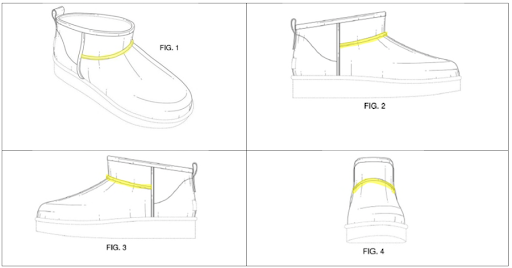
A design patent covers the ornamental appearance of an article of manufacture, governed by 35 U.S.C. Section 171, a completely separate statute from the one covering utility patents. A utility patent protects how an invention functions. A design patent protects how it looks, and the two rights can even cover the same physical object without overlapping, since one claims the mechanism and the other claims the appearance. The right is administered by the USPTO through full substantive examination, not the lighter registration process copyright uses, which means an examiner actually searches prior art before granting the patent rather than accepting the filing on its face.
Why Shoes, Bags and Hardware Fit This Right Especially Well
Garments mostly cannot use copyright to protect their overall shape, since the useful article doctrine strips protection from anything serving a function beyond pure appearance, leaving only prints and surface graphics eligible. Design patents carry no such limitation. A design patent can claim the entire ornamental shape of a shoe, a handbag, or a belt buckle directly, as long as the shape is primarily decorative rather than primarily functional, which is exactly why footwear, bag and hardware categories account for a disproportionate share of fashion’s design patent filings compared to soft goods. A sneaker’s silhouette, a bag’s hardware clasp, or a heel’s overall form can all become the actual subject of the patent claim in a way a shirt’s cut never can under copyright.
The Infringement Test: Ordinary Observer, Not Substantial Similarity
Design patent infringement runs on a completely different standard than copyright does. The test traces back to Gorham Co. v. White, an 1871 Supreme Court case, asking whether an ordinary observer, giving the attention a purchaser normally gives, would be deceived into buying one design believing it was the other. For roughly twenty five years, courts layered a second requirement on top of that test, forcing a plaintiff to also prove the accused design copied the specific “point of novelty” separating the patent from prior art. The Federal Circuit eliminated that second layer in its 2008 en banc decision in Egyptian Goddess, Inc. v. Swisa, Inc., restoring the ordinary observer test as the sole standard, evaluated with prior art as context rather than as a separate hurdle. Critically, this test does not require proof the infringer actually copied anything. A brand that designed its own shoe independently, with no knowledge the patented design even existed, can still infringe if the result looks substantially the same to an ordinary buyer.
FLJ Insider Pro is open: live fashion law jobs and internships, five career guides and two roadmaps. Early bird USD 12/month. See what's inside
Design Patent vs Copyright: The Real Differences
The two rights diverge sharply once granted. A design patent lasts 15 years from the date of grant for applications filed on or after May 13, 2015, with no renewal available and, unlike utility patents, no maintenance fees required to keep it in force for that entire term. Copyright runs far longer, typically the author’s life plus 70 years, but costs far less to obtain and undergoes essentially no substantive examination. The remedy available on infringement is where the two rights diverge most dramatically. Ordinary copyright and trademark damages generally require apportioning a defendant’s profits to the specific infringing element. Design patent law allows something far more powerful under 35 U.S.C. Section 289, letting a patent holder recover the infringer’s entire profit on the article carrying the infringing design, not just a royalty or an apportioned share. That provision sat behind Apple’s billion dollar initial verdict against Samsung, where design patents covering the iPhone’s shape helped justify a damages award based on Samsung’s total profits from the infringing phones, not merely the value of the design feature itself.
Real Fashion Examples
Crocs built one of the most aggressive design patent enforcement programs in the industry, filing dozens of suits against lookalike clog makers over the years with mixed results, a track record that shows the ordinary observer test cuts both ways once a competitor changes enough of the silhouette to create real doubt. Lululemon’s current suit against Costco shows the strategy playing out in real time, combining design patent infringement claims with trade dress and trademark misuse allegations over Costco’s private label activewear. The design patent claim in that case depends entirely on whether an ordinary shopper could tell the two garments apart at a glance, the same narrow, visual test that has governed this right since 1871.
A Right Built for Exactly This Category
Design patents will never cover a cotton t-shirt’s cut, since garments mostly serve too obviously functional a purpose for an ornamental design claim to survive scrutiny on its own. Shoes, bags and hardware sit in a different position, carrying enough pure ornamental value that the right actually works as intended. Brands building a real IP strategy around those categories specifically, rather than assuming copyright or trademark alone will cover a silhouette, are reaching for the one right actually built to protect the thing they are trying to protect.
FASHION LAW JOURNAL INSIDER
Join designers, brand founders and fashion lawyers who get the biggest brand battles, IP fights and career moves in fashion law, straight to their inbox.