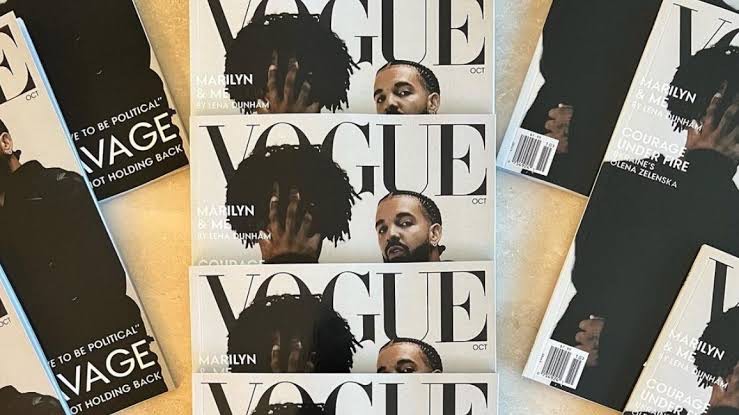
Rap fans like me got some exciting news a few months ago when Drake and 21 Savage, two of the biggest names in hip-hop, announced a joint album, “Her Loss”. To build the buzz, the pair shared Instagram images of what looked like an upcoming Vogue cover starring them. The cover was not real, and Condé Nast, acting through Advance Magazine Publishers, soon took them to court, arguing that the rappers had borrowed Vogue’s trademarks without permission to sell their record. The publisher’s case was that the mock cover led fans to think the two artists would front the next issue, and that the whole stunt amounted to false advertising. The complaint, filed on November 7, 2022, asked for damages of up to $4 million. Earlier this year the dispute ended in a settlement, under which the rappers are permanently barred from using the Vogue mark, or anything resembling it, for commercial purposes.
Going back to November, the two artists posted the image bearing the Vogue name with a caption thanking “Vogue Magazine and Anna Wintour” for their support, which suggested that Wintour, Vogue’s editor-in-chief, had signed off on the shoot. The supposed collaboration quickly became a talking point online and in the press. The cover looked like a central part of the promotion for “Her Loss”, which went on to debut at No. 1 on the Billboard 200. Within days, Condé Nast sued, saying the rappers had used the Vogue mark without permission to promote the album and had shown the fake cover to their many millions of followers. Its claims included trademark infringement and false advertising. The court acted fast. On November 9, U.S. District Judge Jed Rakoff granted a temporary restraining order (“TRO”), finding that Condé Nast was likely to win on its claims and that the campaign risked confusing and deceiving the public. The order told Drake and 21 Savage to stop using the Vogue mark and the mock magazines, and to stop invoking Wintour’s name for commercial ends.
In granting that order, the judge accepted that the mock Vogue covers, and the copies of them in circulation, were likely to make people believe a genuine issue was on its way, and to mislead them into thinking Condé Nast had sponsored or approved the material. Drake and 21 Savage took the posts down and halted that part of the campaign. Condé Nast’s lawyers also pointed to press coverage and social media reactions that treated the collaboration as real. The case was then resolved by agreement in February 2023. Under the settlement, the artists are under a permanent injunction that bars any commercial use of the Vogue mark or of marks close enough to cause confusion, and the rappers made a payment to Condé Nast of an undisclosed amount. Will Bowes, Condé Nast’s general counsel, said the rappers had traded on Vogue’s standing to promote themselves and, along the way, misled readers who look to the magazine as an authority on fashion and culture.
References:
The Print (2023), “Rappers Drake and 21 Settle with Condé Nast over fake Vogue Cover”, [Online: Web] Accessed 22 February 2023 URL: https://theprint.in/entertainment/rappers-drake-21-savage-settle-with-conde-nast-over-fake-vogue-cover/1380315/.
Variety (2023), “Drake and 21 Savage Settle Condé Nast Fake Vogue Cover Lawsuit”, [Online: Web] URL: https://variety.com/2023/music/news/drake-21-savage-fake-vogue-settle-lawsuit-conde-nast-1235526018/.
FASHION LAW JOURNAL INSIDER
Join designers, brand founders and fashion lawyers who get the biggest brand battles, IP fights and career moves in fashion law, straight to their inbox.