
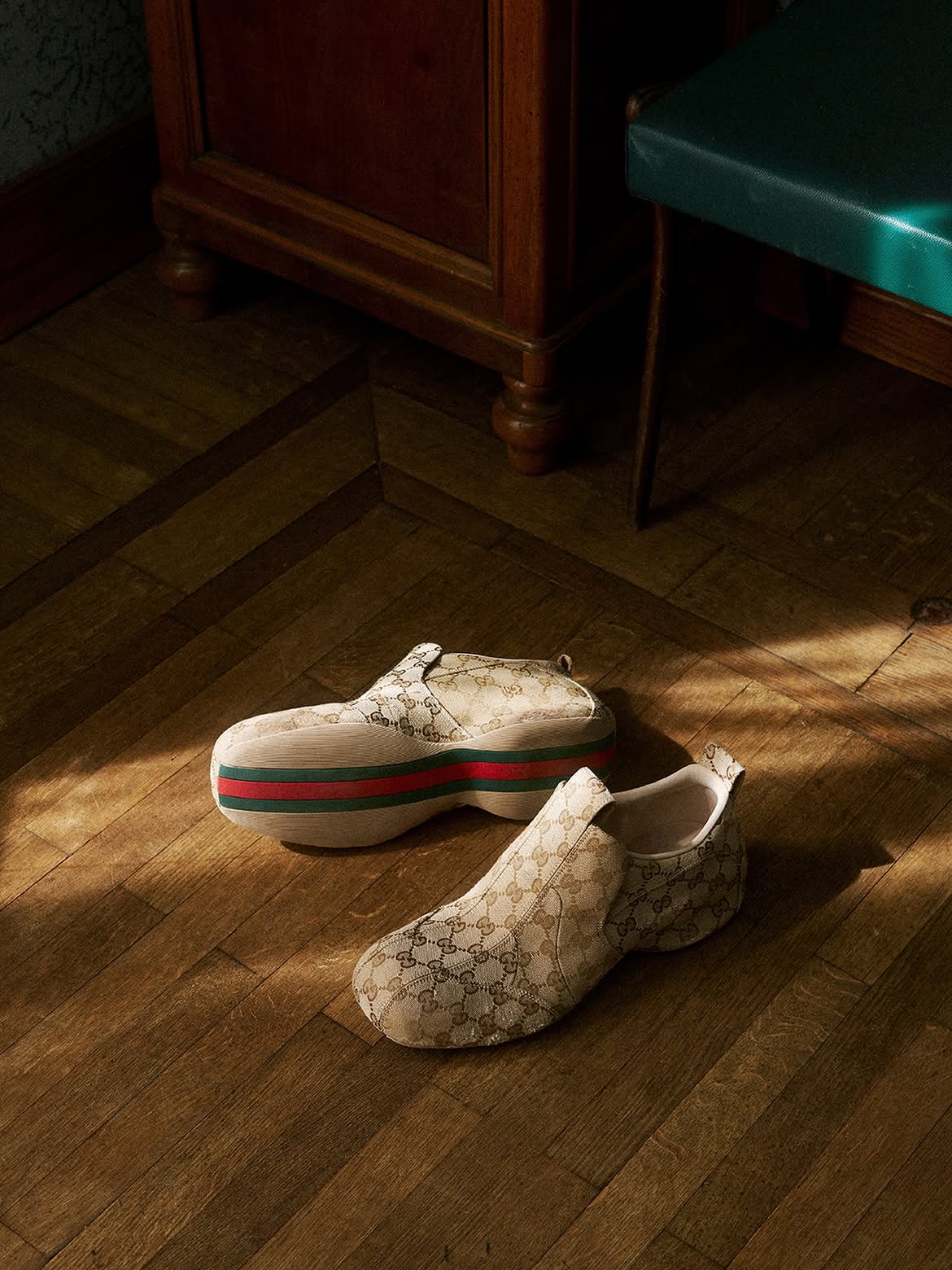
Gucci has started selling a new sneaker line carrying a label the brand has never used before: “Made in China.” Reuters first reported the shift, spotting the label on Gucci’s own website and on Drip sneakers sold at a Gucci store in Paris, and the timing places the announcement just before creative director Demna presents his new collection in Milan. The label itself is not a marketing slip or a quiet compliance footnote. It sits at the center of one of the most legally scrutinized questions in Italian fashion right now.
What Gucci Actually Changed
The Drip, described on Gucci’s site as Demna’s first sneaker design for the house, went on sale last month as part of the Primavera collection, priced around 800 euros in Europe and $1,000 in the United States. That price sits below many of Gucci’s other footwear lines, including the brand’s classic lace-up Ace sneaker, but the Drip’s laceless, sock-like silhouette borrows heavily from the chunky sneaker aesthetic Demna built at Balenciaga. A second laceless slip-on model from the same collection also carries the Chinese origin label. Every other Gucci shoe that lists a country of origin on the site still says Italy.
Gucci’s statement on the change said Italy “will always remain at the heart of the manufacturing model and the brand’s identity,” framing the Chinese manufacturing partnership as comparable to the Swiss and Japanese suppliers the house already uses for watches and eyewear. A company representative said there are no broader plans to shift Gucci’s production outside Italy, and that the specific manufacturer was chosen for its technical capability with the Drip’s particular construction.
Why the Label Itself Was Never Optional
What makes this a legal story rather than a purely commercial one is that Gucci did not have a real choice about disclosing the origin once it decided to manufacture outside Italy. Under Article 4(49) of Italian Law 350/2003, importing, exporting, or marketing goods bearing a false or misleading indication of origin is a criminal offense under Article 517 of the Italian Penal Code, and the same provision requires a brand owner to state a product’s actual foreign origin clearly enough to avoid any confusion once “Made in Italy” no longer applies. Article 16 of Law 166/2009 reinforces the same standard, requiring that anything sold under the “Made in Italy” designation be entirely conceived, manufactured, and packaged inside the country. A clear “Made in China” label on a shoe genuinely made in China is not brand transparency for its own sake. It is what the law affirmatively requires once the alternative, an ambiguous or Italian-sounding label on a foreign-made product, would expose the company to criminal liability.
The Backdrop That Makes the Timing Notable
Gucci’s decision to label its origin with total clarity lands in the middle of the most intense scrutiny “Made in Italy” claims have faced in years. Since early 2024, Milan courts have placed at least five major fashion houses under judicial administration over supply chains that relied on subcontractors accused of labor exploitation while the finished goods still carried Italian-origin branding: units of Dior, Giorgio Armani, Valentino, Alviero Martini, and, as of July 2025, LVMH’s Loro Piana. Fashion Law Journal’s own coverage of the Loro Piana ruling described the case as exposing “a fissure in the very mythology” the Made in Italy label depends on. Italy’s competition authority separately fined Armani roughly $4 million in August 2025 over misleading ethical claims tied to its supply chain. Milan prosecutors have also requested supply chain documentation from thirteen companies as part of the broader inquiry, including Gucci itself alongside Prada, Dolce & Gabbana, and Ferragamo, according to wire reporting on the investigation.
What This Means Next to Each Other
None of this means Gucci’s Chinese manufacturing decision was driven by the ongoing prosecutions, and the company has offered a straightforward technical explanation for the choice. But the two facts sitting side by side say something real about the current cost of ambiguity in Italian fashion labeling. Every brand currently under judicial administration got there over supply chains that blurred, rather than clearly stated, where a garment’s Italian character actually came from. A Barclays analyst told Reuters that Gucci’s pricing and sourcing moves have already left some investors wondering whether they should keep buying the brand at all, and a Milan-based luxury consultant was blunter still, saying the label “does not look ideal” for a house trying to rebuild its position. Whatever the commercial cost turns out to be, the legal cost of choosing clarity over ambiguity is one Gucci was never actually free to avoid.
FASHION LAW JOURNAL INSIDER
Join designers, brand founders and fashion lawyers who get the biggest brand battles, IP fights and career moves in fashion law, straight to their inbox.