
When Charleen Shavies sued Fashion Nova in April over eight promotional texts that arrived before 8 a.m., the case looked like one shopper’s complaint. Court records now show it was part of a wave that never slowed down. Between 1 January 2025 and 20 November 2026, at least 739 federal complaints pleaded a TCPA quiet-hours claim, according to a docket-by-docket count compiled for Fashion Law Journal by the data firm Settlement Insight. At least 181 of them were filed between 24 April 2026, the day Shavies filed, and 29 October.
Retailers and fashion brands are still being named every week. Eight more complaints against retail and fashion businesses were filed between 5 and 20 November alone. And many of these cases end the same way: quickly, quietly, and with no figure on the record.
The rule in plain English
The FCC’s telemarketing rule, 47 C.F.R. § 64.1200(c)(1), bars telephone solicitations to a residential subscriber before 8 a.m. or after 9 p.m. in the recipient’s local time. These are the “quiet hours”. Section 227(c)(5) of the Telephone Consumer Protection Act lets a person who receives more than one such solicitation from the same company within 12 months sue for up to $500 per violation, and up to $1,500 if a court finds it was knowing or willful.
Those are statutory amounts, not payouts. Settlement Insight told us it has not found a single court-approved class settlement of a quiet-hours claim.
FLJ Insider Pro is open: live fashion law jobs and internships, five career guides and two roadmaps. Early bird USD 12/month. See what's inside
What happened to the Fashion Nova cases
Shavies v. Fashion Nova, LLC (N.D. Cal., No. 4:26-cv-03523) did not stay in Northern California for long. On 22 June 2026 the parties’ stipulated order transferred it to the Central District of California “to enable consolidation” with Burton v. Fashion Nova LLC (C.D. Cal., No. 2:26-cv-05986), according to the order on the docket. The Central District docket then shows a notice of voluntary dismissal without prejudice from Shavies on 6 July 2026 (ECF 19).
Richards v. Fashion Nova, LLC (S.D. Ind., No. 1:25-cv-01145), the Indiana case over Memorial Day texts, ended in Fashion Nova’s favour. The court first stayed the case pending its ruling on Fashion Nova’s motion to dismiss (ECF 35, October 2025). On 26 March 2026 it granted that motion, holding that a “telephone call” under § 227(c)(5) “does not include text messages” (ECF 61). Final judgment dismissing the case with prejudice followed on 17 April 2026 (ECF 63). The same question is now before the Seventh Circuit in Steidinger v. Blackstone Medical Services, No. 25-2398, which the Indiana court noted in its order.
That split matters for every brand that texts customers. In Indiana, at least one federal judge has held that quiet-hours texts fall outside the private right of action altogether. Elsewhere, the filings keep coming.
Same records, counted twice
There is a lesson in how these numbers were found. Settlement Insight’s first count, run on 5 November, found 333 quiet-hours complaints since January 2025 and suggested filings had fallen sharply after early 2025. A recount with a 20 November cut-off found 739. Every one of the original 333 was still there.
The difference came from the search tool, not the courts. CourtListener, the free archive of federal court records, added many older complaints to its full-text search on 11 and 12 November. Its results pages had also been skipping and repeating entries when paged through, which the recount avoided by searching in small date windows. The first series measured what was searchable on 5 November, not what had been filed. The apparent decline was not real.
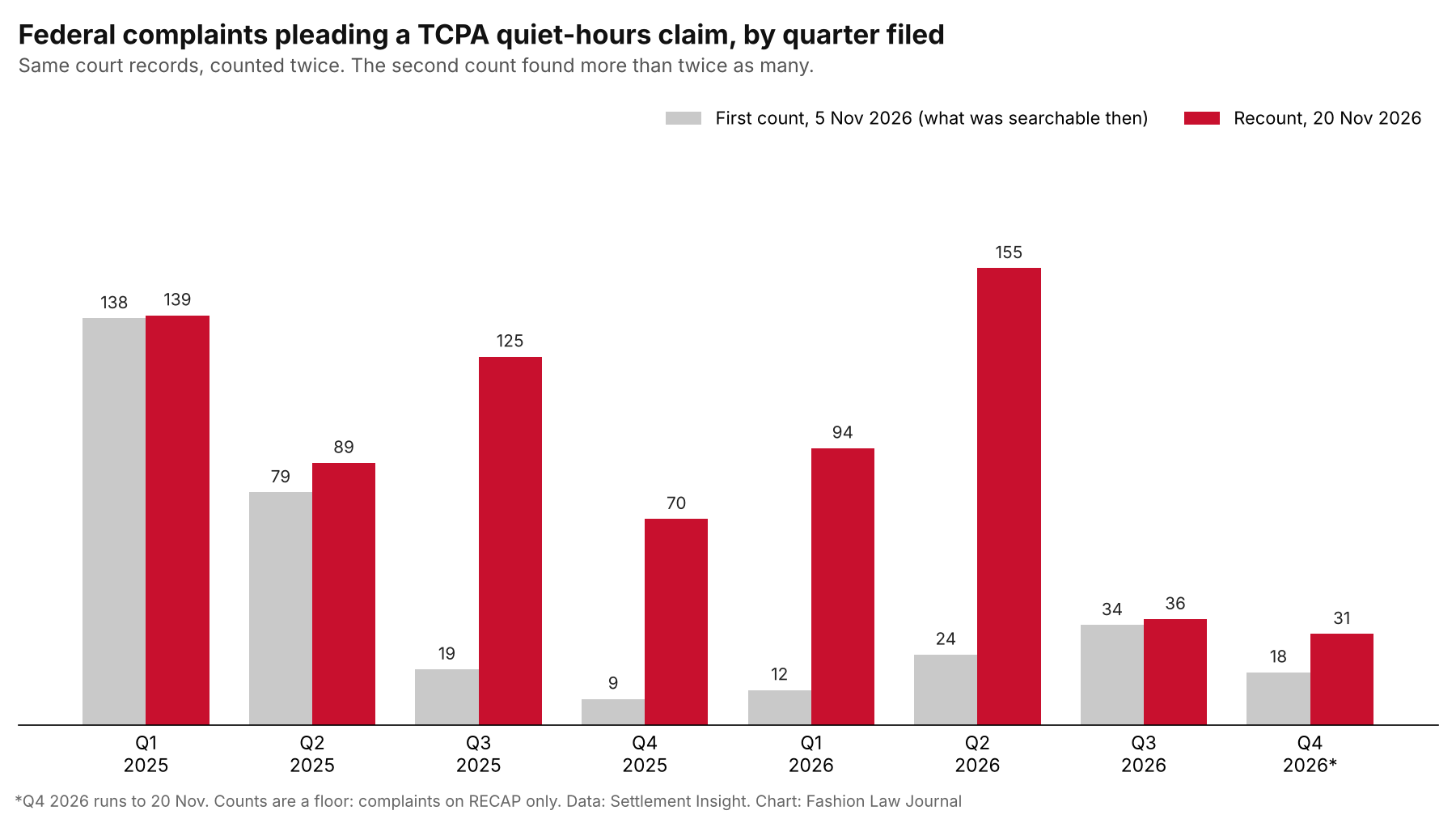
| Quarter filed | First count (5 Nov 2026) | Recount (20 Nov 2026) |
|---|---|---|
| Q1 2025 | 138 | 139 |
| Q2 2025 | 79 | 89 |
| Q3 2025 | 19 | 125 |
| Q4 2025 | 9 | 70 |
| Q1 2026 | 12 | 94 |
| Q2 2026 | 24 | 155 |
| Q3 2026 | 34 | 36 |
| Q4 2026 (to 20 Nov) | 18 | 31 |
| Total | 333 | 739 |
Even the recount is a minimum. RECAP holds only documents that have reached it, mostly ones someone has bought from PACER, so complaints that nobody has downloaded do not appear. The complaints against Saks, Skims and Birkenstock, for example, are still not in the free archive.
Who is being sued now
Of the 12 quiet-hours complaints filed between 30 October and 20 November, eight name a retail or fashion business:
| Defendant | Business | Case | Filed |
|---|---|---|---|
| Boscov’s Department Store | Department stores | Campos v. Boscov’s Department Store, LLC, E.D. Cal. 1:26-cv-09130 | 5 Nov 2026 |
| Flower Knows Cosmetics | Cosmetics | Gillaspie v. Flower Knows Cosmetics Inc, E.D. Tex. 6:26-cv-00542 | 10 Nov 2026 |
| Imperial Barber Grade Products | Grooming products | Bae v. No Limit Ventures, Inc., S.D. Fla. 0:26-cv-63166 | 10 Nov 2026 |
| Flag and Anthem | Apparel | Michael Relph v. Flag and Anthem LLC, C.D. Cal. 8:26-cv-03360 | 13 Nov 2026 |
| Blue Nile | Jewellery | Meredith Relph v. Blue Nile, Inc., C.D. Cal. 8:26-cv-03359 | 13 Nov 2026 |
| Lovepop | Cards and gifts | Mason Ibarra v. Lovepop, Inc., C.D. Cal. 2:26-cv-13496 | 19 Nov 2026 |
| Loveseat | Furniture resale | Cann v. Loveseat, Inc., S.D. Cal. 3:26-cv-06555 | 19 Nov 2026 |
| Tire Streets | Tyres | Duran v. Tire Streets LLC, C.D. Cal. 5:26-cv-06996 | 20 Nov 2026 |
These are allegations. None of the defendants has been found liable, and several cases on the earlier lists were dismissed or withdrawn within weeks.
How they end: settled, with no number
Settlement Insight tracks 97 quiet-hours dockets against retail businesses. On 5 November, 20 of them already showed a settlement entry, including Fasheh v. Skims Body, Inc. on 4 November and Simpson v. Urbn on 2 October. Four more have been added since:
- Seiler v. The Gap, Inc. (W.D. Tex. 5:26-cv-05519): “Notice of Settlement”, ECF 10, 10 November 2026. The case was closed on 12 November.
- Botto v. Lakeshore Learning Materials, LLC (C.D. Cal. 2:26-cv-07967): settlement entry, ECF 15, 16 November 2026.
- Tarlton v. Birkenstock USA, LP (C.D. Cal. 2:26-cv-11801): settlement entry, ECF 11, 16 November 2026.
- Botto v. Foot Locker, Inc. (C.D. Cal. 2:26-cv-11798): settlement entry, ECF 11, 18 November 2026.
None of these entries states an amount, and the settlement documents themselves are not in the free archive. That is the real gap in this story. Thousands of dollars per text is what the statute allows. What brands actually pay to make these suits go away is, so far, not on the public record.
What brands that text customers should take from this
- Send by the recipient’s clock, not yours. The rule runs on the recipient’s local time, and an area code is not a location. Brands that schedule one national send time are the easiest targets.
- Keep the consent trail. The defence that a customer invited the messages depends on records: when they opted in, through which form, and what it said.
- Expect speed, not trials. These cases tend to be filed fast and settled fast. The legal arguments that won in Indiana have not yet been tested on appeal.
This article is information, not legal advice. Brands facing a claim should speak to their own counsel.
How we reported this
Counts, the quarterly series, the list of new complaints and the settlement entries come from a docket-level dataset compiled by Settlement Insight, a New York firm that analyses public court records, using CourtListener’s RECAP archive with a cut-off of 20 November 2026. Fashion Law Journal checked the Shavies transfer order, the Richards stay order, dismissal order and final judgment, and the Shavies and settlement docket entries directly against the court record on CourtListener.
Correction note: in checking these records we updated two earlier Fashion Law Journal articles. Our 7 May report said the Indiana case was stayed until the Seventh Circuit ruled; the court in fact stayed it pending Fashion Nova’s motion to dismiss, which it later granted. Our 20 August case study described Shavies as still before the Northern District of California; it had been transferred in June and dismissed without prejudice in July.
FASHION LAW JOURNAL INSIDER
Join designers, brand founders and fashion lawyers who get the biggest brand battles, IP fights and career moves in fashion law, straight to their inbox.