
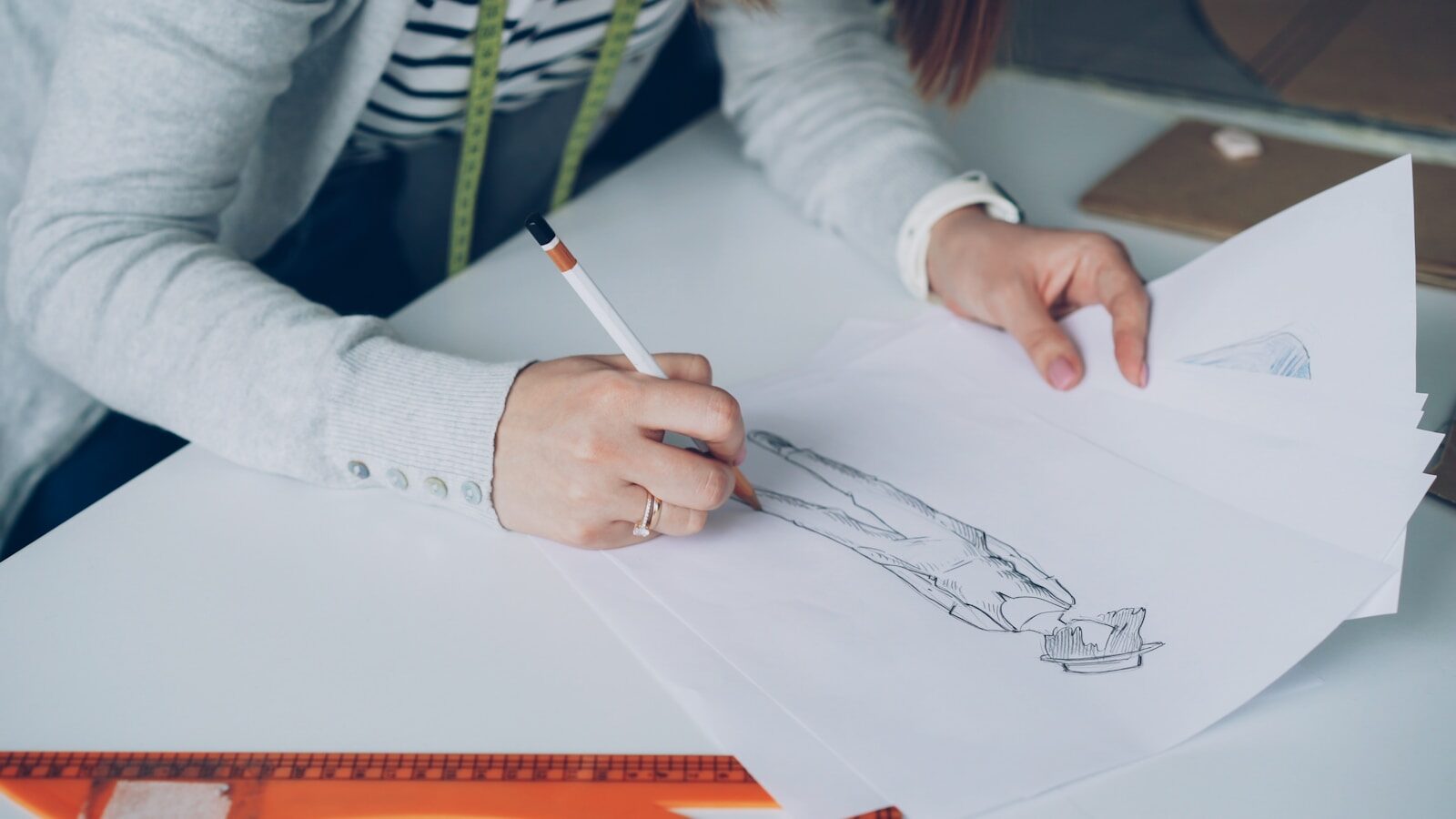
Ask ten design students whether their sketch is copyrighted the moment they draw it, and most will say yes. Ask whether the finished garment carries that same protection once it exists in fabric, and the honest answer gets far more complicated. A drawing of a dress and the dress itself sit in two completely different categories under US law, and understanding exactly where that line falls answers one of the most searched questions in fashion law, one that trips up experienced designers just as often as students still in school.
Clothing Starts Out Excluded, Not Included
Copyright automatically protects original creative works the moment they exist in fixed form, which is why copyright protects the sketch itself without question. Garments do not get that same automatic treatment. The Copyright Act classifies clothing as a useful article, something with a function beyond just portraying its own appearance, and useful articles fall outside copyright unless a design element separates cleanly from that function and would qualify as art on its own. A dress exists to cover a body. That single fact knocks the cut and the silhouette out of copyright before any judge even looks at the specific design, and no amount of originality in the pattern making changes that starting position.
Before 2017, Nobody Agreed on the Test
For decades, separating the art from the function stayed a genuine mess rather than a settled question. When the Varsity Brands cheerleading uniform case reached the Sixth Circuit in 2015, the court counted nine different tests that various circuits, the Copyright Office, and legal treatises had each developed to decide the same question, and the results genuinely depended on which test a judge picked. A stripe pattern that qualified for copyright in one circuit could lose in another, decided under a completely different legal standard for the exact same kind of design, which meant a designer’s actual rights depended less on their work and more on which courthouse a dispute happened to land in.
The Star Athletica Test, In Plain Terms
The Supreme Court cut through that chaos in 2017 in Star Athletica v. Varsity Brands, a case about the chevrons and stripes on a cheerleading uniform. The Court replaced nine competing tests with two clear questions. A design feature qualifies for copyright if it can be imagined as a two or three dimensional artwork separate from the garment, and if that artwork would independently qualify as a protectable pictorial or sculptural work on its own. The chevrons passed both questions. Lift them off the uniform, print them on a canvas, and they still function as recognizable graphic art. The uniform’s actual cut never got that far, because a court still cannot picture a garment’s shape existing independently of the body it covers.
What the Banana Costume Case Actually Proved
Two years later, a costume company proved just how far that test could stretch. In Silvertop Associates v. Kangaroo Manufacturing, the Third Circuit held that a full-body banana costume qualified for copyright, because its combination of colors, lines, shape and length worked as a sculptural artwork separable from the costume’s function of covering a person. The competitor argued the ruling would let one company own the entire concept of a banana costume. The court disagreed, noting a costume can evoke a banana in countless different shapes and colors, so protecting one specific sculptural version does not block anyone else from making their own. The case matters for design students because it shows separability reaches beyond flat prints. A three dimensional design can pass the same test a two dimensional graphic passes, as long as the garment’s function does not dictate the artistic choices.
What Actually Qualifies for a Design Student’s Sketchbook
The pattern across every one of these cases holds steady. An original print, an illustration, an embroidery design or a distinctive graphic motif can qualify for copyright, because each one exists as art independent of the garment carrying it. The cut of a jacket or the general silhouette of a dress does not qualify, no matter how original it looks, because those choices exist to make the garment fit and function. A design student who wants copyright protection is really asking whether their idea could survive as a standalone piece of art if someone printed it on a poster instead of a shirt. If the answer is yes, copyright has a real claim to make. If the only answer is that it makes the garment fit a body correctly, copyright was never going to reach it, and other tools like trademark or plain lead-time in the market end up doing the real protective work instead. Knowing which category a design falls into before spending money on registration saves a student from paying for a right that useful article doctrine was always going to deny them.
This article is general information for fashion industry professionals and is not legal advice. Consult a qualified attorney about a specific situation.
FASHION LAW JOURNAL INSIDER
Join designers, brand founders and fashion lawyers who get the biggest brand battles, IP fights and career moves in fashion law, straight to their inbox.