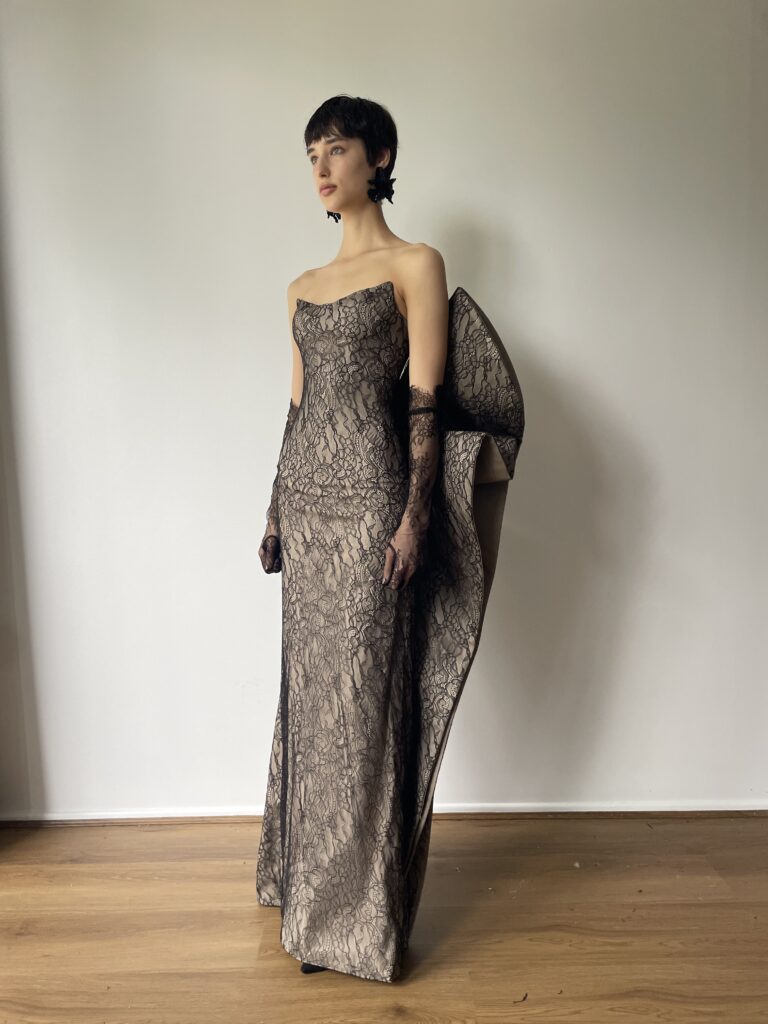


A designer wrote to us last year, confused about why her copyright registration hadn’t stopped a fast fashion label from copying her jacket. She had registered the print on the fabric, a repeating geometric pattern she designed herself, and assumed that covered the whole garment. It did not. The jacket’s actual cut, the silhouette she had spent months perfecting, was never covered by that registration at all, because in the United States, the shape of a garment usually cannot be copyrighted. That gap confuses more designers than almost anything else in fashion law, and clearing it up starts with separating two rights that get used interchangeably but protect completely different things.
What Trademark Actually Protects
A trademark protects the signals that tell a customer who made something: a brand name, a logo, a slogan, and occasionally something more unusual like a single color. Christian Louboutin proved that point in 2012, when the Second Circuit ruled that his red lacquered outsole functions as a valid trademark once it has acquired distinctiveness in the minds of consumers, though the court limited the protection to soles that contrast with the rest of the shoe. A trademark exists to prevent confusion about source. It has nothing to do with whether a design is original or creative.
Registering one costs $350 per class through the USPTO, and the initial examination alone typically takes six to eight months after filing, with the full process to registration often running past a year. Once granted, a trademark can last indefinitely, as long as the owner keeps using the mark in commerce and renews it every ten years.
What Copyright Actually Protects, and What It Does Not
Copyright protects original creative expression the moment it is fixed in a tangible form: a print, an illustration, a photograph, a piece of embroidery artwork. What it does not protect, as a general rule, is the cut, shape, or silhouette of a garment itself. The Copyright Act treats clothing as a useful article, and useful articles fall outside copyright unless a creative element can be mentally separated from the garment’s function.
The Supreme Court drew that line in 2017 in Star Athletica v. Varsity Brands, a case about the stripes and chevrons on a cheerleading uniform. The Court held that a design element qualifies for copyright only if it can be perceived as a two or three dimensional artwork separate from the uniform, and would independently qualify as art on its own. The stripes passed that test. The uniform’s cut never entered the analysis, because the shape of a garment serves a function no court has treated as separable from the garment itself.
Registering a copyright costs far less than a trademark, $45 for a single work by one author or $65 for most other claims, and a certificate typically arrives within a few months. But that certificate will only ever cover the print on the fabric or the graphic on the chest, never the pattern pieces that make the jacket a jacket.
Why This Gap Exists, and Why the EU Handles It Differently
Congress introduced the Design Piracy Prohibition Act in three separate sessions between 2007 and 2011, backed by the CFDA, each version proposing three years of copyright-style protection for fashion designs. None of those bills became law, and the United States still has no dedicated design right for apparel today.
The European Union solved the same problem differently. A garment design there qualifies automatically for an unregistered Community design right the moment it is shown publicly within the EU, lasting three years at no cost, and a designer can register the same design for up to twenty five years if it matters enough to protect that long. That right covers the actual shape and silhouette, the exact thing US law leaves exposed. It exists because EU lawmakers built a system around a simple fact fashion runs on: collections move in seasons, not decades.
Which One a Fashion Brand Actually Needs
Most brands need both, and each protects a different target. Trademark the brand name and logo as early as possible, since that filing takes the longest and the mark only grows more valuable with use. Copyright the prints and original graphics, since that filing is cheap and fast and protects work that genuinely qualifies. Neither filing will stop a competitor from copying the actual cut of a dress, and no amount of paperwork changes that.
That designer who wrote in eventually registered a copyright on a new print and built her brand name into a registered trademark instead of trying to protect a silhouette that was never going to qualify. She still gets copied sometimes. But the parts of her business that can be protected actually are now, and she stopped paying lawyers to chase a right that US law was never going to give her.
This article is general information for fashion industry professionals and is not legal advice. Consult a qualified attorney about a specific situation.
FASHION LAW JOURNAL INSIDER
Join designers, brand founders and fashion lawyers who get the biggest brand battles, IP fights and career moves in fashion law, straight to their inbox.