
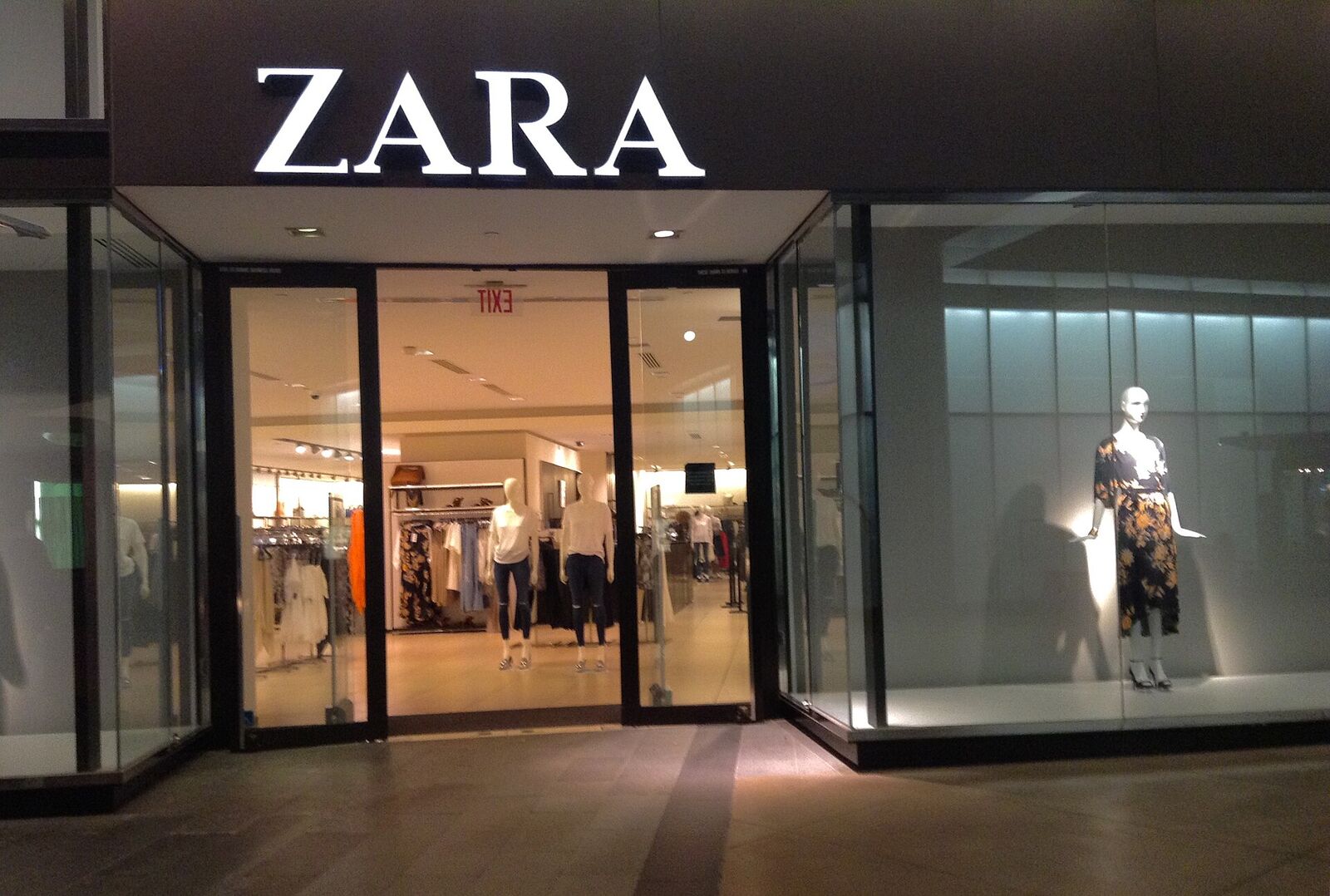
Inditex is the Spanish group behind Zara and seven other high street names, from Bershka to Massimo Dutti. It began as a dressmaking workshop in Galicia in 1963, now runs about 5,460 stores, sold almost €40 billion of clothing in its last financial year and still answers, in the end, to one family. Its size also makes it a regular party to legal disputes: copying claims from independent designers, trade mark fights over the word “Zara”, complaints about forced labour in its supply chain and rulings from advertising regulators. Here is who owns what, what each Inditex brand earns, and the legal fights that have mattered most, updated to November 2026.
Short answer: Zara is owned by Inditex (Industria de Diseño Textil, S.A.), which is listed in Spain. Founder Amancio Ortega controls 59.294% of Inditex through Pontegadea Inversiones and Partler Participaciones, and his daughter Sandra Ortega holds 5.053%. His daughter Marta Ortega has chaired the group since April 2022, with Óscar García Maceiras as chief executive.
Key takeaways
- Inditex owns eight brands: Zara, Pull&Bear, Massimo Dutti, Bershka, Stradivarius, Oysho, Zara Home and Lefties. Zara, Zara Home and Lefties together made €28.1 billion of the group’s €39.9 billion sales in 2025.
- Amancio Ortega is the controlling shareholder with 59.294% of the 3,116,652,000 shares in issue, a stake worth roughly €3.2 billion a year in dividends at the 2025 payout.
- Inditex lost a fight over “pastaZARA” at the EU General Court in September 2025, but Spain’s Supreme Court let it register the number code “26 1 18 1” as a trade mark.
- French complaints alleging that Inditex and three other groups profited from Uyghur forced labour have not led to a prosecution. Inditex has rejected the allegations.
What is Inditex?
Inditex is short for Industria de Diseño Textil, S.A., headquartered in Arteixo, near A Coruña in north-west Spain. The group’s own history starts in 1963, when Amancio Ortega opened Confecciones GOA, a small dressmaking workshop. The first Zara store opened in A Coruña in 1975, and Inditex was founded in 1985 to bring the companies together under one parent. Zara opened in Porto in 1988, New York in 1989 and Paris in 1990. Pull&Bear, Massimo Dutti, Bershka and Stradivarius joined during the 1990s, and Inditex listed on the stock market on 23 May 2001, the same period in which it launched Oysho. Zara Home followed in 2003.
The business model is why Zara became shorthand for fast fashion: short design cycles, much of the production close to Spain and constant new stock in stores. FLJ looks at how Zara built that model in Zara’s global success story, and at where the legal line around the label now sits in what constitutes a fast fashion brand.
FLJ Insider Pro is open: live fashion law jobs and internships, five career guides and two roadmaps. Early bird USD 12/month. See what's inside
Who owns Zara?
Inditex owns Zara outright, and the Ortega family controls Inditex. The group’s shareholder structure page lists three significant holdings:
- Pontegadea Inversiones, S.L.: 50.010%, held for Amancio Ortega Gaona;
- Partler Participaciones, S.L.U.: 9.284%, also held for Amancio Ortega, giving him 59.294% in total; and
- Rosp Corunna Participaciones Empresariales, S.L.: 5.053%, held for his daughter Sandra Ortega Mera.
The rest of the 3,116,652,000 shares trade on the Spanish stock exchanges. Control and management are separate. Amancio Ortega gave up the chairmanship in 2011 but still sits on the board. According to the group’s board listing, Marta Ortega Pérez has been chair since 1 April 2022 and Óscar García Maceiras became chief executive in November 2021; both were re-elected at the annual meeting in July 2026.
The family’s main return is the dividend. For 2025 the board proposed €1.75 a share, paid in two equal parts on 4 May and 2 November 2026. On FLJ’s arithmetic, Amancio Ortega’s 59.294% stake, about 1.85 billion shares, earns roughly €3.2 billion from that payout. FLJ compares this with family control at the luxury end in LVMH brands.
Which brands does Inditex own, and what do they earn?
Inditex reports six concepts, counting Zara, Zara Home and Lefties together. Its FY2025 results, covering 1 February 2025 to 31 January 2026, give these figures in millions of euros.
| Concept | Net sales 2025 (€m) | Net sales 2024 (€m) | Profit before tax 2025 (€m) |
|---|---|---|---|
| Zara (Zara, Zara Home and Lefties) | 28,051 | 27,778 | 5,601 |
| Bershka | 3,286 | 2,930 | 657 |
| Stradivarius | 3,002 | 2,664 | 707 |
| Pull&Bear | 2,546 | 2,469 | 422 |
| Massimo Dutti | 2,019 | 1,960 | 434 |
| Oysho | 960 | 831 | 198 |
| Total | 39,864 | 38,632 | 8,020 |
Group sales rose 3.2%, or 7.0% in constant currency, and net income rose 6.0% to €6.2 billion. Online sales reached €10.7 billion. Inditex ended the year with 5,460 stores after 190 openings and 293 absorptions, as it keeps closing smaller shops in favour of bigger ones. Europe outside Spain produced 51.3% of sales, the Americas 17.8%, Spain 15.9% and Asia and the rest of the world 15.0%. Pull&Bear was the only concept whose profit before tax fell, from €458 million to €422 million.
How is Inditex doing in 2026?
Steadily. In its half-year results on 9 September 2026, Inditex reported sales up 7.6% to €19.8 billion for the six months to 31 July, or 9.2% in constant currency, and net income up 6.8% to €3.0 billion. Sales in the first five weeks of the autumn and winter season, 1 August to 7 September, were up 9% in constant currency. The group expects ordinary capital expenditure of about €2.3 billion for the year.
The smaller brands are where the expansion is. On the results call, chief executive Óscar García Maceiras said Bershka opened its first US store, in Aventura, Miami, in August 2026, and Lefties, the group’s low-price format, opened its first UK store at Liverpool One the same month, after its first French store in May. Each new market brings new trade mark, advertising and consumer law questions for the group’s lawyers.
Has Zara been accused of copying designs?
Yes, repeatedly, and the cases show how hard it is for a small designer to win a copying claim against a fast fashion group. In July 2016 the Los Angeles illustrator Tuesday Bassen said Zara had copied her artwork on Zara products without permission. Fortune reported that Zara’s lawyers replied that “the lack of distinctiveness” of her designs made it hard to see how the public would link them to her, and compared the handful of complaints with the “98,000.000 average monthly visits” to its website. After the story spread, Inditex said it had “immediately opened an investigation into the matter and suspended the relevant items from sale”. Other independent artists made similar claims at the time.
Copying allegations have also come from governments. In 2021 Mexico’s culture ministry accused Zara, Anthropologie and Patowl of using indigenous designs, which FLJ covered in Mexico’s accusations of cultural appropriation. The wider problem of trend copying, and why so little of it is unlawful, is set out in copy, paste and trend.
What has Inditex won and lost over the ZARA trade mark?
ZARA has a reputation for clothing, but that does not give Inditex a veto in every market. On 10 September 2025 the EU General Court ruled in Ffauf Italia v EUIPO (pastaZARA Sublime), T-425/24 that an Italian pasta maker’s application should not have been refused on the strength of Inditex’s opposition. The Court annulled the EUIPO Board of Appeal’s decision, finding that the Board had not shown a relevant link between the marks for goods that neither compete with nor complement each other, and that in any event the pasta company had “due cause” to use its name. It pointed to decades of good-faith use, the company’s market presence and the historical origin of the name, which the pasta business traces to the city of Zara, now Zadar in Croatia, before Inditex existed.
At home the result went the other way. In October 2025 RetailDetail reported that Spain’s Supreme Court had allowed Inditex to register “26 1 18 1”, a number code it has used since 2021 for the Zara Athleticz sportswear line. Read as positions in the alphabet, the numbers spell ZARA. The Spanish Patent and Trademark Office had refused the application for lack of distinctiveness. Numbers are hard to protect as marks, so the case is a useful reference for brands trying to register codes and product numbers.
What happened to the forced labour complaints in France?
In April 2021 NGOs including Sherpa, the French branch of the Clean Clothes Campaign and the Uyghur Institute of Europe, together with a Uyghur woman who had been held in a Xinjiang camp, filed a complaint in France alleging that Inditex, Uniqlo France, SMCP and Skechers had concealed crimes against humanity by profiting from forced labour in Xinjiang. The anti-terrorism prosecutor opened an investigation, then dropped it in April 2023, saying it lacked “jurisdiction to prosecute the facts contained in the complaint”, as AFP reported via FashionUnited. At the time of the allegations, Inditex rejected them and said it had “strict traceability controls in place”.
A fresh complaint followed. An investigating judge refused to open an inquiry in May 2024, and on 5 February 2025 the Paris Court of Appeal upheld that refusal on jurisdictional grounds, AFP reported. The plaintiffs’ lawyer said a new complaint would go before a different judge. The companies have consistently denied using forced labour, and no court has found against them. The legal stakes are rising in the EU, which is phasing in a ban on products made with forced labour, as FLJ explains in the EU Forced Labour Regulation.
Why have Zara adverts been banned or pulled?
In the UK the Advertising Standards Authority ruled on 6 August 2025 that two product images on Zara’s UK website breached rule 1.3 of the CAP Code because the models “appeared unhealthily thin”. Zara, trading through ITX UK Ltd, said both models held medical certificates confirming good health and that it had already removed the images. The ASA told it not to use them again in that form.
Earlier, in December 2023, Zara removed images from its “Atelier” campaign, which showed mannequins missing limbs and statues wrapped in white, after critics said they resembled scenes from Gaza and called for a boycott. Reuters, via Al Jazeera, reported that the campaign was conceived in July and photographed in September, before the war began. France has gone further with rules aimed at the whole sector, covered in France’s anti-fast fashion law explained.
This article is general information about Inditex’s ownership, brands and legal disputes, based on company filings, court and regulator decisions and published reports as of 25 November 2026. It is not legal or investment advice, and complaints described here are allegations unless a court or regulator has ruled on them.
Frequently asked questions
Who is the owner of Zara?
Zara belongs to Inditex, which is controlled by its founder Amancio Ortega. He holds 59.294% of Inditex through Pontegadea Inversiones and Partler Participaciones. His daughter Sandra Ortega holds 5.053%, and the rest trades on the stock market.
What brands does Inditex own?
Eight: Zara, Pull&Bear, Massimo Dutti, Bershka, Stradivarius, Oysho, Zara Home and Lefties. Inditex reports Zara, Zara Home and Lefties together as one concept in its accounts.
Is Inditex a public company?
Yes. Inditex has been listed since 23 May 2001 and trades on the Spanish stock exchanges, but the Ortega family holds a majority of the shares.
Who runs Inditex now?
Marta Ortega Pérez has been chair since 1 April 2022 and Óscar García Maceiras has been chief executive since November 2021. Both were re-elected to the board in July 2026. Amancio Ortega remains a board member and the controlling shareholder.
How much money does Inditex make?
In the year to 31 January 2026, Inditex reported sales of €39.9 billion and net income of €6.2 billion. In the first half of 2026 sales rose 7.6% to €19.8 billion and net income rose 6.8% to €3.0 billion.
Has Inditex won its ZARA trade mark fights?
Not all of them. It lost an EU opposition against the pasta brand pastaZARA when the General Court annulled the EUIPO decision in September 2025, but Spain’s Supreme Court let it register the number code “26 1 18 1”, in a ruling reported in October 2025.
Featured image: Photo: Mike Mozart via Wikimedia Commons, CC BY 2.0
FASHION LAW JOURNAL INSIDER
Join designers, brand founders and fashion lawyers who get the biggest brand battles, IP fights and career moves in fashion law, straight to their inbox.