

Last updated: July 2026
The punk movement in fashion was a radical anti-establishment style revolution born in New York around 1974 and London by 1976. Rooted in punk rock and DIY ethics, it turned torn garments, safety pins, leather, and provocative slogans into political statements. Designers such as Vivienne Westwood and Malcolm McLaren pushed punk from the street into fashion history.
What Were the Origins of the Punk Movement in Fashion?
Fashion, since time immemorial, has been restricted to the rich and the affluent. Trends are made in the ateliers and the boutiques, while the working class waits for those trends to trickle down to department stores and corner shops. Trends were set by the bourgeoisie and followed by the proletariat. Everything changed in the 1970s, when a force emerged that defied the norm, disrupted the status quo, and sent shockwaves through the fabric of society.
The 1970s was a decade of political and social upheaval, marked by coups, government scandals, political conflict, and Cold War tensions between rival blocs. Youth participation in politics surged, with young activists pioneering the anti-war, environmental, women’s rights, and LGBTQ+ rights movements. At the same time, the decade launched the “Me generation,” defined by individualism, advocacy for personal liberties, and self-help culture.
In popular media, especially Hollywood, restrictions on violence, obscenity, and sexual content loosened. The Beatles broke up in 1970, and the public turned to acts such as Queen, the Rolling Stones, ABBA, and the Bee Gees. But sections of the population grew tired of the mainstream: disco, holdover hippies from the 60s, and a handful of rock and roll bands. They wanted a subversion of the status quo, an aesthetic that would both shock and intrigue. That appetite marked the origin of punk.
Punk is, in essence, a subculture rooted in punk rock music and deeply held anti-establishment values. It is characterized by an extremely subversive look, DIY ethics, and a penchant for activism, rebellion, and promiscuity. Reducing the punk movement to a bunch of rebellious kids running around does injustice to the movement as it existed in the 70s and discredits the influence it carries to this day.
“The appeal of punk… For me… lay in its negative identity. Punk demanded total devotion, to be expressed as total rejection of everything that was not punk,” wrote Kelefa Sanneh in his essay The Education of a Part-Time Punk.
Punk rock artists such as the Sex Pistols, the Ramones, and The Velvet Underground featured provocative, politically charged lyrics and quickly acquired a cult-like following. The subculture coalesced around 1974 in New York and 1976 in the UK.
What Political Ideas Drove the Punk Subculture?
The punk subculture emphasizes individual freedom, with non-conformism, anti-authoritarianism, direct action, and anti-corporate narratives stitched through its music, fashion, and art. Slogans, phrases, and imagery echoing the “punk philosophy” appear in punk rock songs, zines, artwork, and on t-shirts and outfits.
The most important aspect of punk is its anti-consumerism and its Do-It-Yourself (DIY) ethic. Because many members of the subculture came from lower-income groups and the working class, they DIYed everything from clothing to music and films. Access to influential publishers, labels, and designers was limited, so punks published their own underground zines, papers, and albums. This strengthened the anti-consumerist philosophy of the movement: members were encouraged to make do with what they had instead of funding big corporations and designers who sought to commercialize the punk aesthetic for their own gain.
How Did Punk Function as Anti-Fashion?
Anti-fashion is a deliberate rejection or subversion of mainstream fashion trends and norms. Unlike traditional fashion, which aims to dictate and perpetuate trends, anti-fashion embraces an individualistic, unconventional approach: second-hand shopping, DIY customization, deconstruction, and avant-garde design. Anti-fashion is associated with non-conformity, self-expression, and the questioning of societal norms, exactly the way punks treated clothing. It served as rebellion against the commercialization and homogenization of fashion, promoting individuality, creativity, and personal style.
Describing the process of “destroying” clothes, Malcolm McLaren wrote, “I had succeeded in taking an article of clothing that was crisp and new and white and making it into a thing that now suggested something wild and primitive. This wasn’t fashion as a commodity. This was fashion as an idea.”
Yet commodification arrived quickly. McLaren himself, who managed the Sex Pistols and worked with Vivienne Westwood in her early years, has been criticized by many for commodifying and profiting off the very movement he championed.
What Defined the 1970s Punk Look?
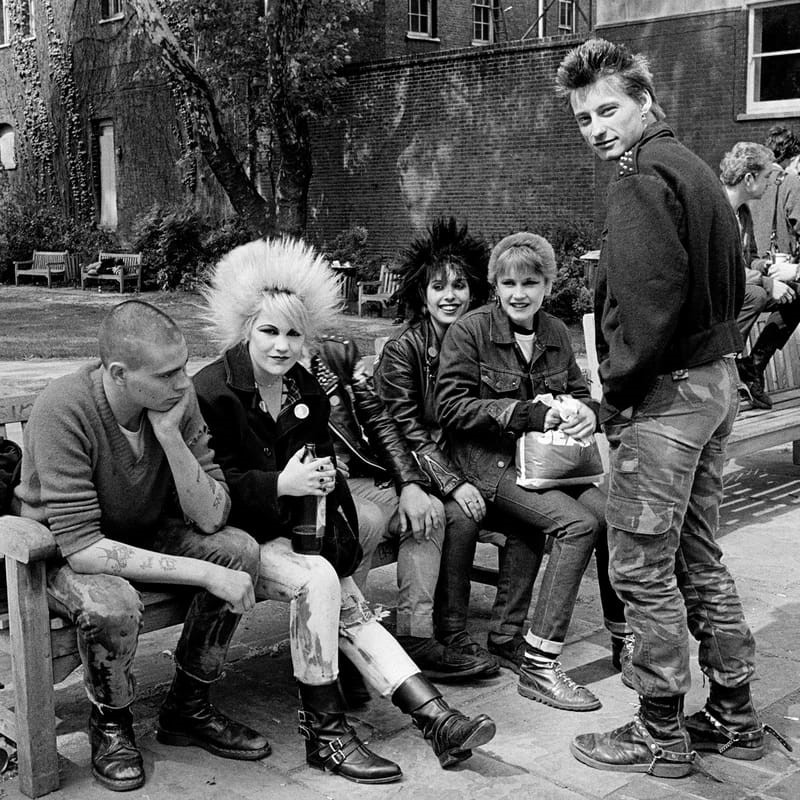
The punk look was remarkably diverse, ranging from the minimalist leather jackets and torn jeans of the Ramones to the hardcore, provocative styles of the UK scene. In a rejection of mass-produced conformity, punks customized everyday clothing themselves: garments ripped, patched with safety pins, and deliberately distressed. Screen printing became hugely popular, with familiar motifs juxtaposed against anti-establishment slogans on t-shirts and jackets.
Leather, rubber, and PVC clothing were staples, along with fetishwear chosen for its transgressive shock value. Early punks were notorious for wearing sensitive symbols such as the swastika purely for shock, even though the movement openly renounced fascists and Nazis. The Vivienne Westwood DESTROY shirt, featuring an upturned crucified Jesus and a swastika, is the most cited example.
Body modifications, tattoos, spiked jewelry, and brightly colored, spiked hairstyles completed the look, alongside Dr. Martens boots, leather jackets, and tight skinny jeans. One of the most remarkable aspects of the movement was its normalization of crossdressing and androgyny. Punk men wore skirts, fishnets, and makeup; punk women wore combat boots, oversized attire, and traditionally masculine clothing. The movement challenged every conformist idea in society, including the gender dichotomy.
| Style Element | New York Punk (1974-1976) | London Punk (1976-1979) |
|---|---|---|
| Key Designers/Influencers | Richard Hell, Patti Smith, Debbie Harry | Vivienne Westwood, Malcolm McLaren |
| Aesthetic Approach | Minimalist, DIY, stripped-down | Provocative, fetish-inspired, confrontational |
| Signature Garments | Torn t-shirts, leather jackets, ripped jeans | Bondage pants, SEX shop designs, tartan |
| Footwear | Converse sneakers, motorcycle boots | Dr. Martens boots, creepers |
| Accessories | Safety pins, thin ties, simple chains | Extensive safety pins, padlocks, spiked jewelry |
| Hair | Messy, spiked, natural colors | Mohawks, bright dyes (pink, green, blue) |
| Political Messaging | Subtle, artistic, nihilistic | Explicit slogans, shocking imagery, anarchist symbols |
Which Designers Shaped Punk Fashion?
A landmark moment in punk fashion was the opening of Vivienne Westwood and Malcolm McLaren’s shop SEX on King’s Road, London, in the mid-1970s. Their designs exerted an unshakable influence on the movement. McLaren managed the Sex Pistols at the time and used the band as a walking canvas for the shop’s collections, which propelled Westwood to fame. But the punk design story runs wider than one boutique: it stretches from New York’s DIY pioneers to couture houses that later absorbed punk’s vocabulary.
Vivienne Westwood: The Mother of Punk Fashion
Vivienne Westwood (1941-2022) remains the most iconic figure in punk fashion history. Working alongside her then-partner Malcolm McLaren, Westwood turned their King’s Road boutique into ground zero for punk style. Her designs combined fetish wear, bondage gear, and deconstructed garments with provocative political imagery; the infamous DESTROY shirt exemplified her confrontational approach. Westwood challenged conventional beauty standards and social norms, establishing punk as a legitimate fashion movement before moving into historically inspired tailoring and, later, environmental activism. Her legacy continues to shape designers worldwide, and her archive pieces remain highly sought after by collectors and museums in 2026.
Malcolm McLaren: Manager, Provocateur, and Entrepreneur
Malcolm McLaren (1946-2010) served as both impresario and commercial architect of punk fashion. As manager of the Sex Pistols and co-owner of the SEX boutique, McLaren understood punk as performance art and political theater. He viewed fashion not as commodity but as confrontation. He also faced lasting criticism for commercializing a movement rooted in anti-consumerism. According to the New York Times, he insisted in an interview, “It is not a question of selling anything. I never did anything to sell. I designed things to upset people.” His dual role as punk champion and businessman embodied the movement’s central contradiction.
Richard Hell: The DIY Pioneer
Richard Hell, bassist and vocalist for bands including the Neon Boys and the Voidoids, pioneered the deconstructed punk aesthetic in New York’s mid-1970s scene. His signature look featured torn shirts held together with safety pins, ripped jeans, and spiked, unkempt hair. Hell recalled in 1988: “We wore ripped-up clothes because we wanted our insides to be outside. The whole intention was to deliver your core self without any filters.” His approach influenced both American and British punk style, proving that rebellion could be built from everyday materials.
Zandra Rhodes: Punk Meets Glamour
British designer Zandra Rhodes took the opposite route into punk. With her 1977 Conceptual Chic collection, Rhodes translated the street’s torn jersey, exposed seams, and safety pins into precisely engineered evening wear, with tears held open by beaded pins and gold chains. Purists accused her of sanitizing rebellion, and the press dubbed the result “punk chic,” but Rhodes demonstrated that punk’s visual language could survive contact with the catwalk. Her collection remains a key study in how quickly subcultural style gets absorbed, credited, and priced by the fashion establishment.
Jean Paul Gaultier: Punk’s Couture Heir
Jean Paul Gaultier, long labelled the enfant terrible of French fashion, carried punk’s provocations into high fashion from the late 1970s onward. Tartan, fishnets, corsetry worn as outerwear, piercings, mohawks on the runway, and men in skirts all echoed punk’s assault on dress codes and gender norms. Gaultier never claimed to be a punk, but he institutionalized punk’s core idea: that clothing built to provoke belongs on the same stage as clothing built to flatter.
How Did Punk Influence Later Designers?
Punk’s fingerprints run through subsequent generations. Alexander McQueen’s confrontational tailoring and theatrical shows carried Westwood’s spirit of provocation into the 1990s and 2000s. Rei Kawakubo of Comme des Garcons made deconstruction, distressing, and deliberate imperfection a couture principle. Raf Simons built collections around youth subculture graphics and rebellion, while Hedi Slimane’s skinny silhouettes and leather drew directly on punk and post-punk codes. Even the streetwear economy, with its limited runs, graphic slogans, and outsider posturing, borrows punk’s playbook while inverting its anti-commercial politics.
| Designer | Era | Signature Punk Contribution |
|---|---|---|
| Vivienne Westwood | 1970s-2020s | SEX boutique designs, bondage wear, DESTROY shirt, punk as legitimate fashion |
| Malcolm McLaren | 1970s-1980s | Punk as performance and provocation, Sex Pistols styling, SEX boutique co-founder |
| Richard Hell | 1970s | New York DIY template: torn shirts, safety pins, spiked hair |
| Zandra Rhodes | 1970s-present | Conceptual Chic (1977), punk chic evening wear with jeweled safety pins |
| Jean Paul Gaultier | 1970s-2020s | Tartan, corsetry, gender-bending runway looks rooted in punk provocation |
| Alexander McQueen | 1990s-2010s | Confrontational tailoring and theatrical rebellion in couture |
| Rei Kawakubo | 1980s-present | Deconstruction and deliberate imperfection as high-fashion principles |
What Controversies Surrounded Punk Fashion?
The punk movement’s provocative, rebellious nature made it a constant target of criticism, some of it valid, some weak. Valid criticisms include:
- Use of the swastika and other sensitive symbols for shock factor
- Encouragement and romanticization of substance and drug abuse
- Punk being a predominantly white-dominated subculture
- Differential treatment of female punk musicians in studios
- Plagiarism and copyright infringement by punk brands against fellow punk brands and mainstream designers
The use of Nazi imagery generated particular backlash. While punks claimed the symbols were deployed ironically to provoke bourgeois sensibilities, critics argued the appropriation trivialized historical trauma and gave cover to genuine extremists. By the late 1970s, many punk communities actively rejected these symbols as the movement matured politically. For a fashion law readership, the plagiarism disputes are equally telling: a movement built on copying, cutting, and remixing sat uneasily with the intellectual property claims its own brands later asserted.
Where Does Punk Fashion Stand in 2026?
Punk today is a diluted version of what it was in its heyday. Intense commercialization and appropriation of the punk aesthetic by major designers and corporations have stripped out the DIY, rebellious ethos of the original subculture and folded it into the mainstream. High-fashion and mass-market remakes of punk are, for the most part, underwhelming and performative.
Dick Hebdige, in his book Subculture, explains this perfectly: “Once removed from their private contexts by the small entrepreneurs and big fashion interests that produce them on a mass scale, they become codified, made comprehensible, and rendered at once public property and profitable merchandise.” This signifies the death of punk, because punk’s main appeal was its subversion of the mainstream. Appropriation by the upper echelon produces a marketable yet weak imitation of the original.
Recent examples abound: luxury houses selling pre-distressed garments at premium prices, festivals packaging punk aesthetics as photogenic content, and fast fashion retailers mass-producing safety pin accessories. Original 1970s punk garments now command serious prices at auction, and museum exhibitions continue to canonize punk’s historical significance, completing its transformation from rebellious subculture to cultural artifact.
Appropriation is an inevitable phenomenon in fashion. Inspiration is taken and given, and ideas flow constantly between high and low fashion. But the roots of the inspiration should be acknowledged, however “unglamorous” they may be. Perhaps the best way to honor the punk ethos is to tear a t-shirt yourself, not pay a designer to tear it for you.
Frequently Asked Questions About Punk Movement Fashion
What materials and techniques defined DIY punk fashion in the 1970s?
Punk fashion relied on accessible materials and simple techniques: safety pins to hold torn fabric together, bleach to distress clothing, screen printing for slogans and graphics, chains and padlocks as jewelry, and metal studs on leather jackets. Punks shopped at thrift stores, military surplus outlets, and fetish shops, then customized their finds into unique anti-fashion statements that rejected mass production.
How did 1970s punk fashion differ between New York and London?
New York punk, emerging around 1974, favored a minimalist, stripped-down aesthetic of torn t-shirts, leather jackets, and simple modifications. London punk, solidifying by 1976, embraced more extreme provocation: fetish wear, bondage elements, shocking imagery, and bright hair colors. New York leaned toward artistic nihilism, while London punk was more explicitly political and confrontational.
Why did Vivienne Westwood become so influential in punk fashion?
Westwood transformed punk from street style into a legitimate fashion movement through her SEX boutique designs. She combined traditional tailoring skill with subversive materials (rubber, bondage gear, safety pins) and provocative imagery, creating garments that functioned as wearable punk ideology. Her partnership with Malcolm McLaren and the Sex Pistols gave her designs unmatched visibility, cementing her as punk’s most important designer.
What role did gender play in 1970s punk fashion?
Punk fashion actively challenged gender norms through androgyny and crossdressing. Men wore makeup, skirts, fishnets, and traditionally feminine accessories, while women adopted combat boots, oversized masculine clothing, and aggressive styling. This gender fluidity was integral to punk’s rejection of conformity, opening space for non-binary expression decades before mainstream culture acknowledged such identities.
How can someone authentically embrace punk fashion principles today?
Authentic punk fashion prioritizes DIY ethics over consumption. Customize your own clothing through distressing, screen printing, or reconstruction rather than buying pre-distressed designer garments. Shop secondhand, learn basic modification techniques, make pieces that express your own politics and identity, and reject the commodified “punk aesthetic” sold by mainstream retailers. The spirit of punk lies in creative autonomy, not branded rebellion.
References:
Valerie Steele (1997) Anti-Fashion: The 1970s, Fashion Theory, 1:3, 279-295, DOI: 10.2752/136270497779640134
The Metropolitan Museum of Art, Art Collection. https://www.metmuseum.org/art/collection
Hebdige, D. (1979). Subculture: The Meaning of Style.
Capelle, A. (2023, March 1). The working class aesthetic is cool now? [Video]. YouTube. https://www.youtube.com/watch?v=8hnnQrL57hM
Hochswender, W. (1988, September 27). Patterns; Punk Fashion Revisited. The New York Times. https://www.nytimes.com/1988/09/27/style/patterns-punk-fashion-revisited.html
McLaren, M. (1997, September 14). Elements of Anti-Style. The New Yorker. https://www.newyorker.com/magazine/1997/09/22/elements-of-anti-style
Sanneh, K. (2021, September 6). The Education of a Part-Time Punk. The New Yorker. https://www.newyorker.com/magazine/2021/09/13/the-education-of-a-part-time-punk
Beer, D. (2014). Punk Sociology. Palgrave Pivot.
By Srinidhi Madurai K, Intern at FLJ
FASHION LAW JOURNAL INSIDER
Join designers, brand founders and fashion lawyers who get the biggest brand battles, IP fights and career moves in fashion law, straight to their inbox.