

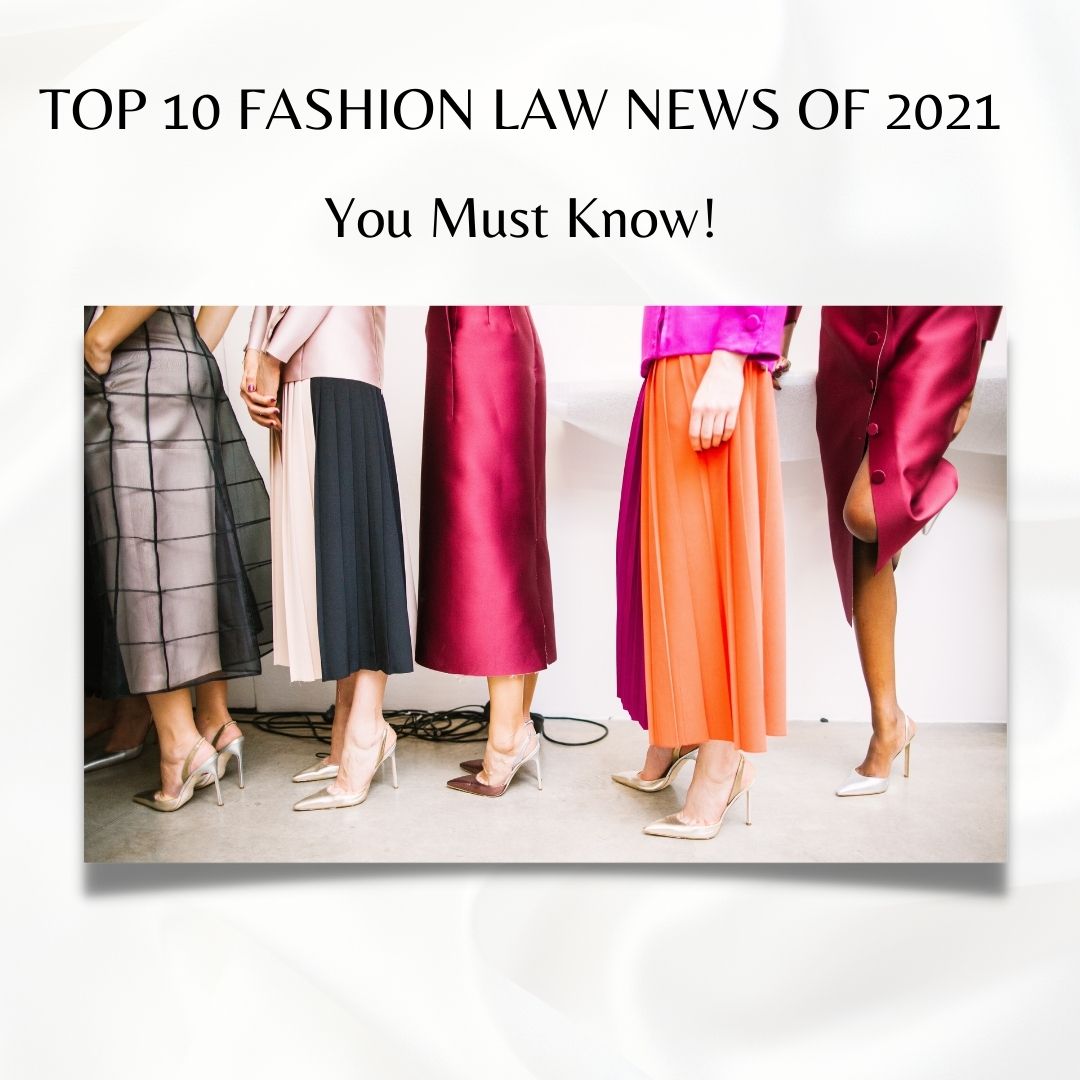
After a rough and crazy 2020, in which most of the events were canceled on the annual fashion calendar, it seemed that 2021 would be a better year for the fashion industry. Although 2021was not how we envisioned it there was a return of physical fashion weeks, across the globe although in a way that’s completely new for the industry and with other key fashion and law events that happened.
As we end this year of 2021, it’s a proper time to look back on the top 10 fashion and law news that gave us moments of amusement, sadness, and excitement.
- Fashion enters the Metaverse:
From video games by Collina Strada and Balenciaga to start-ups creating digital clothes, fashion began experimenting with gaming and virtual reality in 2020. However, in 2021, some of the most influential brands went beyond notions and invested real money in the metaverse. Balmain, Dolce & Gabbana, and Gucci all sold NFTs; Balenciaga collaborated with Fortnite on a line of skins; and Nike acquired Rtfkt, the “Supreme of digital fashion” that combines fashion collectibles and gaming.
- Huawei Triumphs in the Trademark Case Against Chanel:
Chanel’s long-running trademark fight with Huawei suffered a setback this year. The French fashion house had opposed the Chinese technology giant’s application at the EU Intellectual Property Office to register a logo for computer hardware, arguing that it looked too much like Chanel’s famous interlocking “CC” mark.
The EU General Court ruled for Huawei in April 2021. Its key point was orientation: marks have to be compared in the form in which they were registered or applied for, regardless of how they might be rotated when used on products. Viewed that way, Huawei’s sign shows two vertical shapes resembling the letter “u” inside a circle, while Chanel’s mark shows two horizontal, interlocking “c” shapes with rounder curves and thicker lines. The Court accepted that the two logos share some features but found them visually different, so there was no similarity and no risk of consumers confusing them.
- Nike Sued MSCHF Over Modified “Satan Shoes:”
Among the most talked-about lawsuits of 2021, this was also one of the quickest to end. In March, Nike sued MSCHF, the Brooklyn art collective behind the “Satan Shoes”, for trademark infringement and dilution. The shoes were Nike Air Max 97s that MSCHF had reworked with satanic imagery and, it said, a drop of human blood in each sole, released in a limited run of 666 pairs in collaboration with Lil Nas X. The pairs sold out in under a minute, and the launch set off a wave of outrage online, with some consumers calling for a Nike boycott even though Nike had nothing to do with the product.
A federal judge granted Nike a temporary restraining order, and the parties settled within about two weeks, with MSCHF agreeing to recall and buy back the shoes. Short as it was, the case raised a question that keeps returning to the courts as personalised products grow more popular: when does reselling a genuine branded product that someone else has altered cross the line into trademark infringement?
- Israel- Bans Fur Sale in The Fashion Industry:
Israel’s announcement to ban the sale of fur in the fashion sector was praised by the International Anti-Fur Coalition, who called it the ‘first-ever country’ to do so.
Israel’s Minister of Environmental Protection, signed the bill after an awe-inspiring 86 percent of Israelis voted in support of it. The Wildlife Protection Law modification restricts the INPA director’s maneuvering room but allows him to continue giving licenses provided the pelts are utilized for “religious tradition, scientific research, education, or instruction.”
This loophole does not apply to Jews, who regularly wear cake-shaped sable hats known as shtreimels on Shabbat and holidays, but importers will now need to apply for special permissions.
- Luxury Mergers & Acquisitions:
In the realm of luxury fashion, there have been several mergers and/or acquisitions that have set tongues wagging from all walks of life. Some of them are:
Chanel and Paima
The acquisition of a significant share in Paima by Chanel is the most recent luxury restructuring of a company. After more than two decades of collaboration, Chanel purchased a majority investment in the Italian firm, signaling the fashion house’s aim for more control over its manufacturing processes and supply networks.
Authentic and Reebok
Reebok was purchased by Authentic Brands for €2.1 billion from Adidas, the German sportswear powerhouse. The agreement was signed on August 12th, 2021. Authentic Brands is a New York-based company that also owns Forever 21, Brooks Brothers, and Eddie Bauer, purchased Reebok in the hopes of revitalizing the sportswear label.
Reliance – Ritu Kumar and Manish Malhotra’s fashion labels
Reliance Industries has bought a 52 % share in Ritu Kumar, a well-known designer label. The 35 % investment held by Everstone Capital in India’s Ritika Pvt Ltd, which controls the Ritu Kumar brands, was purchased by Reliance Retail as part of the majority share transaction. Reliance Brands Ltd (RBL), a subsidiary of Reliance Industries Ltd, has secured a 40% share in Manish Malhotra’s MM Styles Pvt. Ltd.
- Marc Jacobs stages a major comeback:
Marc Jacobs was away from the runway for well over a year, while his competitors tried virtual shows and look books to stay on course with the fashion calendar. Held at the New York Public Library in June, Marc Jacobs couture, which featured cocoon shapes, gigantic platform shoes, holographic dresses, and trailing faux furs. “This collection was more about pushing the fashion bar than it was about where we’ve been or the current fashion conversation,” wrote Nicole Phelps of Vogue Runway. The collection’s title is “Happiness,” according to Jacobs.
- Infringement & Influencers:
In August, a federal court in California held that a paid endorser can face trademark infringement liability for promoting a product whose name allegedly infringes someone else’s mark. Petunia Products, which owns the “Brow Boost” trademark, sued Rodan & Fields and actress Molly Sims over a sponsored blog post promoting Rodan & Fields’ “Brow Defining Boost”. The court dismissed some of the claims against Sims but allowed the direct infringement and unfair competition claims to proceed. Because the post was sponsored, listed the price and linked to a page where readers could buy the product, it amounted to commercial use rather than protected commentary, and the court found that Petunia had plausibly alleged a likelihood of confusion between the two names.
- The return of Met Gala:
This year, fashion’s largest night returned, but with a few changes, such as requiring attendees to provide proof of vaccination and a mask-on policy indoors (except when dining or drinking). The focus was on the red carpet when celebrities made their entrances and showcased their beautifully planned costumes, but what was surprisingly more entertaining to observe was how some of them used their face covering as a creative accessory.
Kim Kardashian wore a Balenciaga costume that covered her entire head, while singer Grimes made hers a tremendously eye-catching feature of her Dune-inspired attire.
- Rise Of Fashion NFTs:
This is the year of non-fungible tokens, and high-end fashion houses have jumped on board with the cryptocurrency fever, each releasing their kind. It’s no surprise, given that these digital assets have been known to sell for millions of dollars.
This year, Gucci debuted its first official NFT with a short video produced to commemorate the Aria collection and its 100th anniversary, while Burberry and Louis Vuitton went right to gaming.
- Tiffany & Co., Costco Settle Years-Long Lawsuit:
Tiffany & Co. and Costco settled their long dispute this year. Tiffany had sued on Valentine’s Day 2013, objecting to the warehouse chain selling diamond rings labelled “Tiffany” that the New York jeweller had neither made nor approved. In August 2020 the federal appeals court in Manhattan threw out the $21 million judgment Tiffany had won, finding that Costco had acted in good faith and that its shoppers were discerning enough to know Tiffany had not made the rings. Tiffany estimated that 3,349 customers bought rings with “Tiffany” settings at Costco during the period covered by the suit.
References:
- (July 19, 2021) Tiffany, Costco settle 8-year lawsuit over fake Tiffany rings, CNBC. https://www.cnbc.com/2021/07/19/tiffany-costco-settle-8-year-lawsuit-over-fake-tiffany-rings.html
- Emily Farra (December27, 2021) The year in fashion: 20 moments we’ll remember most from 2021, Vogue. https://www.vogue.in/fashion/content/the-year-in-fashion-20-moments-well-remember-most-from-2021
- (April 21, 2021) General Court press release on Case T-44/20, Chanel v EUIPO, Court of Justice of the European Union. https://curia.europa.eu/jcms/jcms/p1_3496068
FASHION LAW JOURNAL INSIDER
Join designers, brand founders and fashion lawyers who get the biggest brand battles, IP fights and career moves in fashion law, straight to their inbox.


Superb article!!!!