
Last updated: July 2026
Givenchy is a French luxury fashion and beauty house founded in Paris in 1952 by aristocrat couturier Hubert de Givenchy. Famous for dressing Audrey Hepburn, the house built its name on elegant haute couture. Since 1988 the fashion house has been owned by LVMH, the world’s largest luxury group, while Givenchy fragrances and cosmetics also sit within the LVMH portfolio.
Who founded Givenchy and who owns it now?
Hubert de Givenchy was born in Beauvais, France, in 1927 into an aristocratic family. Drawn to design from childhood, he moved to Paris as a teenager during the 1940s to pursue fashion, studying at the Ecole Nationale Superieure des Beaux-Arts. He trained in the ateliers of leading postwar couturiers, including an apprenticeship with Jacques Fath, and gained further experience with houses such as Robert Piguet, Lucien Lelong, and Elsa Schiaparelli before striking out on his own.
In 1952, at just 25 years old, he opened his own maison in Paris. His debut collection made an immediate impression on Parisian haute couture, most famously through the Bettina blouse, a simple white cotton shirt named after the model Bettina Graziani. The idea of luxurious separates built from relatively humble fabrics felt fresh in a couture world dominated by formality, and it announced Givenchy as a house with a distinct point of view: aristocratic elegance with ease.
Hubert de Givenchy led his house for more than four decades. In 1988 he sold the business to LVMH Moet Hennessy Louis Vuitton, the Paris-based luxury conglomerate led by Bernard Arnault, and he continued as creative director until his retirement in 1995. He died in March 2018 at the age of 91, mourned across the industry as one of the last of the great postwar couturiers.
As of mid-2026, Givenchy remains part of LVMH’s Fashion and Leather Goods division, alongside houses such as Louis Vuitton, Dior, Fendi, Celine, and Loewe. Givenchy Parfums, home of fragrances such as L’Interdit, Amarige, and Gentleman, operates within LVMH’s Perfumes and Cosmetics business. The brand maintains a global retail footprint spanning dozens of countries, with boutiques concentrated in fashion capitals across Europe, North America, the Middle East, and Asia.
What made Givenchy iconic?
No relationship shaped Givenchy’s identity more than the friendship between Hubert de Givenchy and the British actress Audrey Hepburn. The partnership began in 1953, when Hepburn came to the young designer’s Paris studio looking for wardrobe pieces for the 1954 film Sabrina. What started as a costume commission grew into one of the most celebrated designer and muse relationships in fashion history.
Givenchy went on to dress Hepburn both on screen and off for decades, and their collaboration reached its cultural peak with the 1961 film Breakfast at Tiffany’s. The black column dress Hepburn wore as Holly Golightly, paired with pearls, long gloves, and oversized sunglasses, became arguably the most famous little black dress ever made. It influenced fashion trends throughout the 1960s and remains a reference point for designers today. In 1957 Hubert de Givenchy even created the fragrance L’Interdit with Hepburn in mind, one of the earliest examples of a couture house building a perfume around a star.
Beyond Hepburn, the house’s identity rested on a particular vision of aristocratic French couture: clean lines, architectural simplicity, and an emphasis on the woman rather than the ornament. Hubert de Givenchy’s close friendship with the Spanish master Cristobal Balenciaga, whom he regarded as a mentor, reinforced that discipline. Givenchy dressed Jacqueline Kennedy, Grace Kelly, the Duchess of Windsor, and generations of society figures, cementing a reputation for timeless refinement.
That legacy still surfaces regularly in popular culture. Givenchy remains a fixture at high-profile events such as the Met Gala, the annual showcase of haute couture in New York. At the 2024 Met Gala, themed around the story of Sleeping Beauty, Kendall Jenner wore an archival Givenchy gown from 1999, describing the piece as a beauty that had been slept on, a moment that connected the house’s archive to a new generation of audiences.
How has creative direction changed?
After Hubert de Givenchy retired in 1995, LVMH used the house as a proving ground for a series of high-profile creative directors, each of whom pulled the brand in a different direction.
The British wave: Galliano and McQueen
John Galliano served a brief tenure beginning in 1995 before moving to Dior. He was succeeded in 1996 by Alexander McQueen, whose provocative, theatrical collections generated headlines and controversy in roughly equal measure. Julien Macdonald followed in the early 2000s.
Riccardo Tisci, 2005 to 2017
The Italian designer Riccardo Tisci gave Givenchy its longest and most commercially transformative modern chapter. Over twelve years he fused gothic romanticism with streetwear, put couture craftsmanship into printed T-shirts and sneakers, and made Givenchy a favorite of music and celebrity culture. Tisci’s era repositioned the house for a younger, global luxury customer.
Clare Waight Keller, 2017 to 2020
Clare Waight Keller became the first woman to lead the house. Her defining moment came in May 2018, when she designed Meghan Markle’s wedding dress for her marriage to Prince Harry, a sculptural boat-neck gown of pure white silk seen by a global television audience of many millions. The commission returned Givenchy to the center of the conversation about modern elegance and echoed the house’s history of dressing defining women of their eras.
Matthew Williams, 2020 to 2023
The American designer Matthew Williams, founder of the label 1017 ALYX 9SM, brought an industrial, hardware-driven streetwear sensibility to Givenchy. He departed at the end of 2023 after roughly three years in the role.
Sarah Burton, appointed 2024
In 2024 LVMH appointed Sarah Burton, the celebrated former creative director of Alexander McQueen and designer of Catherine, Princess of Wales’s 2011 wedding dress, as Givenchy’s creative director. Her arrival was widely read as a return to the house’s couture roots: precise tailoring, romantic femininity, and craftsmanship over hype. As of mid-2026, Burton leads both womenswear and menswear, and her early collections have been praised for reconnecting Givenchy with the elegance of its founder.
How does Givenchy make money and protect its brand?
Product lines and target market
Givenchy’s business spans ready-to-wear and haute couture for women and men, leather goods and handbags, shoes, accessories, and, through Givenchy Parfums, fragrance and beauty. Historically the brand’s core identity was built on womenswear, reflecting haute couture’s origins as a womenswear discipline governed by the Chambre Syndicale de la Couture, though menswear has grown into a substantial part of the house. The target customer ranges from young adults drawn to the brand’s modern image to established luxury buyers, with Europe long serving as the house’s commercial heartland while Asia and North America drive growth.
Marketing and ambassadors
Givenchy invests heavily in image-driven marketing: seasonal campaigns, runway shows during Paris Fashion Week, and celebrity dressing at events such as the Met Gala and major film festivals. The house curates a visually cohesive presence across social media, where its Instagram following alone has been counted in the tens of millions across the fashion and beauty accounts combined, and it amplifies celebrity moments by resharing images of stars wearing its pieces. Regional ambassadors are central to this strategy. In 2017 the Chinese actress Li Bingbing became an ambassador aimed at the Chinese market, and in 2021 the South Korean group Aespa, with members Karina, Giselle, Winter, and Ningning, became ambassadors to reach younger audiences across Asia and beyond. The Spring/Summer 2024 womenswear campaign featuring American model Amelia Gray leaned into the minimalism that defined that season.
Sales channels
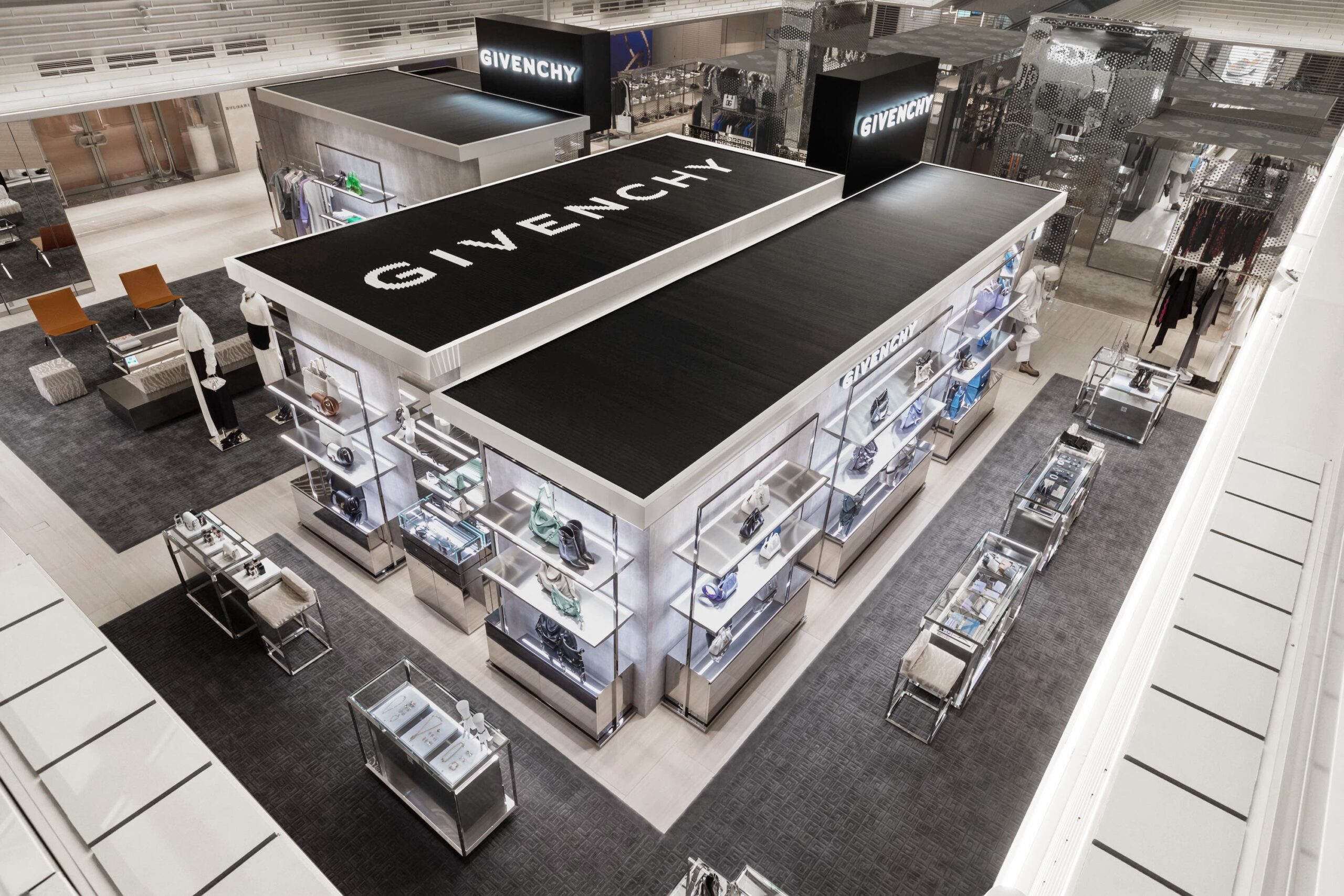
Distribution runs through several complementary channels. The official Givenchy website operates as a global flagship, offering fashion, accessories, and beauty with editorial-quality imagery. A network of directly operated boutiques anchors the brand in fashion capitals such as Paris, New York, London, and Tokyo. Luxury department stores, including partners such as Nordstrom and Neiman Marcus in the United States, extend reach in key markets, and travel retail through duty-free locations at major international airports captures affluent travelers.
Legal protection of the brand
Like every major luxury house, Givenchy actively defends its intellectual property, including trademarks, packaging, and product design. A frequently cited example is the dispute over Givenchy’s Amarige perfume in the early 1990s, in which Givenchy pursued a seller of imitation fragrance products in United States federal court. The litigation, decided in Givenchy’s favor in 1993, underscored that the distinctive elements of a luxury product, from its branding to its packaging, are protectable assets, and that courts will act against copyists who trade on consumer recognition built by the original house. For a house whose value lies overwhelmingly in its name and image, this kind of enforcement is not a side activity but a core part of the business model.
Sustainability and brand stewardship
Under LVMH’s group-wide environmental programs, Givenchy has increased its use of certified and lower-impact materials, including more sustainable cotton, and participates in LVMH initiatives on biodiversity developed with UNESCO, along with group research into recycling, upcycling, and circular design. The house’s logo, the interlocking 4G monogram introduced under its founder, has been refined over the decades but retains its geometric clarity, and the brand describes its own identity as a timeless and avant-garde vision.
Key facts about Givenchy
| Fact | Detail |
|---|---|
| Founded | 1952, Paris, France |
| Founder | Hubert de Givenchy (1927 to 2018) |
| Parent company | LVMH (since 1988) |
| Headquarters | Paris, France |
| Creative director | Sarah Burton (appointed 2024) |
| Main lines | Haute couture, ready-to-wear, leather goods, accessories, fragrance and beauty |
| Signature moment | Audrey Hepburn’s black dress in Breakfast at Tiffany’s (1961) |
Frequently asked questions
Is Givenchy owned by LVMH?
Yes. LVMH acquired Givenchy in 1988, and as of mid-2026 the fashion house remains part of LVMH’s Fashion and Leather Goods division, with Givenchy Parfums operating within the group’s beauty business.
Who designed Meghan Markle’s wedding dress?
Clare Waight Keller, then creative director of Givenchy, designed the silk boat-neck gown Meghan Markle wore to marry Prince Harry in May 2018.
What is Givenchy’s connection to Audrey Hepburn?
Hubert de Givenchy dressed Hepburn from the 1954 film Sabrina onward, most famously creating the black dress she wore in Breakfast at Tiffany’s, and their decades-long friendship defined the house’s image of effortless elegance.
Who is Givenchy’s creative director now?
Sarah Burton, formerly of Alexander McQueen, was appointed creative director in 2024 and, as of mid-2026, leads both womenswear and menswear.
Is Hubert de Givenchy still alive?
No. Hubert de Givenchy retired from his house in 1995 and died in March 2018 at the age of 91.
Author: Jazlyn Ricalde
FASHION LAW JOURNAL INSIDER
Join designers, brand founders and fashion lawyers who get the biggest brand battles, IP fights and career moves in fashion law, straight to their inbox.