
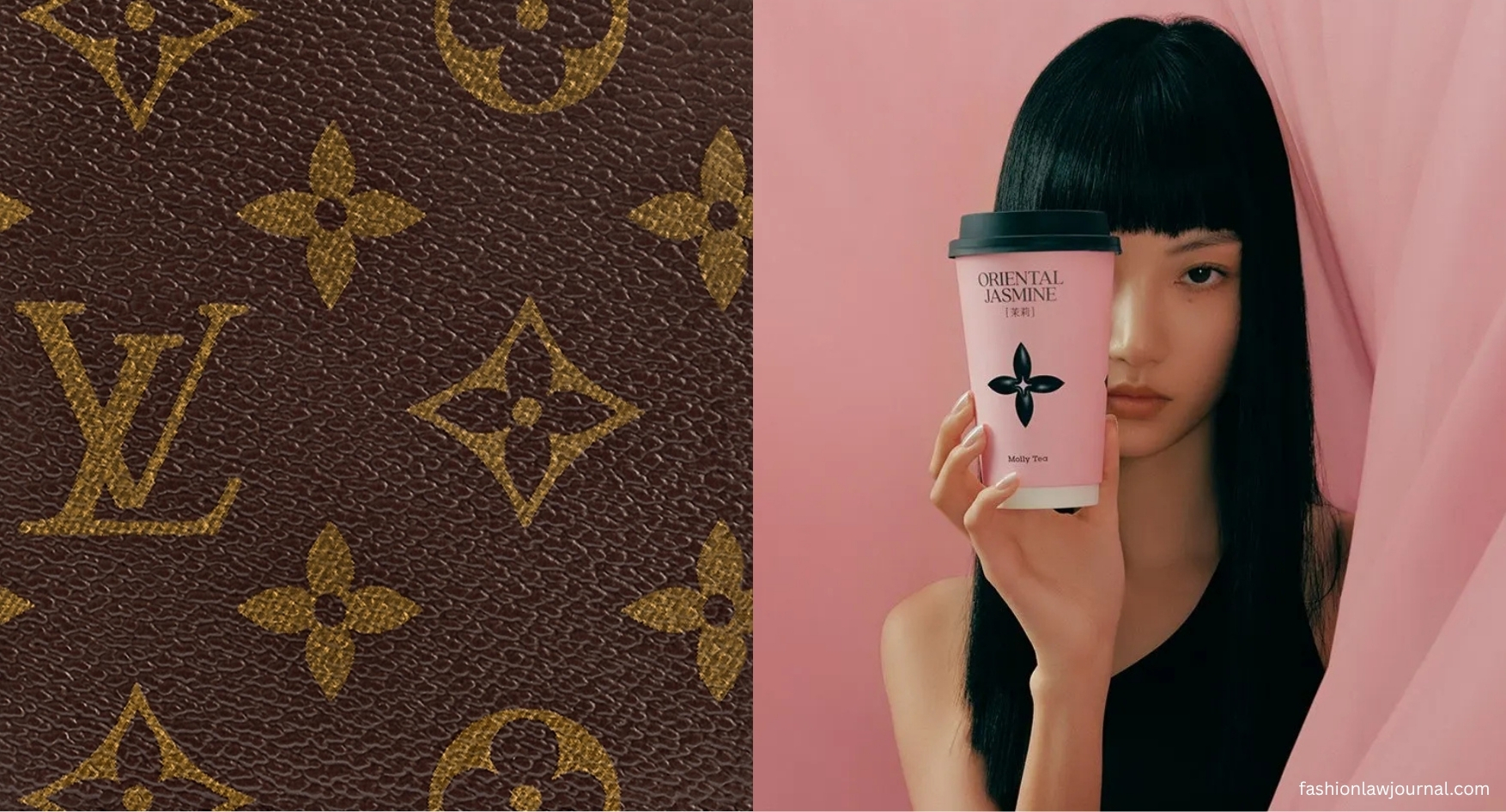
There is a particular kind of irony in a 130 year old French monogram going to war with a four year old Chinese milk tea chain over a flower. But that is exactly what happened this month, and the fallout has turned into one of the more revealing fashion law stories of the year, not because of what the court decided, but because of how China reacted to it.
A Suzhou court ordered Molly Tea to pay Louis Vuitton 10.3 million yuan, roughly 1.5 million US dollars, after finding that the tea chain’s four petal flower logo infringed LV’s famous monogram pattern. Molly Tea has to stop using the design immediately and publish corrective statements online to undo the damage. The brand says it plans to appeal. And somewhere in between the verdict and the appeal, millions of people in China decided that the tea shop was the real winner.
What actually happened in court
Louis Vuitton filed suit against Shenzhen Molly Tea Catering Management Co. and one of its Suzhou franchise operators, arguing that Molly Tea’s floral emblem was too close to its own monogram flower for comfort. The Suzhou Intermediate People’s Court agreed, the infringement was not treated as a one off design choice. The court looked at how the flower showed up across shopfronts, packaging, cup sleeves and marketing materials, and concluded that the pattern was embedded so deeply into Molly Tea’s identity that it created a real risk of confusion with LV’s mark.
What made the ruling sting more is what came out about Molly Tea’s own trademark history. The brand had filed multiple applications with China’s IP office to register its own flower marks, and most were rejected. Only a version using the Chinese characters for Molly Tea actually went through. The court apparently viewed the continued use of the flower device after those rejections as a sign of intent, not accident, which is part of why the damages landed where they did.
FLJ Insider Pro is open: live fashion law jobs and internships, five career guides and two roadmaps. Early bird USD 12/month. See what's inside
The award was not just about the flower itself. It reflected the fact that a fast growing chain with thousands of stores had let a legally risky logo run across an entire retail network, and the cost of fixing that after the fact, new signage, new packaging, new digital assets, new franchise materials, is almost always bigger than the damages figure suggests.
The public did not read it that way
Here is where the story gets interesting for anyone who covers fashion and culture, not just fashion and law. The moment the ruling went public, it exploded on Weibo, racking up hundreds of millions of views according to reporting picked up by outlets including Fortune and the BBC. State affiliated media framed the case as a French luxury house effectively claiming ownership over a floral pattern that Chinese commentators traced back to the baoxiang flower motifs seen on Tang Dynasty artifacts. One widely shared image placed Molly Tea’s logo next to carvings on a centuries old rosewood pipa, the traditional Chinese lute, side by side with LV’s monogram, inviting an obvious question: if this pattern is that old, whose heritage is it actually protecting?
Louis Vuitton, for its part, is currently marking the 130th anniversary of its monogram, which the house has described as inspired by neo gothic ornamentation and the influence of Japonism rather than by Chinese design traditions specifically. That detail matters, because it complicates the narrative in both directions. LV is not claiming a Chinese origin for its own pattern, but the optics of a French house enforcing a floral trademark inside China, against a brand whose entire aesthetic leans into “Eastern tea culture,” were always going to be sensitive. A hashtag roughly translating to “Molly Tea lost the lawsuit but won the public’s heart” picked up tens of millions of views on its own.
Where I land on this
I want to be straightforward about something, because I think a lot of coverage of this case is dodging it. The court did not rule that Chinese cultural heritage belongs to Louis Vuitton. It ruled that a specific commercial logo, used across a specific commercial network, was confusingly similar to a specific registered trademark with a strong reputation. Those are narrower questions than the ones trending on Weibo, and the difference matters.
China runs on a first to file trademark system. Ownership goes to whoever registers first, not whoever has the more compelling cultural story. That system can feel unfair when a global brand walks in and claims something that resonates with local tradition, and I understand why that stings for a domestic company that genuinely built its identity around Chinese floral aesthetics. But Molly Tea tried the registration route multiple times and was turned down. Continuing to build a retail empire around a design that regulators had already flagged is a business decision with consequences, not a heritage defense.
That said, I do not think Louis Vuitton comes out of this looking untouchable either. Winning a trademark case and winning public sentiment are two different fights, and LV lost the second one badly. For a house spending 2026 celebrating a monogram it calls a universal symbol of creativity, being cast as the brand that sued a tea shop over a flower is not a great look in its most important growth market. Legal correctness does not automatically translate into brand goodwill, especially in a market where nationalist sentiment around Western luxury has been building for a while.
What this means if you are building a brand
For readers running fashion, food and beverage, or lifestyle brands with any footprint in Greater China, the practical lessons from this case analysis is worth sitting with regardless of how you feel about the politics of the case.
A logo does not need to be a copy to create liability. It just needs to be close enough to a well known mark that confusion or unfair association becomes plausible, and the bar for “well known” gets lower the more recognizable the earlier brand is. Rebrands are a common blind spot too. Molly Tea’s shift toward a more minimal, geometric floral identity is what triggered this entire dispute, and rebrands often move faster than the legal clearance process meant to protect them. If you are refreshing a logo, packaging system, or monogram of your own, clear it properly before it goes on a single store window, not after you have thousands of them.
And if you already operate at scale, remember that exposure multiplies with your footprint. A logo problem on one storefront is a design fix. A logo problem across a national franchise network is a financial and operational event, and this case is a fairly expensive reminder of that math.
Molly Tea says it is appealing. Whether the flower survives that appeal or not, the bigger story has already been decided in public opinion, and that is the part every brand operating between East and West should be paying attention to.
Disclaimer: This article is a work of editorial commentary and is intended for general informational purposes only. It does not constitute legal advice and should not be relied upon as a substitute for advice from a qualified lawyer licensed in the relevant jurisdiction. Details of the case are drawn from public reporting and third party legal commentary as cited above, and readers with a specific legal question relating to trademark, IP, or brand protection matters should consult independent legal counsel.
FASHION LAW JOURNAL INSIDER
Join designers, brand founders and fashion lawyers who get the biggest brand battles, IP fights and career moves in fashion law, straight to their inbox.