
The face is not a mood. It is a dial, and the industry decides which way to turn it.
Somewhere in the Tuileries at the end of September, a woman walked out of a tent in gossamer chiffon and python-effect metallic trousers, and her face was doing absolutely nothing.
Not sullen. Not bored, though you would forgive it. Something cooler and harder to name, a beautiful arranged absence, the expression of a person mentally somewhere across town. She did it for about forty seconds. Forty-odd women did it after her. Then the same thing happened at Chloé in vinyl rain macs, and at Schiaparelli overexposed hip padding, and at Margiela in toeless knee-high boots among the wilting flowers, and across the forty-nine gold looks of Saint Laurent’s fifty-nine, and it kept happening in four cities for roughly a month.
It is such a total convention that it reads as nature. Like most things that read as nature, somebody invented it, and the reason is better than you would expect.
FLJ Insider Pro is open: live fashion law jobs and internships, five career guides and two roadmaps. Early bird USD 12/month. See what's inside
Why Models Don’t Smile: The Mannequin Parade Origins of the Runway Face
Charles Frederick Worth, the Englishman who more or less invented the Paris couture house, also invented the format you have been scrolling through. He dressed living women and walked them past clients, and he called the result a mannequin parade.
He meant it. The women were there to perform the function of a shop dummy, which is to hold a garment up while contributing nothing of their own to it. A dummy has no view on the dress. That was the entire specification.
Rebecca Halliday, who teaches at The Creative School, describes the unsmiling model as the product of a European preference for a certain conformity. The look was meant to run uninterrupted from one girl to the next. A face with something happening in it is an interruption.
Why Models Don’t Smile in Old Portraits: Smiles as a Class Signal
Here is where it stops being a fashion story.
Cathy LeDrew, who runs a modelling agency, makes the point that nineteenth-century models were asked to emulate painted portraiture. And in European portraiture, the open smile was a class marker that marked you down, violently.
A French etiquette manual of 1703, Saint Jean-Baptiste de la Salle’s The Rules of Christian Decorum and Civility, held that showing the teeth was entirely contradictory to decorum. By the seventeenth century, the broad smile in paint belonged to a very particular cast of characters: the poor, the lewd, the drunk, the innocent, and the entertainment. Jan Steen painted them. Frans Hals painted them. Judith Leyster painted them, and all three were understood to be documenting the lower orders rather than flattering a sitter. When Caravaggio gave his Triumphant Eros of 1602 a wide, voracious grin, the painting read as a celebration of lust, and people were shocked by it.
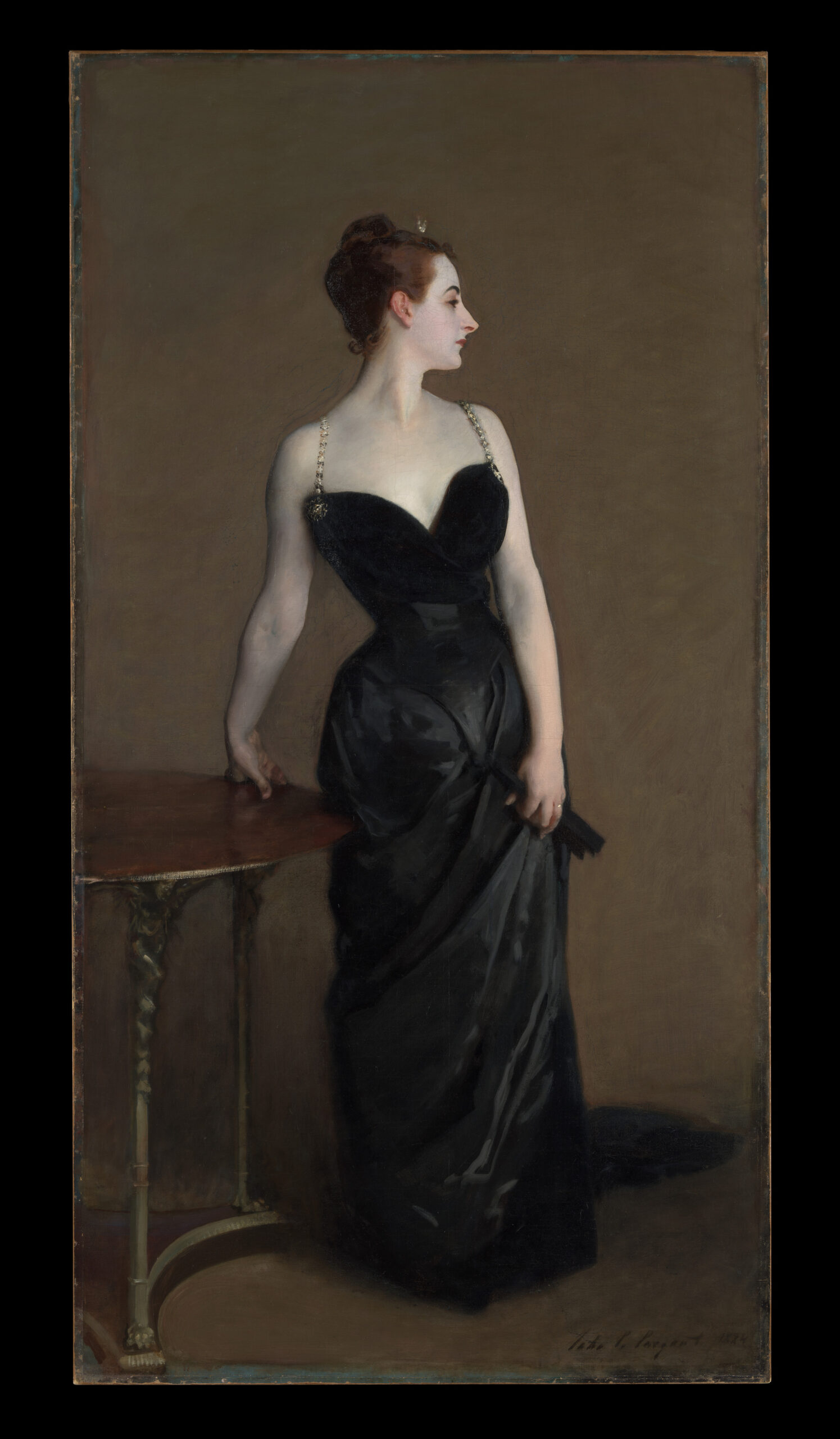
The sitters who could afford a portrait held their mouths closed. John Singer Sargent, who painted more of them than almost anyone, left behind the only summary anybody needs on the subject, which is that a portrait is a picture of a person with something wrong with the mouth.
So the blank runway face is not a nineties invention or a European affectation. It is a four-hundred-year-old rule about who is permitted to look happy in public, inherited whole by an industry that does not know it is quoting anyone. The woman in the chiffon at the Tuileries was obeying Dutch painters.
Versace’s 1991 Show: The one spring everybody smiled, and what it cost
Which makes the exception worth looking at closely, because there was one, and it was magnificent.
On 1 April 1991, Gianni Versace finished his autumn show by sending out Linda Evangelista, Cindy Crawford, Naomi Campbell and Christy Turlington together, in cocktail gowns of red and yellow and black, lip-synching to George Michael’s Freedom. They were restaging the David Fincher video they had appeared in the year before. Arms linked, visibly delighted, entirely uninterested in approximating a shop dummy.
Each of them was reportedly paid somewhere between twenty-five and fifty thousand pounds for it. Tim Blanks later called it a fashion moment of biblical proportions. Versace himself said the mood was happiness, that it was modern, that it was alive, that it was a gift to the women.
Note the phrasing. The mood is happiness. Not the woman is happy. A mood is something a designer commissions, costumes and pays for, and that season he had bought one.
He could afford to, because the economics had inverted. For about a decade the model was the product. People knew these women’s names, their rates and their contracts. Nobody was going to ask Linda Evangelista to hold her face still, because stillness does not sell a magazine cover and she was the magazine cover.
When the woman is what you are buying, she is permitted a personality. When the dress is what you are buying, the personality stands in front of the thing for sale.
Why it swung back and stayed back
Then the clothes changed, and the faces followed.
Sonya Abrego, a design historian at Parsons, puts it exactly: the aesthetic was pared back to the point where it would have looked almost goofy for a model to have a grin or a bouncy walk. Grunge and minimalism were not asking anyone to be charming. A severe grey coat and a woman beaming at you are two separate arguments, and they cancel each other out.
By the 2000s, there was a general sense that shows had drifted into celebrity and away from clothing, and the serious face returned as a correction. It has stayed, not because anyone enforces it with a memo, but because every casting director in Paris has absorbed what it signals and so has every girl walking.
What the Runway Model Face Signals to Buyers and the Press: The dial, and how to read it
Watch any show now and ask which way the dial has been turned, because it tells you where the value is sitting that season.
A blank face says look at the garment; the woman is a delivery mechanism, do not get attached to her. A warm face says look at the woman; she is the asset, the clothes are what she happens to have on while being herself. Neither is more honest. Both are commercial positions, and the industry moves between them whenever the money does.
Which is why the finale is the tell. The girls hold the line for twelve minutes, the designer comes out, the room softens, the applause starts, and for about ninety seconds you get actual human faces. Everyone relaxes at precisely the moment the selling stops.
And it explains why this particular season could never have gone the other way. You cannot put a grin on top of Rick Owens’ prismatic tentacles, or Margiela’s wilting flowers, or forty-nine gold looks shown in a recreation of the ballroom where Yves Saint Laurent held his couture salons, to a front row dressed entirely in black and a closing song written for the occasion by Charlotte Gainsbourg. Nobody has confirmed that Anthony Vaccarello is leaving after a decade. Everybody in that room understood what they were being shown. Those clothes are an argument, and an argument requires a face that does not interrupt it.
Nobody at a fashion show is having a good time, including the front row. That is also a convention, and it is considerably older than fashion.
FASHION LAW JOURNAL INSIDER
Join designers, brand founders and fashion lawyers who get the biggest brand battles, IP fights and career moves in fashion law, straight to their inbox.