
A handbag that disappeared from stores at the end of a season may return decades later with an entirely different status. It might be displayed in a museum, brought back to shops as a limited reissue or become highly sought-after on the resale market. Luxury houses increasingly look to their archives not only for inspiration, but also for designs they can sell again. These archives once served mainly to preserve a house’s creative history and craftsmanship. Today, they are commercial assets too. An exhibition or anniversary release can bring an old design back into the public eye. But when the same design returns in limited quantities, its history also becomes part of the reason people want to buy it. This makes the line between preserving heritage and using it as a sales strategy increasingly difficult to draw. By bringing the past back to the market, a house also gains greater control over the story attached to it. It can influence which objects are accepted as authentic – and what they are ultimately worth.
How Luxury Houses Turn Their Archives Into Sellable Assets
Fashion houses can return to their past in several ways. Their archives hold original pieces and documents from earlier periods. A new collection, however, may refer to an older style only through its shape, fabric, or overall appearance. A reissue is more direct: it brings a particular design from the past back onto the market. Vintage resale is different again: instead of recreating an earlier product, it returns the original object to circulation. When the house manages this process, the brand also becomes the curator of which pieces deserve rediscovery and how their history should be presented. Gucci Vault offers a particularly revealing example. In Gucci’s official story, Rachel Koffsky, Christie’s international head of handbags and accessories, explores the House’s archive and Vault’s approach to vintage. One featured piece is a Made-to-Treasure Collector’s Bamboo bag, created from a 1960s vintage find and given a contemporary addition of handcrafted flowers. The archive also contains earlier bags that preceded today’s Jackie 1961 and Horsebit 1955. Gucci is not simply copying an old design here. It is choosing an existing vintage object, altering it and returning it to the market under the authority of the house.
Museums do more than protect fashion from physical decay; they also shape the way it is remembered. As Louise Wallenberg explains in her study of fashion exhibitions and museum practice, the museum is a memory institution that acquires, stores and displays historical and artistic objects. Inside a museum, a garment is no longer viewed only as something that was once made and sold. It also tells visitors about the skills behind its creation and the time to which it belonged. Wallenberg notes that major exhibitions devoted to designers such as Dior, Balenciaga and Jean Paul Gaultier often present them as exceptional creative figures. Visitors may see their garments up close, even though owning such pieces remains beyond the reach of most people. This distance can add to their sense of exclusivity. The popularity of these exhibitions also shows that fashion has secured a significant place in contemporary culture. At the same time, museums influence that culture through their choices: the designers they exhibit are more likely to remain in the public memory. For a luxury house, this cultural recognition may reinforce the desirability of its archive, although it also becomes difficult to separate historical preservation from commercial image-making.
Scarcity, Nostalgia, and the Fendi Baguette Reissue
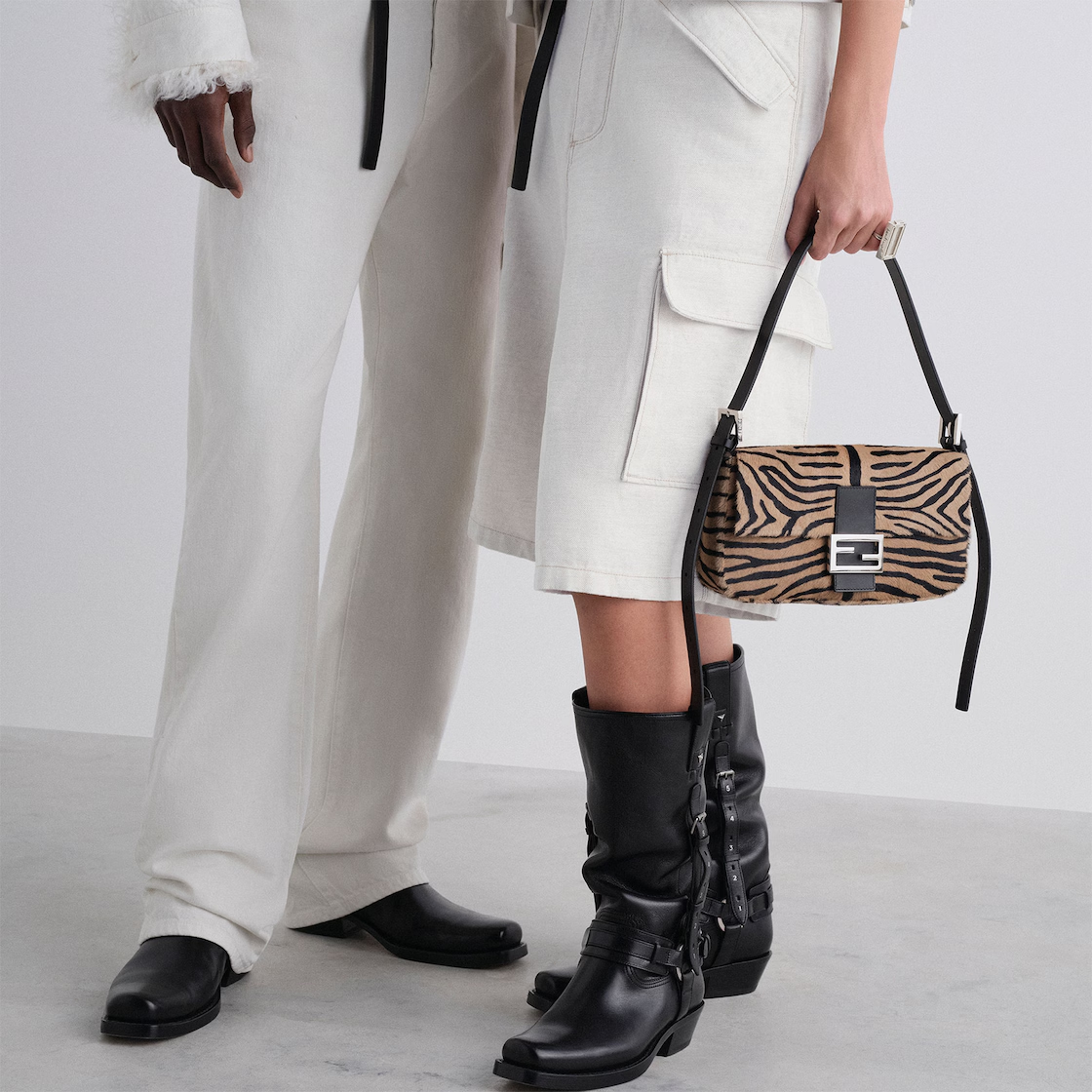
Scarcity in archival luxury is not simply determined by how many original pieces have survived. It can be recreated years later through a controlled release, an anniversary and a familiar story. The Fendi Baguette provides a clear example of this process. Silvia Venturini Fendi designed the bag, which was launched in 1997. It later became closely linked to Carrie Bradshaw after appearing in Sex and the City. For its twenty-fifth anniversary, Fendi released 25 limited-edition reissues, followed by collaborations with Sarah Jessica Parker, Tiffany & Co., Marc Jacobs and Porter. The number of designs matched the anniversary, while the collaborations brought the bag’s fashion and pop-cultural history into the present. With prices listed by Vogue between $3,100 and $7,200, the reissues were not positioned as straightforward reproductions of an old product, but as collectible versions of an established icon. The design itself was already familiar. What made its return feel scarce was the limited release, the anniversary and the sense that the opportunity would not last. This does not necessarily make the strategy cynical. The fact that people still want the same design decades later shows that it has lasting appeal. At the same time, it leaves room for a less flattering interpretation. When an old product generates more excitement than a house’s recent work, is this proof of the brand’s enduring creativity, or a sign that creating a new icon has become more difficult?
Authenticating Archival Luxury in the Age of Digital Product Passports
An archive piece does not carry its history on its surface. Its authenticity must be established by someone, and that decision has financial and legal consequences. Resale platforms rely on trained specialists who examine details such as stitching, fonts, hardware and construction, supported by tools including X-ray technology and documented inventories. Yet there are no global regulations or common training standards for luxury authenticators, while increasingly sophisticated counterfeits make even expert judgments vulnerable to error. The problem is also one of access: brands possess extensive historical information but, according to Fashionphile’s founder, have often been reluctant to share it with the resale market. Digital Product Passports may offer a different model by giving products a digital record of their origin, materials, repairs and lifecycle. Industry-led blockchain certificates could also create a traceable history from manufacture to resale. However, the current EU framework focuses mainly on newly introduced and remanufactured goods, leaving many existing vintage pieces outside its scope. Technology may therefore improve future provenance without resolving every dispute about the past. Authentication is therefore not a neutral step. The party that controls the records, the expertise or the digital system has real influence over which pieces the market accepts as genuine – and valuable.
A reissue does not have one predictable effect on the original. Bringing an older design back can remind the public of a house’s influence and may even lead collectors to search for original versions. However, reviving the same styles too often risks making them feel less special. An original and a reissue are not the same object. The original belongs to a particular moment in the house’s history and has acquired its own story over time. A reissue, by contrast, shows how the brand has chosen to present that design to today’s market. This makes it difficult to describe archival luxury as either preservation or reinvention. In practice, it is usually both. Fashion history remains visible, but it also becomes something the brand can market on its own terms. A house cannot create a different past. It can, however, shape the version of that past that consumers encounter and profit from bringing it back.
Sources:
- Gucci, ‘Collecting Heritage: Part 2: In the Gucci Archive, Christie’s Explores Vault’s Unique Vision of Vintage’, Gucci Stories, https://www.gucci.com/us/en/st/stories/article/collecting-heritage-part-2 (accessed 18 August 2026)
- Louise Wallenberg, ‘Art, Life, and the Fashion Museum: For a More Solidarian Exhibition Practice’, Fashion and Textiles, Vol. 7, Article 17 (2020), https://doi.org/10.1186/s40691-019-0201-5
- Lilah Ramzi, ‘It’s a Baguette—Fendi Re-Releases 25 Baguettes From the Archive’, Vogue, 3 November 2022, https://www.vogue.com/article/fendi-25th-anniversary-baguette-bags (accessed 18 August 2026)
- Georgia Rhodes, ‘Can Luxury Brands Trust Authenticators to Wipe Out Counterfeits?’, Vogue Business, 12 February 2024, https://www.vogue.com/article/can-luxury-brands-trust-authenticators-to-wipe-out-counterfeits (accessed 18 August 2026)
- Christophe Gösken, ‘Fashioning Authenticity: How Digital Product Passports Could Shape the Future of Trade Mark Law’, Journal of Intellectual Property Law & Practice, Vol. 20, No. 2 (2025), pp. 105-110, https://doi.org/10.1093/jiplp/jpae121
- Chiara Colombi and Marcella Martin, ‘Fashion Archive Abilities: The Impact of Digital Technologies on the Development and Research of Fashion Heritage’, European Journal of Cultural Management and Policy, Vol. 15 (2025), Article 15689, https://doi.org/10.3389/ejcmp.2025.15689
Author: Simona Stoycheva
Disclaimer: The views expressed in this article are those of the author and do not necessarily reflect the views of Fashion Law Journal
Jimmy Choo’s Iconic Archive: A Deep Dive into the New Collection
FASHION LAW JOURNAL INSIDER
Join designers, brand founders and fashion lawyers who get the biggest brand battles, IP fights and career moves in fashion law, straight to their inbox.