

In the century when the most beautiful colour in the room was also the most dangerous
Matilda Scheurer made leaves for a living. Not real ones, fabric ones, cut and shaped and then dusted with a fine powder that gave them the sheen of something freshly picked. She was nineteen; she worked in a London workroom alongside other girls doing the same thing, and the powder got into everything. It settled on their hair. It settled on their hands. It settled on the bread they ate at the bench, because nobody in 1861 was sending anyone out of the room to have lunch.
She died that November, and the newspapers printed the details, which were terrible. She had been vomiting green for days. The whites of her eyes had gone green. Near the end she told the people looking after her that everything she saw was green, and it is difficult to read that line now without hearing a young woman trying to describe something she had no other words for.
The powder was copper arsenite. The trade called it Scheele’s Green, after the Swedish chemist who first produced it in 1775, and later there was a brighter version manufactured in Bavaria that went by emerald or Paris green depending on who was selling it. It was cheap. It held its colour through washing and wear, which almost nothing else did. And under gaslight, which drained the life out of every other pigment in a room and turned soft blues to grey and pale pinks to nothing at all, it did the opposite. It glowed.
FLJ Insider Pro is open: live fashion law jobs and internships, five career guides and two roadmaps. Early bird USD 12/month. See what's inside
That is the part worth sitting with, because it explains everything that follows. Every woman who chose that green was choosing the only colour in the room that looked alive after dark.
It was also arsenic, in quantities that a modern regulator would find difficult to believe.
The most beautiful room in the house
Understanding how this happened requires setting aside the assumption that the Victorians were ignorant of what they were handling. They were not. Arsenic was well known as a poison; it was the preferred instrument of a certain class of domestic murder, so familiar in the courts that Britain passed an Act in 1851 restricting its sale to purchasers who signed a register and to compounds coloured with soot or indigo so that nobody could mistake the powder for flour. A country capable of legislating carefully about arsenic in a kitchen went on to wear it to dinner without evident discomfort.
The colour was everywhere. It papered drawing rooms, tinted candles, coloured children’s toys, dyed the fabric of curtains and carpets, and turned up in confectionery and in the leaves of artificial wreaths that women wore in their hair. A chemist of the period, examining one such headdress, calculated that it carried enough arsenic to poison a room of twenty people, which is a striking thing to read about an object designed to sit above a woman’s forehead all evening.
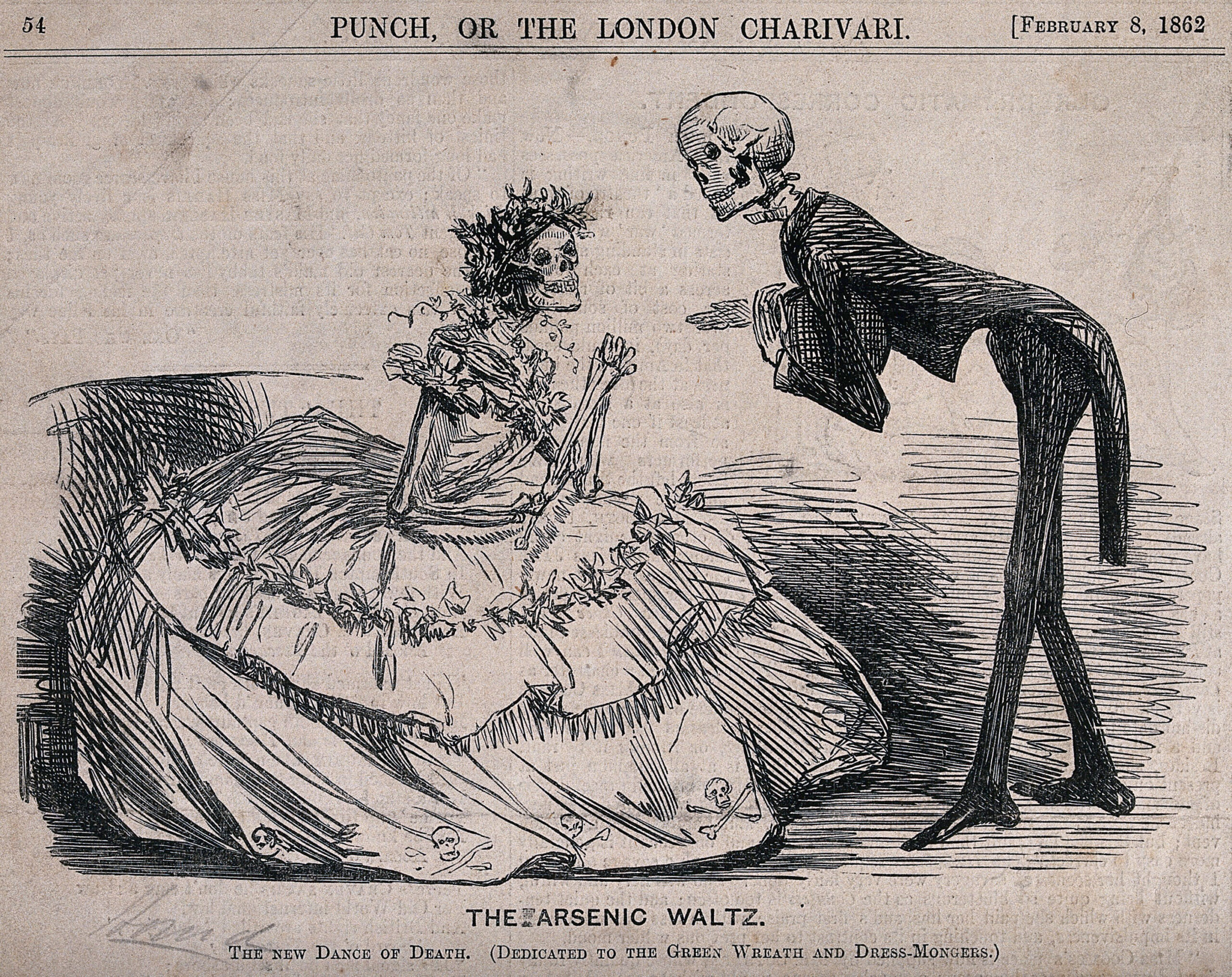
Ball gowns were worse, because they moved. The pigment did not bind well to fabric and shed continuously as the wearer danced, distributing a fine dust across the floor, the air, and the sleeves of everyone she turned with. Punch published a cartoon in 1862 showing two skeletons in evening dress mid-waltz and titled it the arsenic waltz, which was the sort of joke that landed because everybody already knew.
The symptoms were consistent and well documented. Sores on the hands and face, ulcerated nostrils, headaches, nausea, and, with prolonged exposure, the failure of the liver and kidneys. Doctors wrote it up. The Lancet published. Cases were reported and reported again.
Fashion carried on regardless, for the reason fashion usually carries on, which is that the colour was extraordinary and no adequate substitute existed.
The mine, the wallpaper, and the man who called it witch fever
There is a detail in this story so neat that it would be rejected from a novel.
William Morris, whose wallpapers defined the English domestic interior for a generation and whose politics were among the most humane of his era, drew a substantial part of his family’s wealth from Devon Great Consols, at one point the largest arsenic mine in the world. When the public grew nervous about arsenical wallpapers in the 1880s, Morris wrote to a colleague dismissing the alarm as a kind of hysteria among doctors, comparing the panic to a witch scare. He was not being cynical. He simply did not believe it, and the fortune that funded the workshop happened to depend on his not believing it.=
Meanwhile the theory circulated, and circulates still, that Napoleon died at Saint Helena partly from the damp green paper on his walls. The evidence is contested and probably always will be. It survives because it is irresistible, and because it captures the era’s central absurdity, which is that the wealthiest people in the world had furnished their most private rooms with something that made them slowly and mysteriously unwell.
Mad as a hatter, and not remotely figurative
Green was not the only offender. It was merely the prettiest.
The hat trade had its own arrangement with poison. To turn animal pelt into felt, hatters brushed the fur with a solution of mercuric nitrate in a process called carroting, for the orange tinge it left behind, and then worked the treated fur over steam in poorly ventilated rooms. Mercury vapour attacks the nervous system. The result was a recognised occupational condition producing tremors, slurred speech, memory loss, paranoia, and social withdrawal so severe that it was known in Connecticut simply as the Danbury shakes.
The phrase mad as a hatter entered common speech because the men who made hats visibly were. Lewis Carroll gave the world a delightful eccentricity at a tea party, and generations of readers have laughed at a joke whose original subject was industrial nerve damage.
France restricted the use of mercury in hatting at the end of the nineteenth century. The United States did not arrive at a comparable arrangement until 1941, which is to say that the condition remained a feature of American manufacturing well into the era of the wristwatch and the aeroplane.
The dress that would not be flame-proofed
The period’s third and least discussed hazard was fire. Crinolines put an enormous cage of light fabric around a woman in a house lit entirely by open flame, and the newspapers of the 1860s carried a steady traffic of women who had stood too near a grate.
The most famous casualty was the dancer Emma Livry, who died in 1863 after her costume caught alight during a rehearsal at the Paris Opera. Treated gauze that resisted flame was available at the time. Livry had declined it, on the grounds that the treatment dulled the fabric and made it hang badly. She was twenty-one, and her objection was entirely reasonable within the terms of her profession.
How it ended, which was not by law
The green did not disappear because a legislature banned it. Britain never passed a statute prohibiting arsenical dyes in clothing.
It disappeared because the press kept publishing, because doctors kept writing, because a young woman’s death was reported in sufficient detail that readers could picture it, and because the buying public eventually decided that the most beautiful colour available was no longer worth the association. Manufacturers advertised arsenic-free goods as a selling point. Retailers competed on safety. The market corrected roughly forty years after the evidence did, which is a lag that anyone who follows the industry today will find familiar.
What lingers is the ordinariness of it. Nobody in this story was a villain. The flower makers wanted work, the manufacturers wanted a colour that held, the hatters wanted felt, and the women in the ballroom wanted to glow under gaslight in a way that nothing else permitted. Every individual decision was sensible. The accumulated result was a generation of people quietly poisoning themselves in pursuit of a shade of green.
The historian Alison Matthews David, who has written the definitive account of all this, chose a title for it that does the work of an entire argument. She called them fashion victims, and she meant it literally.
FASHION LAW JOURNAL INSIDER
Join designers, brand founders and fashion lawyers who get the biggest brand battles, IP fights and career moves in fashion law, straight to their inbox.