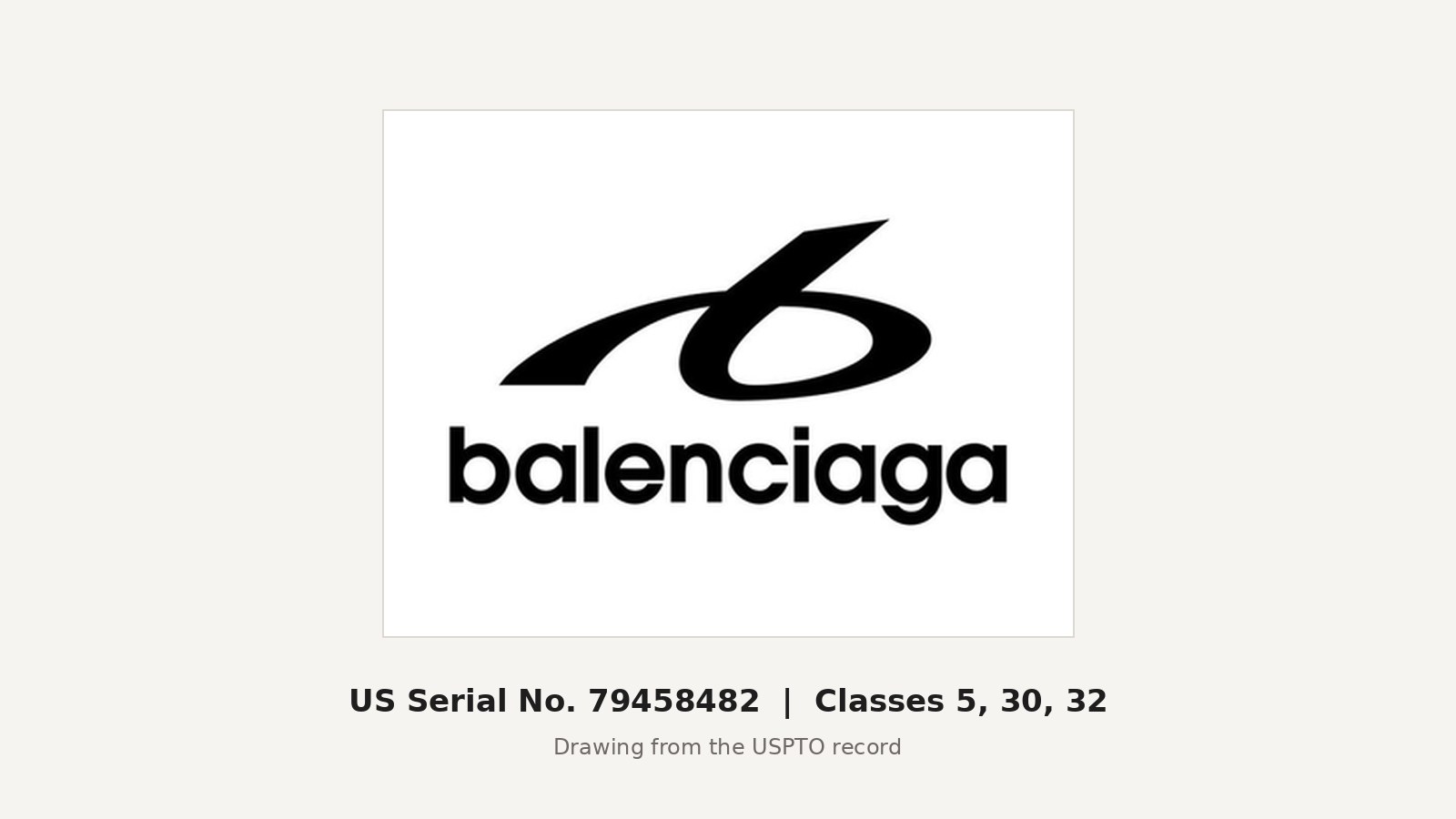
Balenciaga wants its name on energy drinks, protein bars and dietary supplements in the United States. A new filing at the US Patent and Trademark Office extends the house’s looped “B” and lowercase balenciaga logo into Classes 5, 30 and 32, the classes that cover supplements, snack foods and soft drinks. The USPTO examiner has already written a first refusal, and it is being processed for mailing.
Short answer: Balenciaga has sought US trademark protection for its logo on vitamins, supplements, protein and energy bars, coffee, confectionery and non-alcoholic drinks, including energy drinks. The filing is the US designation of international registration 1937598 under the Madrid Protocol (US Serial No. 79458482). On 8 October 2026 the USPTO wrote a non-final Office action, so the application faces at least one objection before it can register.
Key takeaways
- The application covers Class 5 (supplements and vitamins), Class 30 (cereal and protein bars, coffee, chocolate, confectionery) and Class 32 (energy drinks, sports drinks, juices, smoothies and other soft drinks).
- It reached the US through the Madrid system: international registration 1937598, dated 1 July 2026, with a priority claim of 11 May 2026.
- A non-final Office action was written on 8 October 2026. Because this is a Madrid filing, it will go to WIPO as a provisional refusal, and Balenciaga will need to respond through a US attorney.
- A trademark filing is not a product launch. It shows where a brand wants legal room to move, and it often comes years before anything reaches a shelf, if it ever does.
What exactly did Balenciaga file?
The record on the USPTO’s Trademark Status and Document Retrieval (TSDR) system shows Balenciaga SAS of 16-18 rue Vaneau, Paris, as the owner. The mark is not a plain word mark. It is the drawing of a stylised looped “B” above the word balenciaga in lowercase letters, filed as a design mark that includes words.
The goods are broad, and they read like a full wellness and food line rather than a single collaboration:
FLJ Insider Pro is open: live fashion law jobs and internships, five career guides and two roadmaps. Early bird USD 12/month. See what's inside
| Class | What it covers | Examples from the filing |
|---|---|---|
| Class 5 | Supplements and vitamins | Vitamins, protein bars and gels as food supplements, probiotics, whey protein isolates, electrolytes, dietary supplement beverages, pharmaceutical preparations containing caffeine |
| Class 30 | Staple foods and snacks | Protein cereal bars, energy bars, coffee, tea, chocolate, confectionery, ice cream, muesli, rice and cereal snacks |
| Class 32 | Non-alcoholic drinks and beer | Energy drinks, isotonic and sports drinks, protein-based beverages, juices, smoothies, mineral water, lemonades, beers |
How does a Madrid filing reach the US?
Balenciaga did not file directly with the USPTO. It used the Madrid system, run by the World Intellectual Property Organization, which lets a brand owner file one international application and then designate the countries where it wants protection. International registration 1937598 is dated 1 July 2026 and claims priority from 11 May 2026. The US designation was notified on 17 September 2026, and the USPTO gave it serial number 79458482 the same day.
A Madrid designation into the US is examined like any domestic application, under Section 66(a) of the Lanham Act. One practical difference is timing. The USPTO has 18 months from the notification to send any refusal to WIPO, otherwise the mark is protected automatically. The TSDR record puts that date at 17 March 2028. The examiner has moved well inside that window.
Brand owners who have never used this route will find the basics, along with how to check classes before filing, in our guide to running a USPTO trademark search and our trademark class finder.
What does the Office action mean?
The application was assigned to an examining attorney on 1 October 2026. On 8 October the examiner wrote a non-final Office action, and on 9 October it was marked as an “IB refusal” prepared for review, the label the USPTO uses when a refusal on a Madrid filing is headed to the International Bureau at WIPO. The status line on TSDR reads that a non-final Office action “is being processed for mailing.”
The text of the action is not yet public, so the grounds are not known. A first action on a filing this broad can raise anything from a likelihood of confusion with earlier marks to requests to narrow or clarify the wording of the goods. Some entries, such as “pharmaceutical preparations containing caffeine” in Class 5, are the kind of wording examiners often ask applicants to make more specific. That is an observation about common practice, not a statement of what this examiner wrote. Once the action issues, it will appear in the TSDR documents tab, and Balenciaga will have a set period to respond. Foreign applicants must use a US-licensed attorney for that response, and the record currently lists no attorney of record.
Why would a fashion house file for energy drinks?
There are three usual reasons, and they are not mutually exclusive.
- Brand extension. Luxury houses have pushed into hospitality, homeware and food for years, through cafés, chocolate and branded coffee. Wellness is the obvious next shelf.
- Collaborations. Balenciaga has already done food as marketing. In December 2023 it sold a charcoal-black juice with the Los Angeles grocer Erewhon around its first LA runway show. A registration in Classes 30 and 32 makes it easier to license the logo for that kind of product and to police knock-offs.
- Defensive coverage. A famous fashion name invites others to borrow it on merchandise far from fashion. Owning registrations in neighbouring classes gives a brand a cleaner basis for oppositions and takedowns, which matters on marketplaces where counterfeit supplements and drinks are common.
It is also the logo being filed, not just the name. Houses tend to register the word mark and each logo separately, because the two protect different things, a point we cover in word mark vs logo mark.
What happens next?
The provisional refusal will reach Balenciaga through WIPO. If it overcomes the objections, the mark will be published in the Official Gazette, and anyone who believes they would be harmed, such as an existing energy drink or supplement brand with a similar mark, will have 30 days, extendable, to oppose it before the Trademark Trial and Appeal Board. Unlike a US-based filing, a Madrid designation does not need proof of use before registration, but the owner must file a declaration of use between the fifth and sixth year after registration to keep it alive.
For context on the group behind the house, see our guide to French luxury fashion brands and the groups that own them. FLJ will update this story when the Office action is published.
Frequently asked questions
Is Balenciaga launching an energy drink?
Not that it has announced. The filing gives Balenciaga the legal basis to use and license its logo on energy drinks, supplements and snacks in the US, but a trademark application is not a product launch.
What is the Balenciaga US serial number for this filing?
US Serial No. 79458482. It is the US designation of international registration 1937598, dated 1 July 2026.
Which trademark classes did Balenciaga file in?
Class 5 for vitamins and dietary supplements, Class 30 for foods such as protein and energy bars, coffee and confectionery, and Class 32 for non-alcoholic drinks including energy drinks.
Has the USPTO refused the application?
The examiner wrote a non-final Office action on 8 October 2026, which is being processed for mailing to WIPO as a provisional refusal. It is not a final decision, and Balenciaga can respond.
What is a Madrid Protocol designation?
It is a request, made through WIPO, to extend an international trademark registration to a particular country. In the US it is examined under Section 66(a) of the Lanham Act like a domestic application.
Can other brands oppose Balenciaga’s application?
Yes. If the application is approved for publication, anyone who believes they would be damaged can file an opposition with the Trademark Trial and Appeal Board within the opposition period.
FASHION LAW JOURNAL INSIDER
Join designers, brand founders and fashion lawyers who get the biggest brand battles, IP fights and career moves in fashion law, straight to their inbox.