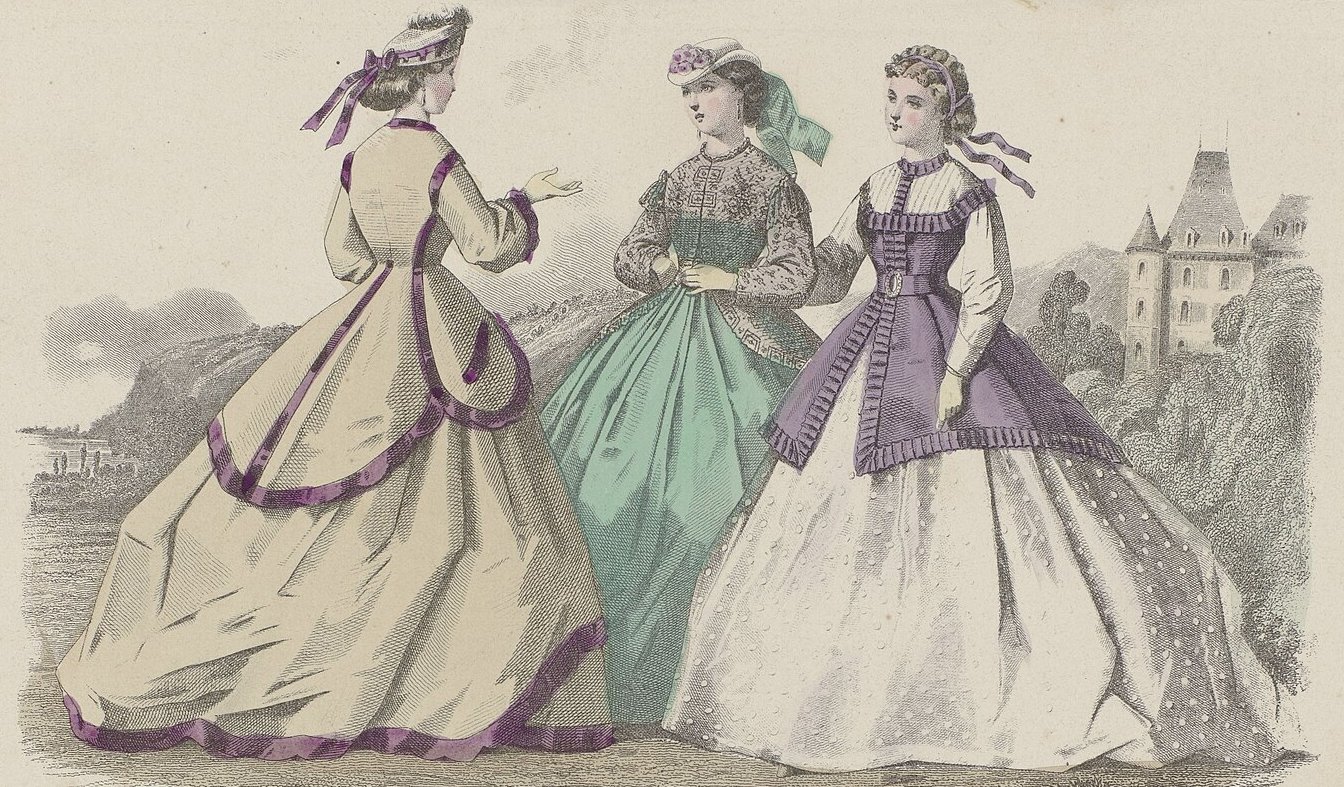
Victorian fashion looks like romance from a distance: tiny waists, skirts the size of a small room, green silk the colour of new leaves. Up close it was an industrial product, and a dangerous one. Steel cages were turned out by the thousand in London factories, green dyes were made with arsenic, and the young women who sewed ball gowns sometimes worked through the night. Parliament had stopped telling people what to wear more than two centuries before Victoria took the throne, so the law that shaped Victorian clothes was not about dress at all. It was about poison, factory hours and who owned a woman’s money. Here is what Victorians wore between 1837 and 1901, and the laws that sat behind the corsets and crinolines.
Short answer: Victorian fashion covers dress during Queen Victoria’s reign, from 1837 to 1901. It moved from full skirts over the steel cage crinoline, introduced in 1856, to the bustle of the 1870s and 1880s, all worn over a corset. No law dictated dress, but arsenic regulation, the Factory Acts and the Married Women’s Property Acts shaped how clothes were made and bought.
Key takeaways
- The cage crinoline appeared in 1856 and was out of fashion by around 1868; the bustle followed in the 1870s and returned in an exaggerated form from about 1883.
- England had no dress laws in the Victorian era, because James I voided the old Acts of Apparel in 1604. Etiquette, such as mourning rules, did the policing instead.
- The Arsenic Act 1851 regulated sales of arsenic to stop poisoning, but left industrial users free to buy it, and arsenic greens stayed in dresses and artificial flowers.
- The Factory Acts slowly limited working hours, while the Married Women’s Property Acts of 1870 and 1882 gave wives control of their own earnings and property.
What was Victorian fashion?
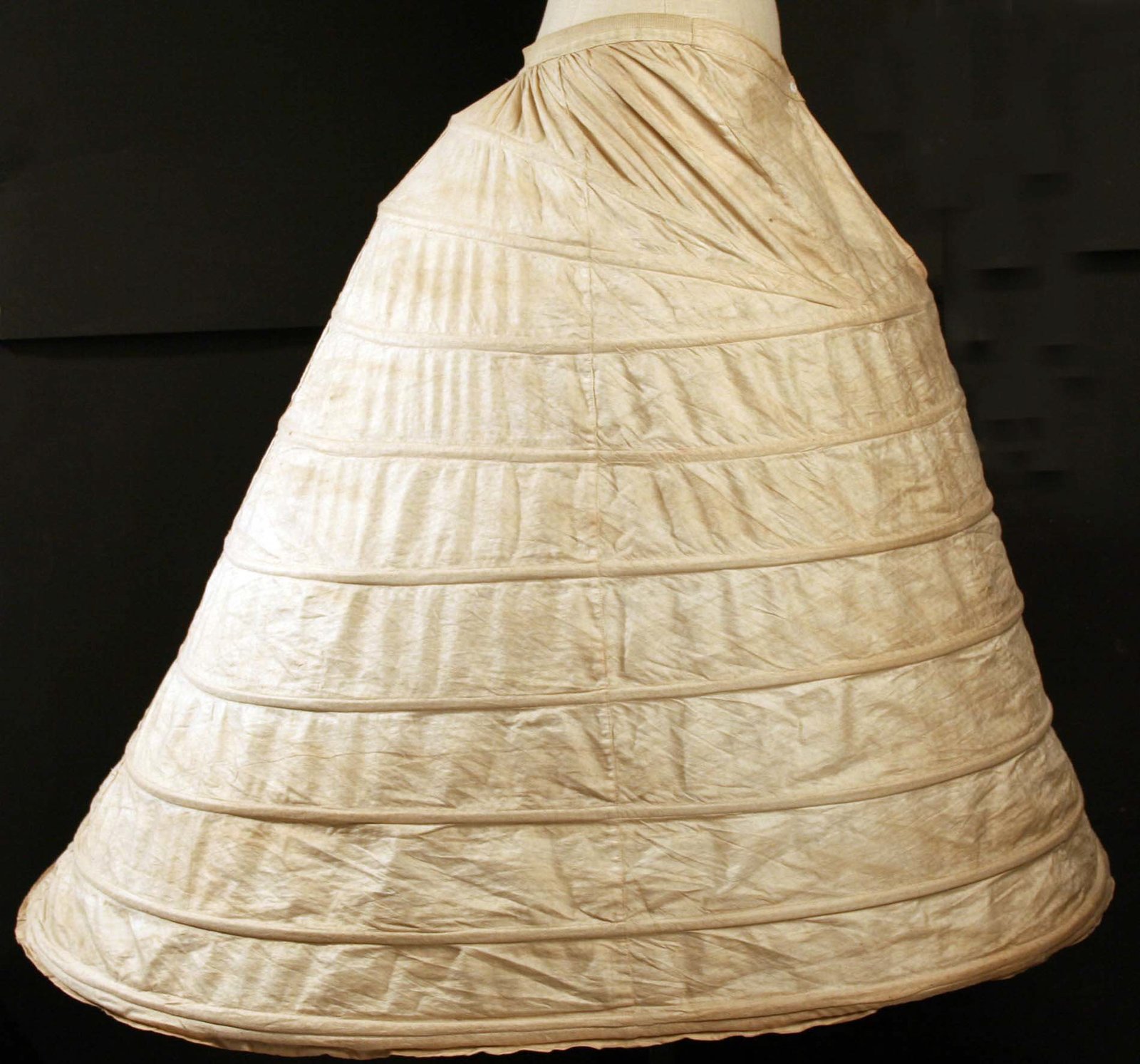
Victorian fashion is the dress of the years Victoria reigned, from 1837 to 1901, and its story is mostly told through women’s underwear. The Victoria and Albert Museum traces the shape in three stages. Before the 1850s, skirts were held out by stiffened petticoats of woven horsehair and linen, which is where the word crinoline comes from. In 1856 the cage crinoline arrived, a frame of steel hoops that widened towards the hem, and sewing machines made it cheap enough for almost everyone. By around 1868 the crinoline had fallen out of fashion, and the 1870s brought the bustle, which pushed the volume to the back. It shrank, then returned from about 1883 in a hard, shelf-like form before fading at the end of the 1880s.
Technology moved as fast as taste. William Henry Perkin patented aniline purple in 1856, opening the door to bright synthetic dyes, and machine sewing changed how corsets and cages were produced. FLJ’s guide to fashion era names places the Victorian period in the wider timeline, after the Regency.
FLJ Insider Pro is open: live fashion law jobs and internships, five career guides and two roadmaps. Early bird USD 12/month. See what's inside
How did the Victorian corset work?
The corset was the foundation under every silhouette. The V&A notes that metal eyelets, invented in the 1820s, allowed corsets to be laced more tightly than before. A busk of wood or metal ran down the centre front, with a curved spoon busk appearing in the 1870s and a long straight busk in the 1890s. Boning was usually baleen, the so-called whalebone. In the late 1860s Edwin Izod developed steam moulding, which produced stiffer, more rounded corsets. Tight-lacing eased in the crinoline years, when a wide skirt made any waist look small, then returned in the 1870s and 1880s with a more pronounced hourglass.
Were corsets as harmful as their critics said? The V&A is careful here: some reformers’ health claims were accurate, but others seem to have been exaggerated or invented. The garment was uncomfortable and restrictive. The more reliable horror stories of the period are about the crinoline and the dyes.
Why was the crinoline so dangerous?
Size and fire. A cage crinoline held a large skirt of light, often highly flammable fabric away from the body, and the wearer could not always tell where its edge was. The V&A links crinolines to serious accidents around open fires. In a 2014 Gresham College lecture, art historian Lynda Nead described newspapers reporting women burned to death “week after week”, and noted that in October 1861 the Guardian reprinted an article titled “Crinoline: A Real Social Evil”. She also described the scale of the trade: Thomson’s, the largest maker, employed more than 1,000 women at its London factory and produced three to four thousand crinolines a day.
Historian Alison Matthews David, in her book Fashion Victims, reports that The Lancet estimated about 3,000 women died by fire in 1860. Two of the best-known victims were Oscar Wilde’s half-sisters, Mary and Emily Wilde, who died in 1871 after one’s dress caught fire at a party and the other caught fire trying to help. Ballet dancers were especially exposed, and in 1859 France issued a decree requiring fire-resistant treatments in theatres. In Britain, no law banned or regulated the crinoline itself. Fashion, not Parliament, retired it.
Were there laws about what Victorians could wear?
Not in England. The sumptuary laws that once told each social rank which fabrics and colours it could wear had gone long before. According to the Folger Shakespeare Library, James I effectively voided all the Acts of Apparel at his first Parliament in 1604. FLJ covers that earlier history in sumptuary laws in England.
The Victorians replaced statute with etiquette, and etiquette could be just as strict. Mourning is the clearest example. The Metropolitan Museum of Art, describing a mourning dress Victoria wore in 1894, notes that wearing black was a social requirement across all classes, for anything from about three months to two and a half years after a death. Victoria herself wore mourning from Prince Albert’s death in 1861 until her own in 1901.
| Dress issue | Governed by | Year |
|---|---|---|
| Who could wear which fabrics and colours | No law; Acts of Apparel voided | 1604 |
| Sale of arsenic, including for pigments | Sale of Arsenic Regulation Act | 1851 |
| Fireproofing of stage costumes | French decree (not British law) | 1859 |
| Hours of women and young workers in larger workplaces | Factory Acts Extension Act | 1867 |
| A wife’s right to her own earnings | Married Women’s Property Act | 1870 |
| A wife’s control of all her property | Married Women’s Property Act | 1882 |
| Mourning dress | Social convention only | Throughout |
What did the law do about arsenic dyes?
Very little, at least directly. Scheele’s green, an arsenic-based pigment, was invented by Carl Wilhelm Scheele in 1775, and arsenic greens coloured Victorian dresses, wallpapers and artificial flowers. The workers paid first. Matilda Scheurer, a 19-year-old artificial flower maker in London, died on 20 November 1861 after breathing in the green powder she dusted onto fabric leaves; an autopsy found arsenic in her stomach, liver and lungs. FLJ tells her story in Arsenic and Old Lace.
The main statute, the Sale of Arsenic Regulation Act 1851, was aimed at murder, not fashion. Its preamble says the unrestricted sale of arsenic “facilitates the Commission of Crime”. Sellers had to record every sale in a book signed by the buyer, could not sell to minors or unknown buyers without a witness, and had to colour the arsenic by mixing in soot or indigo. But a buyer who said the colouring would make it unfit for their purpose could take ten pounds or more uncoloured. Industry, in other words, kept its pure arsenic. Change came through public pressure rather than law: William Morris began using arsenic-free greens around 1870.
Who made Victorian clothes, and did the Factory Acts protect them?
The textile mills were the first target of reform. The 1833 Factory Act barred children under nine from textile factories, capped hours for those aged nine to 13 at 48 a week, limited 13 to 18 year olds to 12 hours a day and created a four-man inspectorate. The 1847 Ten Hours Act set a ten-hour day for women and young people. The Factory Acts Extension Act 1867 reached other factories with more than 50 workers, and the Factory and Workshop Act 1878 consolidated the rules and applied them to all trades.
The dressmakers of the West End sat outside much of this for years. In June 1863 The Spectator reported the death of Mary Anne Walkley, aged 20, who worked for the court dressmaker Madame Elise and had spent 23 hours on a dress for a royal Drawing-room. The inquest heard of 15-hour working days in the season, four girls to a bedroom and air far below what a doctor said they needed. The case caused outrage, and it is still cited when people talk about the human cost of fast turnaround fashion.
How did the Married Women’s Property Acts change women’s money?
For most of the era, a married woman’s legal capacity was folded into her husband’s under the common law. Parliament changed that in two steps. The Married Women’s Property Act 1870 declared that money and property a woman earned during marriage was her own. The Married Women’s Property Act 1882, dated 18 August 1882 and in force from 1 January 1883, went further: section 1 made a married woman capable of acquiring, holding and disposing of any property “in the same manner as if she were a feme sole”, meaning an unmarried woman. A seamstress’s wages, and a wife’s spending on clothes, were finally hers in law.
What was the Rational Dress Society?
The Rational Dress Society, founded in 1881, campaigned against what it saw as constrictive and cumbersome women’s fashion, with corsetry as a main target. Its members argued that women’s dress kept them from being full, productive members of society. Liberty opened a dress department in 1884 selling looser styles influenced by reformers and the Aesthetic movement, but both were mocked in the press, and the V&A dates reform’s real influence on mainstream dress to the 1890s.
Fashion also drove one of Britain’s best-known conservation laws. The RSPB began in 1889, founded by Emily Williamson to stop wild birds being killed for feathers in hats. Its first big win came after the Victorian era, when the Plumage (Prohibition) Act passed in July 1921.
Why does Victorian fashion still matter?
Because the arguments have not changed much. Toxic chemicals in clothing, punishing hours for garment workers, and who controls the money behind the purchase are all live questions in fashion law today. The corset has returned as outerwear, and period dramas have made the look a trend again, which raises its own questions about copying historic designs, explored in corsets, culture and copyright. If the history pulls you in further, our guide to what a fashion historian does is a good next stop.
Frequently asked questions
What years count as Victorian fashion?
The Victorian era runs from Queen Victoria’s accession in 1837 to her death in 1901. Fashion historians often split it into the early full-skirted years, the crinoline years from 1856 to about 1868, and the bustle years of the 1870s and 1880s.
When was the cage crinoline invented?
The V&A dates the steel cage crinoline to 1856. It replaced layers of stiffened horsehair petticoats, and cheap machine production made it popular across social classes until it fell out of fashion around 1868.
Did crinolines really kill people?
Yes. Contemporary newspapers regularly reported women burned to death when their skirts caught fire, and Oscar Wilde’s half-sisters died this way in 1871. Exact national figures are hard to verify, but the danger was widely recognised at the time.
Was arsenic really used in Victorian dresses?
Yes. Arsenic-based greens such as Scheele’s green coloured fabrics, wallpapers and artificial flowers. The Arsenic Act 1851 controlled retail sales to prevent poisoning but did not ban arsenic pigments, and industrial buyers could still obtain it.
Were there dress laws in Victorian England?
No. England’s sumptuary laws had been voided under James I in 1604. Victorian dress was policed by etiquette, such as mourning conventions, rather than by statute.
What was the Rational Dress Society?
It was a reform group founded in 1881 that campaigned against corsets and heavy, restrictive women’s clothing on health grounds, arguing that such dress held women back. Its ideas fed into looser fashions from the 1890s.
This article is a historical overview based on museum collections, statutes and contemporary reports. Figures from the period, especially on deaths, come from contemporary estimates and should be read with care.
FASHION LAW JOURNAL INSIDER
Join designers, brand founders and fashion lawyers who get the biggest brand battles, IP fights and career moves in fashion law, straight to their inbox.