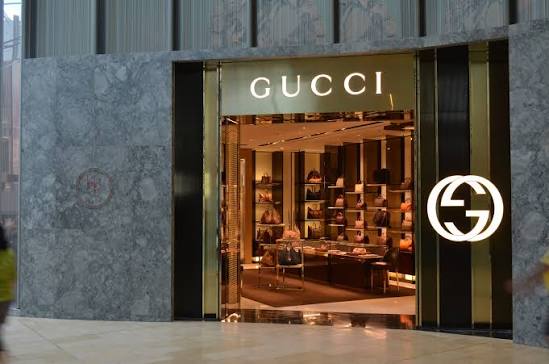
The Gucci logo is two letters, and Gucci has spent decades in court proving that those two letters belong to it. The interlocking GG, the green-red-green stripe and the diamond pattern of tiny Gs are among the most copied marks in fashion, which is exactly why the house has fought over them in New York, Milan, Paris, Nanjing and Luxembourg. It has not won every round. Some of its marks were cancelled, one judge awarded it a fraction of what it asked for, and the EU’s General Court decided that a rival’s G was not a G at all. Here is where the Double G came from, what Gucci actually owns, and the fights that tested it.
Short answer: The Gucci logo is the interlocking GG, matching the initials of founder Guccio Gucci, who opened his first store in Florence in 1921. A US court found Gucci has used its repeating GG pattern since 1966. The house’s biggest fight, against Guess from 2009 to 2018, produced wins in New York and China, losses in Milan, Paris and the EU General Court, and a worldwide settlement.
Key takeaways
- Gucci was founded in Florence in 1921. The repeating GG pattern has been in use since 1966 and the green-red-green stripe since the 1960s, according to findings in a 2012 US judgment.
- In Gucci v Guess, a New York federal judge awarded Gucci about $4.6 million in 2012 and banned three Guess designs, but rejected Gucci’s much larger damages claim.
- Courts in Milan and Paris sided with Guess and cancelled some Gucci marks, and the EU General Court ruled against Gucci in 2016. The two companies settled worldwide in April 2018.
- Gucci’s trademarks also stopped a family member using the name as a brand in 1988 and were challenged by Forever 21 over the stripes in 2017.
Where does the Gucci logo come from?
Gucci’s parent company, Kering, dates the house to 1921, when Guccio Gucci opened his first store at Via della Vigna Nuova 7 in Florence. Kering’s history of Gucci lists the Bamboo bag of 1947, the first New York store and the Horsebit loafer in 1953, and the Jackie bag in 1961 as the early icons. The two Gs match the founder’s initials, and the logo grew out of a Florentine leather goods business long before Gucci was a fashion label.
The best evidence for when the marks entered use comes from a courtroom rather than a brand book. In the 2012 judgment in Gucci America, Inc. v. Guess?, Inc., Judge Shira Scheindlin found that Gucci had used its Repeating GG Pattern since 1966, its green-red-green stripe since the 1960s and its Script Gucci logo since 1967, and its Stylized G since 1994. In court filings against Forever 21, Gucci said it first used the striped webbing in the US in 1963, on bridles, walking sticks and necktie cases, as Business of Fashion reported.
FLJ Insider Pro is open: live fashion law jobs and internships, five career guides and two roadmaps. Early bird USD 12/month. See what's inside
Which Gucci logos are protected by trademark?
“The Gucci logo” is really a family of marks. The US judgment sets out the core ones and their status at the time of trial.
| Mark | In use since | US registrations noted by the court | Court’s view in 2012 |
|---|---|---|---|
| Repeating GG Pattern | 1966 | 2003 (jewellery); 2006 (handbags, luggage, small leather goods, ties, scarves, footwear) | Famous |
| Diamond Motif (GG pattern in brown and beige canvas) | Not stated | Unregistered trade dress | Famous, with secondary meaning |
| Green-red-green stripe | 1960s | 1979 (bags, luggage, leather goods); 1988 (footwear) | Famous |
| Script Gucci | 1967 | 2006 (bags and cases) | Fame not decided |
| Stylized G | 1994 | 1997, 1999 and 2006 | Weak, not famous when Guess began |
Fame matters because, in the US, only a famous mark can bring a dilution claim, which protects it even where shoppers are not confused about who made a product. That is why Gucci could win against the Quattro G on dilution but not against the Square G. FLJ explains the difference between marks, patterns and trade dress in trade dress in fashion and word mark vs logo mark.

What happened in Gucci v Guess in the US?
Gucci sued Guess in the Southern District of New York in 2009. After a bench trial from 28 March to 19 April 2012, Judge Scheindlin found that Guess and some of its licensees had infringed and diluted Gucci’s marks with three of four challenged designs: the Quattro G pattern in brown and beige, a green-red-green stripe used on footwear, and a Square G that replicated Gucci’s Stylized G on a handful of products. Guess’s Script Guess logo was cleared. The court also rejected Gucci’s counterfeiting claim and cancelled Guess’s own Quattro G registration for abandonment.
The money was the sting. Reuters, in a report carried by FashionNetwork, said Gucci had sought more than $120 million. The amended opinion awarded a total of $4,613,478 across Guess and its licensees, based on their profits from specific products, and called Gucci’s expert evidence on lost sales “highly speculative”. The judge also held that Gucci had known or should have known about the Quattro G by 2006 at the latest, and that its delay in suing had prejudiced Guess. She closed by quoting Oscar Wilde on fashion as “a form of ugliness so intolerable that we have to alter it every six months”. FLJ’s case note on Gucci v Guess covers the US reasoning in more detail.
How did Gucci v Guess end in Europe and China?
Outside the US, the same designs met very different judges.
- Italy. The Tribunale di Milano dismissed all of Gucci’s claims in decision no. 6095/2013, published on 2 May 2013, and declared some Gucci marks invalid, including two G-logo international registrations for lack of distinctive character and marks covering the Flora pattern, as reported by The IPKat.
- China. The Nanjing Intermediate People’s Court sided with Gucci on trademark infringement and unfair competition, according to China Daily’s report in January 2014.
- France. A Paris court ruled for Guess at the end of January 2015, rejected Gucci’s claim for €55 million, ordered Gucci to pay Guess €30,000 and nullified three of Gucci’s G logo marks, as Fashionista reported. Gucci said it would appeal.
- European Union. On 11 October 2016, the General Court dismissed Gucci’s actions in T-461/15 and T-753/15 against Guess’s interlocking G marks. It held that the public would see Guess’s sign as an abstract ornamental motif rather than a letter G, so the marks were not confusingly similar.
The war ended quietly. In April 2018 the companies announced a settlement that would conclude all pending intellectual property litigation and trademark office matters worldwide, with terms undisclosed, as Business of Fashion reported. Nine years, five jurisdictions, and no single answer to whether a G pattern is too close to another G pattern.
Can a Gucci family member use the Gucci name?
Not as a brand. In Gucci v. Gucci Shops, Inc. (S.D.N.Y. 1988), Paolo Gucci, a member of the founding family, wanted to sell products under his own name. Judge William C. Conner barred him from using “Paolo Gucci” as a trademark or trade name because shoppers would likely confuse his goods with the house’s. He could identify himself as the designer of products sold under a different mark, provided his name was no more prominent than that mark and came with a disclaimer that he was no longer linked to any Gucci company. The court noted that Gucci Shops then held 19 US registrations for GUCCI and four for the diamond pattern with interlinked GG letters at each corner. The family story behind the name is told in the House of Gucci murder case.
What was the Gucci v Forever 21 stripe dispute?
In June 2017, after Gucci sent cease-and-desist letters over jackets and jumpers with blue-red-blue and green-red-green stripes, Forever 21 sued first in the US District Court for the Central District of California. It asked the court to cancel Gucci’s stripe registrations, arguing they lacked secondary meaning, were aesthetically functional and had become generic. Gucci moved to dismiss and counterclaimed for infringement, dilution and unfair competition. In November 2017 the judge dismissed Forever 21’s complaint with leave to amend, saying the court was “skeptical” of its arguments. The parties later settled, according to Fordham’s Fashion Law Institute. The stripes survived.
What do the Gucci logo fights teach other brands?
Three lessons stand out. First, a single stylised letter is a thin mark. Milan found two of Gucci’s G logo registrations lacked distinctive character, and the US court called the Stylized G weak. Guess, for its part, lost its own Quattro G registration because it never used the pattern in the form it had registered. Second, act fast. The US court’s finding that Gucci sat on its rights cost it money. Third, a pattern built from letters is vulnerable: once judges see a design as ornament rather than as a letter, the brand’s monopoly shrinks. Louis Vuitton has faced the same problem with its checks, as FLJ discussed in beyond monograms. For buyers, the practical point is simpler: the logo is the first thing counterfeiters copy, so check the details in how to spot counterfeit luxury before buying.
Frequently asked questions
What does the Gucci logo stand for?
The interlocking GG matches the initials of Guccio Gucci, who founded the house in Florence in 1921. Gucci also uses a script logo, a single stylised G and the green-red-green stripe as separate trademarks.
When was the Gucci GG logo created?
A US federal court found in 2012 that Gucci has used its Repeating GG Pattern since 1966. The court found the Script Gucci logo dates from 1967 and the single Stylized G from 1994.
Did Gucci win its case against Guess?
Partly. Gucci won an injunction and about $4.6 million in New York in 2012 and won in China, but lost in Milan, Paris and the EU General Court. The companies settled all disputes worldwide in April 2018.
Is the Gucci stripe a trademark?
Yes. Gucci’s green-red-green stripe was registered in the US in 1979 and 1988, and a US court found it famous in 2012. Forever 21’s 2017 attempt to cancel Gucci’s stripe registrations was dismissed, and the parties later settled.
Can I sell products with a double G logo?
Not one that is likely to be confused with Gucci’s, and in the US not one that dilutes a famous Gucci mark. The Guess cases show that outcomes depend on the exact design, the court and the market, so take advice before launching.
Who owns Gucci today?
Gucci is part of the French luxury group Kering, which lists it among its fashion and leather goods houses. Kering says Demna was named Gucci’s artistic director in 2025.
This article is general information about trademark disputes involving Gucci, based on court records and published reports as of October 2026. It is not legal advice, and it makes no allegation beyond what the courts found.
FASHION LAW JOURNAL INSIDER
Join designers, brand founders and fashion lawyers who get the biggest brand battles, IP fights and career moves in fashion law, straight to their inbox.