
There was a valid reason why she was called ‘Catherine the Great’. Not because she was a great wife and queen to Tsar Peter III of Russia, not because she only bore sons and certainly not for being a pretty queen on the throne of Russia.
Born in Stettin, Prussia, on May 2nd, 1729, and the eldest of five children, Sophia Augusta Frederica of Anhalt-Zerbst was the daughter of a German Prince, Christian Augustus, Prince of Anhalt- Zerbst of the House of Ascania, and Duchess Joanna Elisabeth of Holstein- Gottorp of the German House of Holstein- Gottorp. In 1745, she converted to the Russian Orthodox Church and changed her name to Catherine before marrying the Grand Duke, Peter, later Tsar Peter III. Her unhappy marriage to the Tsar did not go to waste. His useless rule as Tsar paved the way for her.
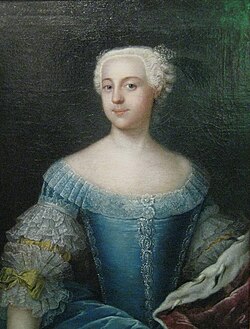
Catherine II was Empress of the Russian Empire from 1762 to 1796. How do you ask? Well, she staged a military coup d’état and took the throne from her husband. Who can blame her? He was incompetent and loved Germany more than his own empire. Patriotism was not in his vocabulary.
Fashion Before Catherine II
During the reign of Tsar Alexis I, traditional Russian style was the only acceptable attire one could wear in court. Clothing for the courtiers was heavy, elaborate and consisted of layered Muscovite garments, which were often loose- fitting garments of fabrics with heavy ornaments and furs. They also wore traditional headwear. Women wore elaborate, bejewelled headwear while men wore fur-trimmed, jewel- studded hats.
The only ones who could defy this rule were the tsareviches, or the sons of the Tsar; they could wear Western clothing. However, the Western style was welcomed during masquerades.
During Peter I’s reign, he forbade courtiers from wearing Russian-style dresses. He instructed the females to wear dresses, hats, kuntysh or kaftans, bostrogs or short jackets under the kaftans, skirts and German shoes. In other words, he advocated Western clothing. He even went on to call himself an Emperor, discarding the title ‘Tsar’.
Women were expected to follow German and Austrian fashion attire, and by the 18th century, French fashion made its way and dominated the empire.
Was her fashion sense as ‘Great’ as she was?
Catherine used fashion as a powerful statement to secure her legitimate rule in Russia, and with her being known as a usurper, she might as well show what she was capable of.
Catherine lived during the thriving Rococo era, so that meant it was the height of French fashion. Hooped gowns and wigs were all the rage. As a foreigner on the throne of a foreign land, you must do whatever it takes to prove to your subjects that you were one of them; in Catherine’s case, a Russian. So, in order to solidify her claims, she embraced the Russian style as well as incorporated both the Russian and the European fashion in her court. She wore a Gallicised version of the Russian kaftans, sarafan and kokoshnik to show her vision for fashion as well as her reputation.
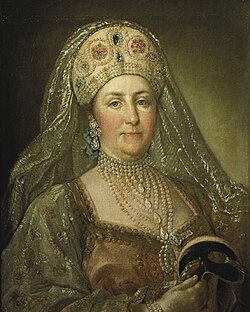
During her reign, she loved masquerades. In the portrait, Catherine was dressed in a 17th- or 18th-century masquerade outfit, in the Russian style. She was draped in pearls right down her gown’s neckline. She was also wearing her traditional Russian headdress, the kokoshnik, which was heavily embroidered with gemstones and pearls.
Catherine’s Coronation
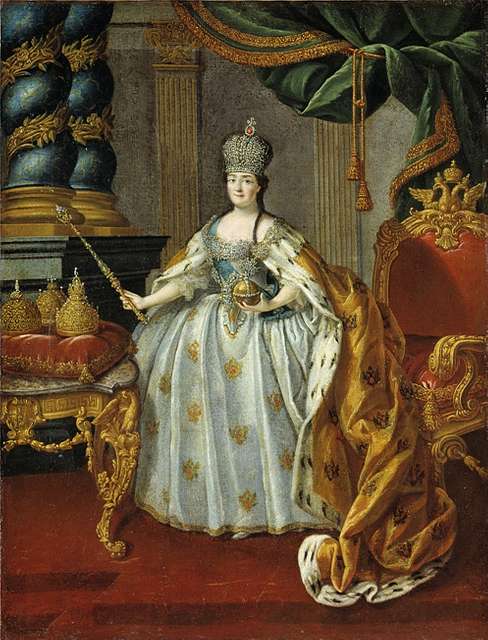
Catherine’s Coronation gown was one to behold. Rich in European style, with luxurious silver silk draped all over her, laced sleeves and a low-cut neckline, similar to that of the Italian style. Throughout her gown, golden eagles were embroidered along with ermine trim at the hem. Another addition to her outfit is the blue sash of the Order of St Andrew the First Called.
Catherine in Uniform.
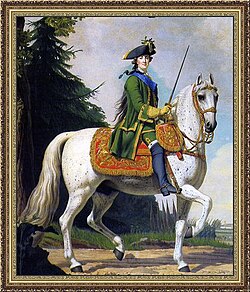
This portrait, painted by Vigilius Erichsen, showed Catherine in a different light. She was painted in a uniform of the Preobrazhensky Regiment during a coup to dethrone her husband. What made this a highlight in her life was her boldness in wearing a man’s uniform to project authority and dominance over the military and her people.
The military uniform had borrowed elements of Russian and European styles. She was wearing a dark green military infantry coat with gold trim and gold braids, with matching trousers and a tricorne military hat. She was also wearing knee-high riding boots. Catherine also had a star of the Order of St. Andrew draped across her chest.
The great thing about Catherine in the world of fashion was her idea to bring European fashion into her empire. This shows that she was a woman with a vision and a plan, and this skyrocketed her rule into popularity among the commoners. She was a revolutionary, and being a foreign woman in a strange land with a different language and a different take on life, she really showed them who was in power and who had the upper hand. And how she presented herself was a big bonus.
So was she ‘Catherine’ with ‘the Great’ fashion sense, or were the European monarchs better?
FASHION LAW JOURNAL INSIDER
Join designers, brand founders and fashion lawyers who get the biggest brand battles, IP fights and career moves in fashion law, straight to their inbox.