
The houses compete ferociously. Their shows are made by the same small group of firms, and one of those firms now belongs to a group that also places the press coverage.
Think of the images that defined the last decade of fashion. The eighteen-metre mountain of blue delphiniums in the courtyard of the Louvre. A supermarket built inside the Grand Palais. A Saint Laurent runway staged in the shadow of the Eiffel Tower. Robot dogs walking alongside models.
Now try to name the person who built any of them.
You cannot, and neither can almost anybody else, which is a remarkable thing to say about the most photographed objects in the industry. The designer gets the credit, and the house gets the coverage, but the room itself, the thing that made the photograph worth taking, was almost certainly produced by one of four companies. And the economics of that arrangement explain a great deal about why fashion looks the way it does.
The four names
Bureau Betak is the largest. Alexandre de Betak set up in Paris in 1987, at a point when there was no established word for what he wanted to do, and the company as it exists was founded in 1990. It has since produced something in the order of 1,500 runway shows for Dior, Saint Laurent, Fendi, Calvin Klein, Jacquemus, Gucci, Valentino and a long list of others, and now runs more than a hundred events a year from offices in Paris, New York, Los Angeles and Shanghai. It is run today by Benedicte Fournier, Paco Raynal and Guillaume Troncy.
Villa Eugénie, founded by the Belgian producer Etienne Russo and based in Brussels, emerged from the Antwerp scene and became the house that Chanel used under Karl Lagerfeld. Its client list runs through Miu Miu, Hermès, Lanvin, Ferragamo and Dries Van Noten. If Betak specialises in spectacle, Villa Eugénie is generally credited with storytelling.
La Mode en Images completes the set in Paris, alongside smaller firms such as Focus and OBO.
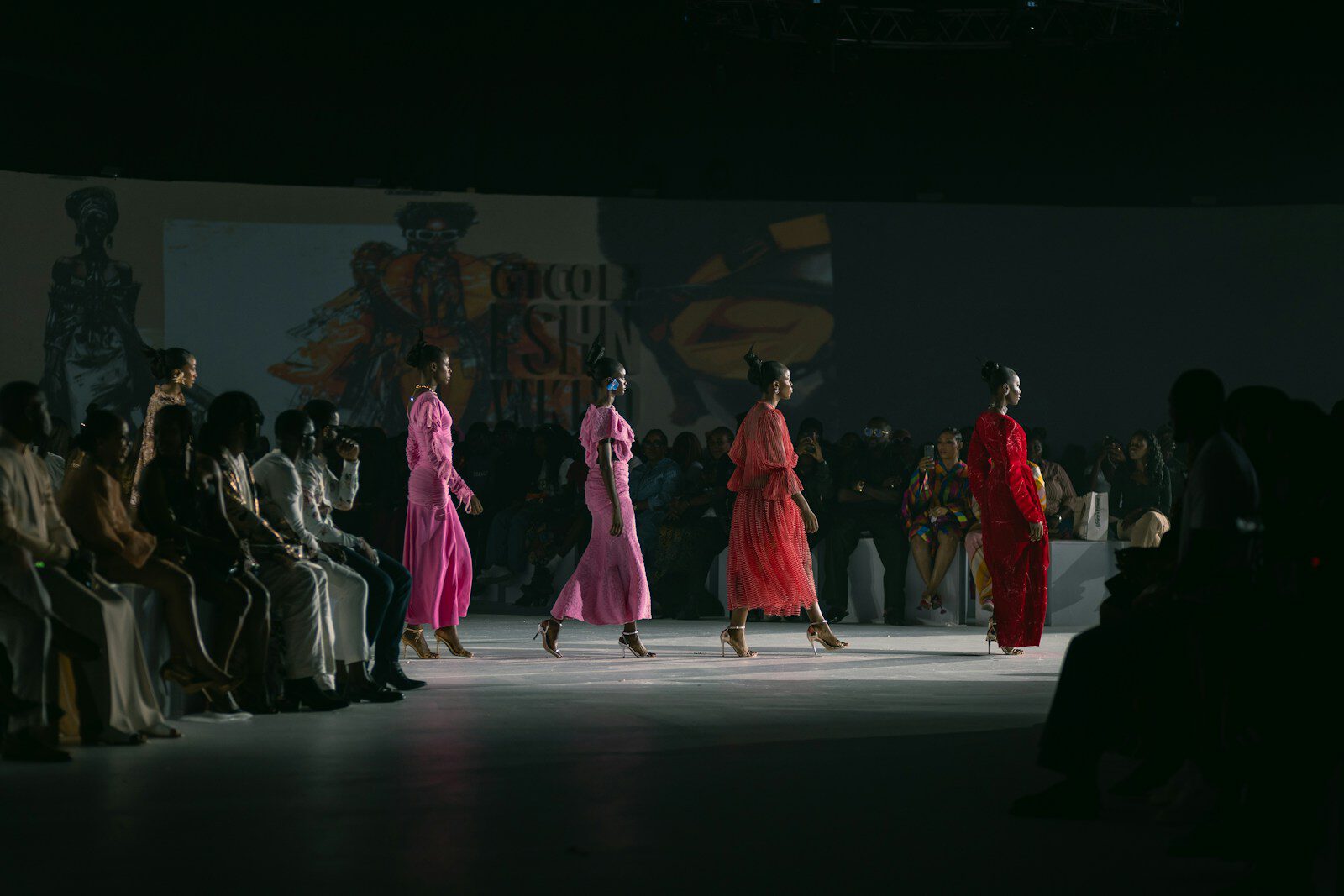
Between them, these companies handle the full physical production of a show: set design, lighting, technical logistics, casting coordination, and the creative direction of the space itself. They take a rail of clothes and turn it into something walkable and, far more importantly, photographable.
The interesting part is what this does to competition
Here is where it becomes an economics story rather than a list.
Luxury houses compete on differentiation. The entire value proposition of a maison rests on being recognisably itself and recognisably not the house next door. It is the most product-differentiated industry on earth, and its customers pay a premium precisely for that distinction.
And yet the physical environments in which those differentiated identities are presented are built by a supplier base of perhaps six firms, using overlapping teams, comparable technology and, inevitably, a shared sense of what currently works in a photograph.
This is a textbook condition for convergence. When rival firms outsource a core element of differentiation to the same specialist suppliers, the outputs drift toward each other, because the suppliers carry knowledge across clients and because success in one season is visible to every competitor by the following morning. It is the same dynamic that makes cars from rival manufacturers look increasingly alike once they share component suppliers and wind tunnels.
Which offers a rather unglamorous explanation for something critics complain about every season. When four houses in a week produce shows that feel tonally similar, the cause is not a failure of imagination in four separate design studios. It is a structural feature of a market where the room is built by a shared supplier.
Then it got more interesting.
Read that portfolio as a supply chain rather than as a list of acquisitions.
One group can now build the show that generates the image, place the press coverage that carries the image, and supply the analytics that measure what the image was worth. That is vertical integration of the attention economy, assembled quietly, in an industry that does not generally describe itself in those terms.
There is nothing improper about it. Every one of those businesses is legitimate, and several are the best in their field. But it does mean that the distance between the thing that happens and the thing that is reported about the thing that happens has become considerably shorter than most readers assume, and that a meaningful share of what the industry calls organic coverage is produced inside a single corporate structure.
What the producers actually sell
Ask what these firms are being paid for and the obvious answer is a set. The obvious answer is wrong.
One of Bureau Betak’s longest-serving partners has described how the work has changed: where the company once produced four shows a year for a brand, it now does eight to twelve, and each one is bigger. What was once fashion show production has become something closer to conducting a single movement in the ongoing performance of a brand, and ensuring it plays correctly to a global audience that is mostly not in the room.
So the product is not a runway. It is a controlled environment designed to generate a specific set of images that will travel, at scale, through systems the producer increasingly also understands commercially.
Betak has also pushed the industry’s most serious attempt at cleaning up after itself, publishing a set of commitments covering reuse, upcycling, waste sorting, the elimination of single-use plastic, reduced flying and carbon compensation. That such a document had to come from a production company rather than from a house tells you where the operational power in this arrangement actually sits.
The credit problem
None of this is hidden. It is simply never foregrounded, and the reason is commercial rather than sinister.
A house sells the idea of singular authorship. A creative director is presented as the origin of everything the audience sees, because that story is what a customer is buying into when she buys the bag. Acknowledging that the most memorable element of a show was conceived and built by a third-party agency with a hundred other clients complicates that story considerably.
So the producers remain almost invisible, which is an odd fate for the people responsible for the most reproduced images in the industry.
There is a version of this industry in which the producers are credited the way a cinematographer is credited, and the work is understood as collaboration rather than as the output of a single mind. That version would be more accurate and slightly less saleable, which is precisely why it does not exist. A house is not only selling clothes. It is selling the belief that one person imagined all of this, and that belief costs a great deal to maintain, though not as much as the set.
FASHION LAW JOURNAL INSIDER
Join designers, brand founders and fashion lawyers who get the biggest brand battles, IP fights and career moves in fashion law, straight to their inbox.