
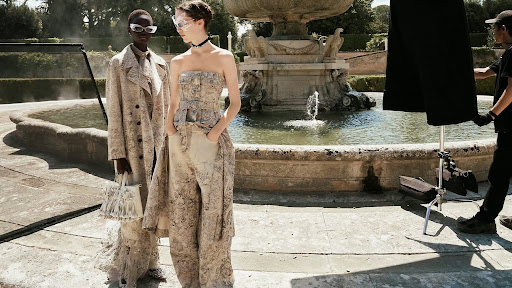
Dior has released the campaign for its Cruise 2026 women’s collection, continuing the house’s exploration of Rome through fashion, cinema and Italian cultural history. Shot at Villa Albani Torlonia, the campaign brings together the collection’s references to Roman heritage with a distinctly cinematic setting.
The campaign follows the Cruise 2026 collection presented by Dior in Rome in May 2025. The collection was created by Maria Grazia Chiuri, then creative director of Dior’s women’s lines, and was inspired by the city’s relationship with cinema, theatre, art and fashion. Dior describes the collection as a tribute to the “magic and mirages” of Rome, drawing on the atmosphere of legendary balls and the dreamlike world associated with filmmaker Federico Fellini. Dior’s official campaign presentation
Dior Cruise 2026: A Campaign Set in Historic Rome
The campaign was photographed by Brigitte Lacombe at Villa Albani Torlonia, a historic Roman villa and garden complex. The photographs are closely connected to Matteo Garrone’s short film Les Fantômes du Cinéma, which accompanied the Cruise 2026 collection. Rather than presenting the clothes against a conventional studio backdrop, the campaign places the models within the villa’s open-air setting. Dior describes the location as a space where fiction and reality meet, with the models moving through an environment marked by its history and architecture. Dior’s Cruise 2026 campaign story
The setting also connects directly to the original presentation. The Cruise 2026 show took place in the gardens of Villa Albani Torlonia on May 27, 2025, bringing together ready-to-wear and haute couture creations. Dior’s parent company, LVMH, described the collection as an expression of Chiuri’s connection with her native Rome and her interest in the city’s history through cinema, theatre, art and fashion. LVMH’s report on the Cruise 2026 collection
FLJ Insider Pro is open: live fashion law jobs and internships, five career guides and two roadmaps. Early bird USD 12/month. See what's inside
White Becomes the Connecting Thread
White is one of the strongest visual elements throughout the campaign. The colour appears across different fabrics, textures and silhouettes, giving the photographs a consistent look while allowing the construction and details of each garment to stand out. The collection includes vests inspired by menswear, loose skirts, tailcoats and dresses finished with fine lace and bas-relief embroidery. Some of the dresses take inspiration from the shape of chasubles, while military-style jackets are finished with red trims. The accessories continue the same Italian-inspired mood. Ballet flats and lace masks reference the atmosphere of historic Italian balls, while chokers and bows add another decorative element to the looks. The campaign also features several Dior bags, including the Lady Dior, D-Journey and Dior Toujours. Dior’s official Cruise 2026 campaign details
The result is a collection that moves between different parts of fashion history rather than following one particular period. Menswear references sit alongside eveningwear, military details appear beside lace, and traditional techniques are presented through a contemporary collection.
Cinema and Fashion Share the Frame
Cinema is particularly important to the story behind Cruise 2026. Les Fantômes du Cinéma, directed by Matteo Garrone, was created alongside the collection and explores the idea of cinema, memory and the people who inhabit its imagined worlds.
The connection between Dior and Italian cinema also has a historical reference. During the original collection presentation, Chiuri paid tribute to the Fontana sisters, the Italian designers whose work appeared in several films, including Federico Fellini’s La Dolce Vita. LVMH notes that the collection’s use of velvet was among the references to their work for cinema. LVMH’s account of the collection’s inspiration
This makes the campaign feel connected to more than just a location. Rome is being presented as a meeting point for different forms of visual culture, with fashion, film, architecture and history appearing alongside one another.
Dior Cruise 2026: A Collection Between Past and Present
The Cruise 2026 campaign is ultimately less about presenting a single trend and more about creating a particular view of Rome. The clothes draw from historical references, but they are not presented as period costumes. Menswear tailoring, military jackets, lace, masks, bows and embroidered dresses are brought together within Dior’s contemporary vocabulary.
That balance is also visible in the campaign itself. The historic Villa Albani Torlonia provides the setting, while Lacombe’s photographs and Garrone’s film give the collection a modern fashion image. For Dior, the Cruise 2026 campaign becomes another way of telling the story behind the collection: a story that begins in Paris, travels to Rome and moves between fashion, cinema and craftsmanship. The clothes may be the focus, but the campaign makes the setting part of the collection’s identity too.
The Jonathan Anderson Effect: When Creative Directors Become Strategic Assets
FASHION LAW JOURNAL INSIDER
Join designers, brand founders and fashion lawyers who get the biggest brand battles, IP fights and career moves in fashion law, straight to their inbox.