Search for ethical clothing brands and you will find lists, rankings and badges, most of them built on what brands say about themselves. The problem is that “ethical” has no legal definition. It can mean fair pay for garment workers, organic cotton, safe chemicals, animal welfare or all of the above, and a single logo rarely covers more than one of those. This guide does not tell you which brands to buy. It shows you how to check the claims yourself: what each major certification actually certifies, what the law in the US, UK and EU says about ethical and green claims, the red flags to look for, and the public tools that let you test a brand’s supply chain story.
Short answer: To check ethical clothing brands, look for a specific, verifiable certification and confirm what it covers, because most labels certify one thing: a fibre, a factory, a chemical standard or a company. Then check the brand’s modern slavery statement, supplier list and transparency score. Vague words like “ethical” with no evidence behind them are a warning sign, and in the EU and UK they can break the law.
Key takeaways
- No certification covers everything: GOTS certifies organic fibre and processing, OEKO-TEX STANDARD 100 tests for harmful substances, and SA8000 and WRAP certify workplaces, not finished products.
- Fair Trade USA and Fairtrade International are different organisations with different marks, and Fair Wear does not certify products at all.
- From 27 September 2026, EU law bans sustainability labels, including social ones, that are not based on a certification scheme or set up by a public authority.
- The UK’s modern slavery statement registry, the US UFLPA Entity List and the Fashion Transparency Index let shoppers test a brand’s claims for free.
What makes a clothing brand “ethical”?
There is no legal test. In practice, people use “ethical” to mean some mix of how workers are treated (wages, hours, safety, freedom to join a union, no forced or child labour), how the environment is affected (fibres, chemicals, water, waste) and sometimes how animals are treated. Brands know this, which is why the word is so popular: it suggests a lot and commits to little.
The useful question is not “is this brand ethical?” but “what exactly is being claimed, and who checked it?” Claims work at three different levels. A product claim covers the item you are buying, such as an organic cotton t-shirt. A facility claim covers a factory or mill. A company claim covers the business as a whole. A brand can hold a company-level certification while still making most of its range in factories nobody outside the business has audited. FLJ’s guide to checking sustainable fashion brands’ claims covers environmental claims in more depth; this guide focuses on the social side.
FLJ Insider Pro is open: live fashion law jobs and internships, five career guides and two roadmaps. Early bird USD 12/month. See what's inside
What do the main certifications actually certify?
This table sets out what each scheme covers, based on the schemes’ own published descriptions.
| Label | Level | What it covers | What it does not tell you |
|---|---|---|---|
| Fair Trade USA (Fair Trade Certified) | Factory | Factory Production Standard with over 100 social, environmental and economic criteria; a premium paid to workers for each certified product sold | Not, on its own, the farming of the raw material |
| Fairtrade International (FAIRTRADE Cotton) | Raw material | Cotton farmers receive a Minimum Price and a Fairtrade Premium; bans exploitative child labour | The cotton programme focuses on farming, not full garment manufacture; the separate Fairtrade Textile Standard covers the wider chain |
| GOTS | Product and supply chain | “Organic” grade needs at least 95% certified organic fibre, “made with organic” at least 70%; environmental and social criteria at every processing stage | Anything about non-textile parts of the business |
| OEKO-TEX STANDARD 100 | Product | Tested against a list of more than 1,000 harmful substances | Working conditions or organic content |
| MADE IN GREEN by OEKO-TEX | Product and facilities | Harmful substance testing plus STeP-certified production sites and a traceable product ID | Brand-wide practices beyond that product |
| B Corp | Company | Company-wide performance standards across governance, climate, human rights and fair work | That any particular product or factory has been audited |
| SA8000 | Workplace | Decent work requirements based on ILO conventions, audited by accredited bodies | Which products came from that workplace |
| bluesign | Product and chemicals | Chemical management and resource use; PRODUCT label needs at least 90% approved fabrics | Wages or labour rights in detail |
| Fair Wear | Brand membership | Member brands are assessed and rated on how they improve conditions in their factories | Product certification; Fair Wear says it does not certify products or brands as 100% fair |
| WRAP | Factory | Facility certification against 12 principles, valid for one year | Product quality or anything beyond that facility |
A few details are easy to miss. Fair Trade USA’s factory certification works through a premium that workers decide how to spend through an elected committee, while Fairtrade International’s cotton mark starts at the farm. They are separate organisations with separate marks. GOTS labelling rules require “made with organic” products to state the exact organic percentage, and every company processing the product must be certified by an approved independent body. B Lab published new B Corp standards on 8 April 2025, moving away from a points score towards requirements every B Corp must meet across seven topics, but it remains a certification of the company, not of the shirt. Fair Wear allows only member brands rated Leader or Good to use its logo on garments, and tells resellers not to suggest products are certified.
What does the law say about ethical and green claims?
United States. The Federal Trade Commission’s Green Guides, last revised in 2012 and under review since December 2022, cover environmental claims. They say marketers should not make unqualified general environmental benefit claims such as “eco-friendly”, because they are almost impossible to substantiate. On certifications, 16 CFR 260.6 says it is deceptive to misrepresent that a product has been certified by an independent third party, and that third-party certification “does not eliminate a marketer’s obligation” to back up every claim the seal conveys. Social claims such as “fair wages” or “sweatshop free” are not covered by the Green Guides, but they are still subject to the FTC Act’s general ban on deceptive advertising.
United Kingdom. The Competition and Markets Authority’s Green Claims Code, published on 20 September 2021, sets six principles: claims must be truthful and accurate, clear and unambiguous, must not omit or hide important information, must make fair and meaningful comparisons, must consider the full life cycle, and must be substantiated. In March 2024, ASOS, Boohoo and George at Asda gave the CMA undertakings on their green claims, including references to accreditation schemes. In September 2024 the CMA published a compliance guide for fashion brands and wrote to 17 brands about vague terms, unclear composition claims and potentially misleading claims about affiliations. Since April 2025, under the Digital Markets, Competition and Consumers Act 2024, the CMA can fine businesses up to 10% of global turnover for breaching consumer law.
European Union. The Empowering Consumers for the Green Transition Directive, Directive (EU) 2024/825, has applied since 27 September 2026. It matters for ethical claims because it defines a sustainability label as a trust or quality mark that sets a product apart “by reference to its environmental or social characteristics, or both”. According to the Commission’s FAQ, such labels must be based on a certification scheme or established by public authorities, and a certification scheme must use third-party verification and be open to all traders on fair terms. Generic environmental claims are banned unless the trader can show recognised excellent environmental performance. A self-made “ethically made” badge is now a legal risk in the EU. FLJ explains the wider changes in the EU greenwashing ban.
How can you check a brand’s supply chain disclosures?
UK modern slavery statements. Under section 54 of the Modern Slavery Act 2015, businesses that supply goods or services, carry on business in the UK and have annual turnover of £36 million or more must publish a statement each year. The government’s modern slavery statement registry lets anyone search them. Uploading to the registry is still voluntary, so a missing entry is not proof of a breach, but a large brand with no statement anywhere, or one that repeats the same text every year, tells you something. FLJ has looked at the gap between statements and practice in modern slavery in fast fashion brands.
US forced labour rules. Since 21 June 2022, US Customs and Border Protection has applied a rebuttable presumption under the Uyghur Forced Labor Prevention Act that goods made wholly or partly in Xinjiang, or by entities on the UFLPA Entity List, are made with forced labour and barred from entry. The list is public and includes textile and garment companies. If a brand’s supplier list names a listed company, that is a serious red flag. FLJ’s report on Xinjiang cotton and the UFLPA Entity List explains how the list works, and its guide to the EU Forced Labour Regulation covers the European ban coming in 2027.
Transparency rankings. Fashion Revolution’s Fashion Transparency Index reviews 250 of the world’s largest fashion brands and retailers. It is clear that it “does not measure sustainability or ethics; it measures public disclosure of information”. In its latest full edition the average score was 26%, and 129 of the 250 brands (52%) disclosed their suppliers. A brand that publishes its factory list lets outsiders check its claims; a brand that does not is asking you to trust it. FLJ has asked whether the trend is real in transparency is trending, but is it real?
What are the red flags in ethical fashion claims?
- Vague words with no proof: “ethical”, “conscious”, “responsible” or “fair” with no named standard, data or audit behind them.
- Home-made badges: leaf icons or “ethically made” seals that do not name an independent certifier. In the EU, these can now be unlawful.
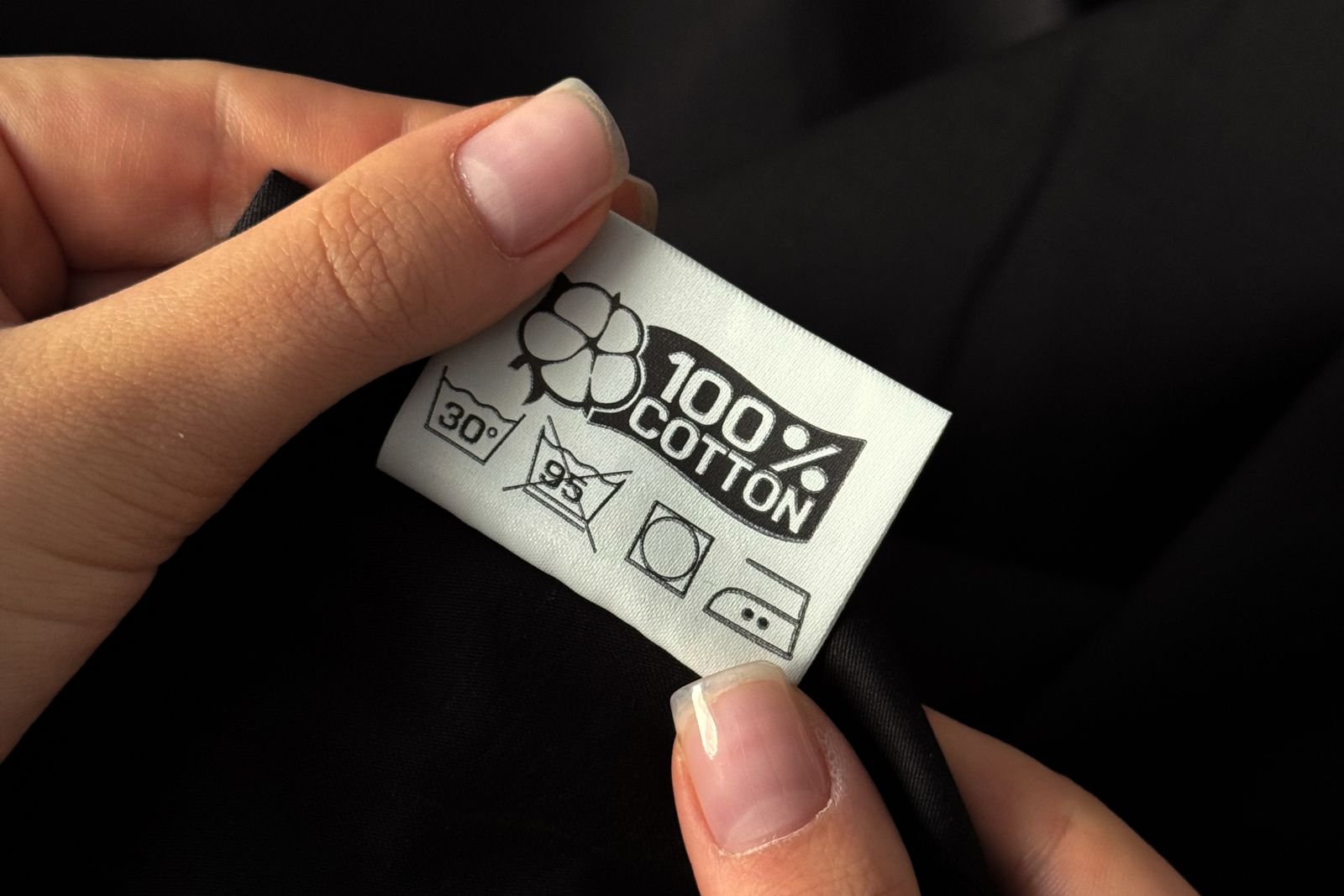
- A certificate that does not match the claim: an OEKO-TEX STANDARD 100 label used to suggest fair wages, or a company B Corp badge presented as proof that a specific product was ethically made.
- “Made with” fibre claims with no percentage: GOTS requires the organic share to be stated.
- No supplier list and no modern slavery statement from a brand big enough to need one.
- Capsule collections doing the work: a small “ethical edit” marketed as if it covered the whole brand. The CMA has specifically warned against unclear criteria for green collections.
- Prices that cannot cover decent wages, repeated across endless new drops. This proves nothing on its own, but it is a reason to ask harder questions.
If a claim fails these checks, you can ask the brand which certifier stands behind it and for a certificate or licence number. A brand with real evidence usually answers quickly.
This article is general information for consumers, not legal advice, and does not endorse or criticise any particular brand. Certification rules change; check each scheme’s current standard.
Frequently asked questions
How do I know if a clothing brand is really ethical?
Look for an independent certification and check exactly what it covers, then look at the brand’s supplier list, modern slavery statement and Fashion Transparency Index score if it is a large brand. Specific, verifiable evidence counts; general promises do not.
Which certification is best for ethical clothing?
There is no single best label because each certifies something different. For workers in factories, look at Fair Trade USA, SA8000, WRAP or Fair Wear membership. For organic fibre with processing criteria, GOTS. For chemical safety, OEKO-TEX STANDARD 100 or bluesign.
Is B Corp certification proof that clothes are ethically made?
No. B Corp certifies a company’s overall performance and governance, not individual products or factories. It is a useful signal about the business, but it does not show that a particular garment was made in an audited factory.
Does OEKO-TEX mean clothing is ethical?
Not on its own. OEKO-TEX STANDARD 100 means the product has been tested for harmful substances. It says nothing about wages or working conditions. MADE IN GREEN by OEKO-TEX adds requirements for certified production sites and traceability.
Is it illegal to call clothing ethical without proof?
It can be. Misleading claims breach consumer law in the US, UK and EU. In the EU, sustainability labels covering social characteristics must now be based on a certification scheme or set up by public authorities, and the UK CMA can fine brands up to 10% of global turnover.
What is the difference between Fair Trade and Fairtrade?
They are different organisations. Fair Trade USA certifies garment factories and pays a premium to workers. Fairtrade International’s cotton mark certifies that the cotton came from Fairtrade farmers paid a Minimum Price and Premium, with a separate Textile Standard for the wider supply chain.
FASHION LAW JOURNAL INSIDER
Join designers, brand founders and fashion lawyers who get the biggest brand battles, IP fights and career moves in fashion law, straight to their inbox.