
As the weather turns crisp and shearling boots make their seasonal comeback, one of fashion’s cosiest icons is feeling the legal heat. UGG’s attempts to obtain exclusive rights to its Classic Ultra Mini boots and Tasman slippers have been unsuccessful. But let’s go back to the beginning and how the iconic UGG brand was born…
The Birth of an Icon, aka How UGG Stepped into the Spotlight
Deckers Outdoor Corporation, the parent company behind UGG, has been engaged in the design, distribution, marketing and sale of footwear since 1975. Deckers owns and markets its footwear products under several distinctive trademarked brands, including the (not-so) one-and-only UGG. This is one of the most well-recognised premium comfort and leisure shoe brands in the United States. UGG started life as a humble sheepskin boot before becoming a pop culture phenomenon in 2000, when UGG boots were featured on Oprah’s Favourite Things, where Oprah emphatically declared on national television how much she loves her UGG boots. [Case: 3:23-cv-04850-AMO, Complaint for Damages and Equitable Relief, p. 3.] She did it again in 2015, with the furry footwear being once again among her favourites. Since then, the popularity of UGG footwear has grown exponentially, embraced by celebrities such as Hailey Bieber, Kendall Jenner, Emily Ratajkowski, and Meghan Fox, among many others, who are regularly seen wearing the brand’s fuzzy footwear. The worldwide recognition as a premium brand and the overwhelming popularity of the UGG are due to Deckers’ continuous commitment to quality and excellence. [Case: 3:23-cv-04850-AMO, Complaint for Damages and Equitable Relief, p. 4.]
The Legal Battle Beneath the Sheepskin
The story began in summer 2023 when Deckers filed a lawsuit against Quince (Last Brand, Inc.). Among other things, Deckers alleged that Quince had crossed the line with its “Australian Shearling Mini Boots”, arguing that the design infringed the unregistered trade dress rights of the Classic Ultra Mini, as well as its ‘161 Patent. The company also claimed that “Australian Shearling Button Boot” mimicked the Bailey Button Boot, while the “Australian Shearling Clog Slipper” took a little too much inspiration from the iconic Tasman. [Case: 3:23-cv-04850-AMO, Complaint for Damages and Equitable Relief, p. 4.; Case: 3:23-cv-04850-AMO, Order Re Motions for Summary Judgement, p. 1.]
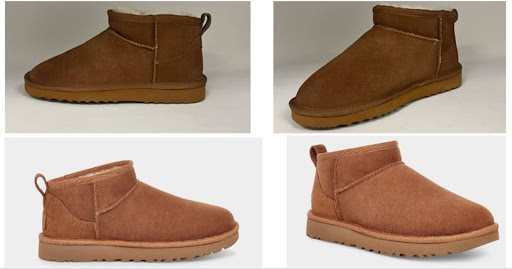
source: Case: 3:23-cv-04850-AMO, Complaint for Damages and Equitable Relief, pp. 5-6.
Back in 2020, Deckers introduced a fresh iteration of its UGG family, featuring the design elements protected under the “Classic Ultra Mini Trade Dress”. [Case: 3:23-cv-04850-AMO, Complaint for Damages and Equitable Relief, p. 5.] The trade dress in question is not just about comfort, but about a very specific look. It comprised of the following non-functional elements: an ankle-high silhouette, classic suede booty styling, an exaggerated, raised and exposed circular stitch pattern, exposed tufting, a raised and rounded vamp, a suede heel overlay, a fabric binding along the top of the boot and along the sole, a thick flat base, a top line that is higher in the front and lower in the back. Building on its portfolio of distinctive designs, Deckers describes the Tasman trade dress as including an embroidered braid around the opening of the upper, a raised front seam, a rounded dome-shaped toe, a brushed suede-like exterior, and a thick, flat outsole. [Case: 3:23-cv-04850-AMO, Defendant’s Notice of Motion and Motion for Partial Summary Judgement, p. 14.]
Deckers argues that, taken as a whole, this mix of features serves no functional purpose, stands out visually and has no equivalent elsewhere in the footwear market. On its account, the look of the boot is not needed for the shoe to work and has no bearing on how much it costs to make or how well it performs. [Case: 3:23-cv-04850-AMO, Complaint for Damages and Equitable Relief, p. 6.] Deckers says Quince rode on the popularity of the UGG Classic Ultra Mini to sell its own version without permission, which genuinely risks confusing shoppers. It wants the Court to stop Quince from infringing the Classic Ultra Mini Trade Dress, or any design confusingly close to it [Case: 3:23-cv-04850-AMO, Complaint for Damages and Equitable Relief, p. 8.], and from infringing the related ‘161 Patent [https://patentimages.storage.googleapis.com/20/bb/51/fc45bb48c055f9/USD927161.pdf]
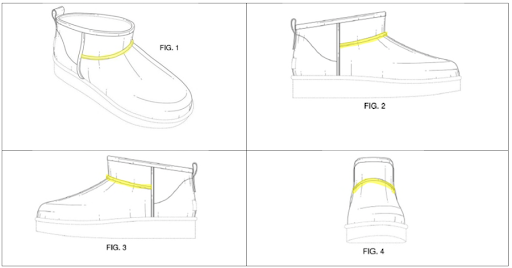
source: Case: 3:23-cv-04850-AMO, Defendant’s Notice of Motion and Motion for Partial Summary Judgement, p. 34.
In response, Quince filed a motion for partial summary judgment, arguing that UGG’s designs were too generic to support trade dress protection because the Mini and Tasman trade dresses consist of overbroad, generalised elements that are so common in the industry and represent the basic form of sheepskin ankle-high boots and slippers. Furthermore, Quince stated that there could be no unfair competition without a protectable design and that the cited patent was invalid from the outset. [Case: 3:23-cv-04850-AMO, Defendant’s Notice of Motion and Motion for Partial Summary Judgement, p. 10.]
Defining the Look: What Trade Dress Really Protects
US law protects trade dress through the Lanham Act (Section 43(a)), and the Supreme Court has confirmed that this protection reaches beyond words and logos. It began with packaging, but courts have since applied it to the design of products themselves. To qualify, the claimed trade dress has to be non-functional and capable of identifying its source. For product design, the Supreme Court held in Wal-Mart v. Samara Brothers that this means proving “secondary meaning”, because a design is never treated as inherently distinctive. Functionality comes in two forms, utilitarian and aesthetic, and a design caught by either one falls outside trademark protection. A design is functional in the utilitarian sense when the product needs it in order to do its job, or when it has an impact on the product’s cost or quality, a test the Supreme Court applied in TrafFix Devices v. Marketing Displays. [Case: 3:23-cv-04850-AMO, Order Re Motions for Summary Judgement, p. 4.] This creates a particular hurdle for fashion: a designer has to show that a distinctive feature is not functional, while clothing and footwear are, by their nature, generally seen as functional items.
Trade dress law can sometimes cover the shape and overall configuration of a product, but there are cases where a design patent is the better fit.
The Lanham Act protects trade dress that serves the same source-identifying function as a trademark. While it is possible to register trade dress as a trademark, most trade dress and product configurations are protected under 15 U.S.C. § 1125(a) without registration for practical reasons. Most trade dress is protected without registration.
How UGG’s Cosy Classics Ended Up in a Legal Storm
On 2 October, the U.S. District Court for the Northern District of California granted both parties’ motions.
Deckers has argued that its trade dresses are non-functional because none of them gives its boots or slippers a practical edge over rival products. Quince, relying on its expert, takes the opposite view: the boots contain features that influence their cost or quality, which makes them functional. [Case: 3:23-cv-04850-AMO, Order Re Motions for Summary Judgement, p. 5.] Quince also says the Mini and Tasman designs are now so widespread that they no longer point consumers to any one brand. It pointed to at least 14 competitors selling boots similar to the Mini and nine selling slippers similar to the Tasman, all offering comparable sheepskin ankle boots, moccasins or slippers. [Case: 3:23-cv-04850-AMO, Order Re Motions for Summary Judgement, p. 7.]
The Court ruled in favour of Quince, finding that UGG’s designs were too widely used and prevalent in the industry and marketplace to be attributed to a single source.
The Takeaways
While autumn and winter are all about staying warm, the legal climate has just become a lot colder for UGG…
The court rejected Deckers’ trade dress claims for the Mini and the Tasman, but the case is not over. UGG may own the streets, yet its legal fight is still running: the ‘161 design patent claim survived summary judgment, and the Bailey Button boot claim is still alive. The ruling leaves Deckers with fewer ways to enforce its rights and highlights a wider point in fashion law: no design, however famous, can claim exclusive rights over a look that has become part of the industry’s common vocabulary.
Timeline
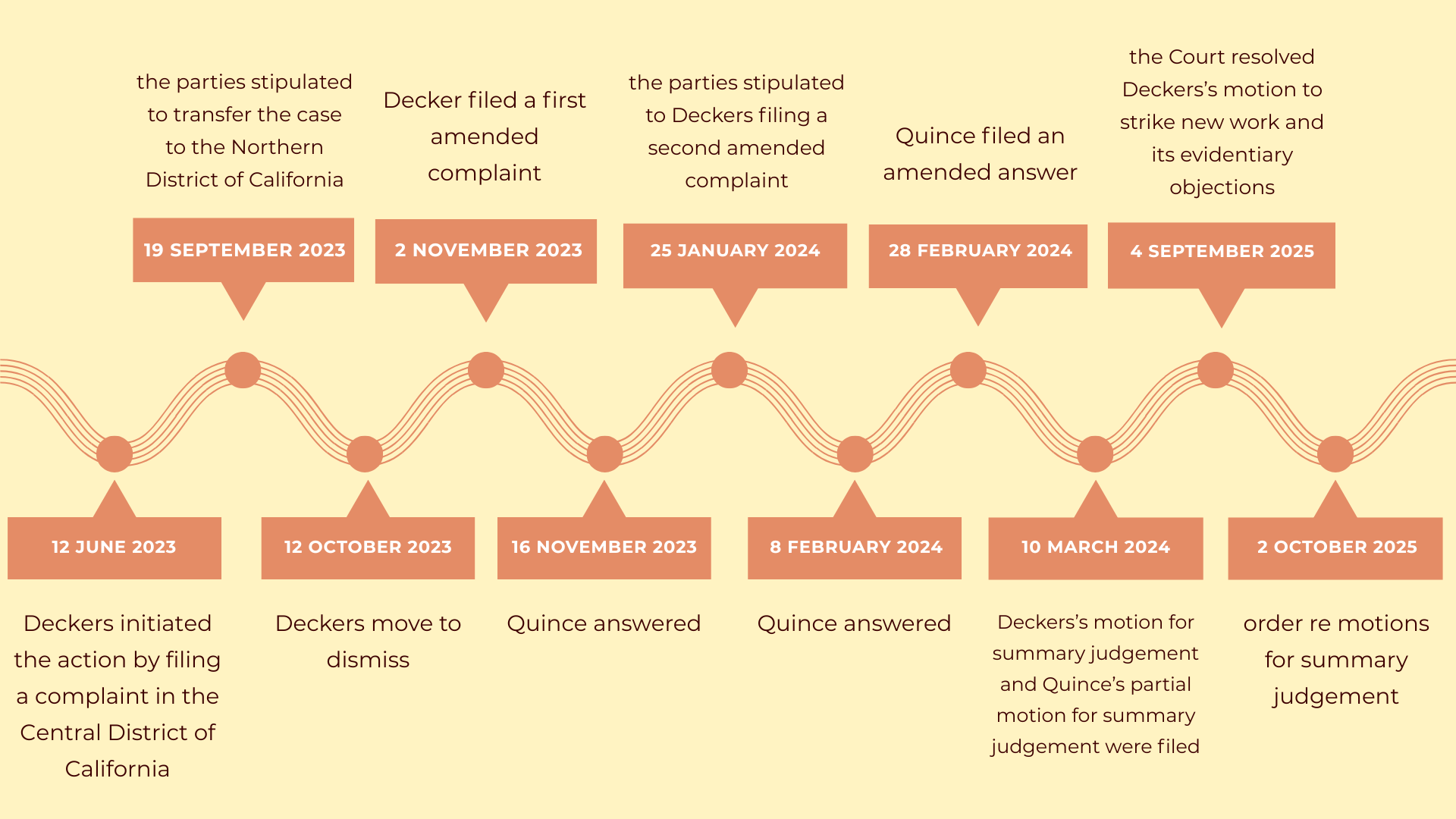
To make sense of the twists, turns, and courtroom drama of the UGG dispute, I have laid out a timeline of the key milestones:
Dr. Kata Zsófia Prém

Dr. Kata Zsófia Prém is completing her doctorate at the Deák Ferenc Doctoral School of Law, University of Miskolc. Her research centers on Intellectual Property Law, with a particular focus on originality and copyright in fashion products. She is also interested in trademarks, designs and the wider field of Fashion Law. She earned her law degree in 2022. Fashion is her passion, and away from her studies she enjoys reading, baking, traveling and spending time with family and friends
FASHION LAW JOURNAL INSIDER
Join designers, brand founders and fashion lawyers who get the biggest brand battles, IP fights and career moves in fashion law, straight to their inbox.