

The 197.80-carat stone sells on 11 November at an estimate of CHF 850,000 to 1.7 million. A century ago, the same provenance was almost worthless. What changed was the paperwork, and the most valuable document attached to it was written by the Soviet government that confiscated it.
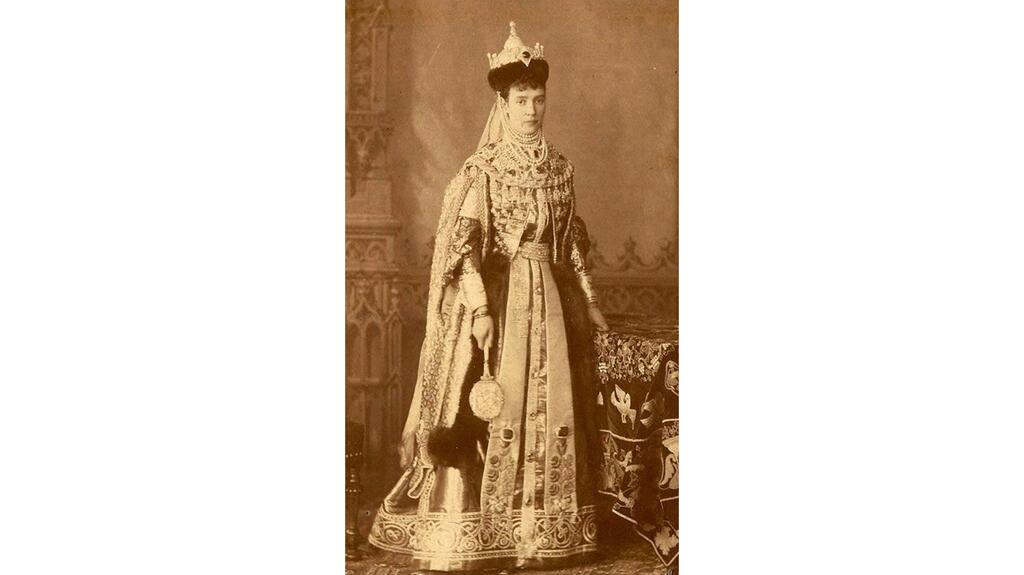
In February 1903 the Winter Palace held a ball at which everybody came dressed as somebody from three hundred years earlier, in the costume of a Russia that had not existed since before Peter the Great. It is the most photographed party in Russian history, partly because the photographs are extraordinary and partly because of what happened to almost everyone in them.
Among the jewels in the room that night was a sapphire of 197.80 carats, unheated, from Ceylon, mounted by Fabergé and worn by the Dowager Empress Maria Feodorovna.
On 11 November, it goes under the hammer at the Mandarin Oriental in Geneva, lot 1080 in Sotheby’s Royal and Noble Jewels sale. Bidding opens at CHF 600,000. The estimate runs to 1.7 million.
FLJ Insider Pro is open: live fashion law jobs and internships, five career guides and two roadmaps. Early bird USD 12/month. See what's inside
The stone has not changed. Everything around it has changed twice, and the second change is the one worth writing about.
What happened to the Russian crown jewels after 1917?
After the revolution, the sapphire entered the Fersman inventory, the catalog the Soviet state compiled of the imperial jewels it had taken.
Think about what that document was for. It was not scholarship, whatever it became later. It was a stocktake, assembled so that a new government with no foreign currency could work out what it had in the vault and what it might fetch. The Bolsheviks spent the twenties trying to convert the Romanov collection into hard money, and by most accounts they struggled. When the Russian crown jewels were sold in 1926, bidding topped three million dollars and the prices, as one survey of royal sales puts it with some restraint, did not reflect the historical value of what was being sold.
Nobody wanted a dead empire’s jewellery. The association was too recent, too unpleasant, and too easily read as loot. The provenance that makes the catalog entry glitter today was, at the time, the reason the stone was difficult to sell.
Who was Ganna Walska, and why did she sell it?
Cartier bought it anyway and sold it in 1927 to Ganna Walska, a Polish opera singer whose performances were received without enthusiasm and whose six husbands were received with a great deal of it. She held it for over forty years. Then, after three years of hesitation, she put a hundred and forty-six pieces of her collection through Parke-Bernet in New York on 1 April 1971, with Harry Winston, Van Cleef & Arpels and Doris Duke among the buyers, and spent the proceeds on rare cycads for the garden she was building at Montecito.
A stone from a three-hundred-year dynasty was converted into plants that have been on earth for two hundred million years. It is the only transaction in this story that improved on its own provenance.
The sapphire surfaced again in Geneva in 1992, lot 497, and in 2015 Cartier remounted it. The detail worth noticing is not the brilliant-cut and shield step-cut diamonds, four of them GIA-graded with two at 1.25 carats and internally flawless. It is that the centerpiece is interchangeable. The owner can lift the sapphire out and drop in a rock crystal, which means the house designed the setting on the working assumption that the most valuable object in it would spend most of its life somewhere else.
How much does provenance add to the price of a jewel?
Here is the turn.
The Fersman inventory was compiled by people disposing of the stone. It is now the document that authenticates it. A confiscation record written to help a revolutionary government sell imperial property at a discount has become, a hundred years later, the single line in the lot description that lifts the price.
The catalog entry carries two kinds of paperwork, and they are doing the same job. There are the gemmological reports from SSEF and Gübelin, confirming Ceylon origin and no heat treatment, which is the modern apparatus of trust. And there is the Winter Palace, Maria Feodorovna, the Fersman inventory, Walska, Cartier. One set of documents proves the stone is what it claims to be. The other proves it was somewhere worth having been.
The market pays enormously for the second kind, and the numbers are not subtle. At the Bourbon-Parma sale in Geneva in November 2018, a hundred lots made around fifty-three million dollars, of which a single drop-shaped pearl pendant that had belonged to Marie Antoinette accounted for thirty-six million. One object took sixty-eight per cent of the sale and the other ninety-nine shared what was left.
It repeats wherever the provenance is good enough. Princess Margaret’s Poltimore tiara carried an estimate of three hundred and seventy thousand dollars and sold for one point seven million, which is four and a half times. Queen Mary’s diamond rivière went at three and a bit times its estimate. The Grand Mazarin diamond was estimated at around four million dollars in 2017 and finished at fourteen and a half times.
None of those stones got better between the estimate and the hammer. What was being bid on was the sentence underneath them.
Why the Romanov Sapphire is worth more now than in 1926
So the Romanov sapphire has been through two complete reversals of meaning without anybody re-cutting it.
In 1926, its history was a liability, because the people who had owned it had recently been shot and the people selling it were the ones who had done the shooting. By 2026, that same history has become the most bankable attribute the object possesses, which required nothing except the passage of enough time for horror to cool into romance.
This is the part of the jewellery market that no other category can imitate. A dress worn at the Winter Palace in 1903 would now be a textile conservation problem. A sapphire worn at the Winter Palace in 1903 is a lot with an opening bid.
The stone was always a stone. Ceylon, unheated, 197.80 carats, the same as it was when Fabergé had it. What has appreciated is the story attached to it, and the strangest thing in the catalog is that the most valuable piece of that story was written by a government trying to get rid of it.
The History of Jewellery: The Ancient World, The Medieval Era and the Renaissance (Part 1)
FASHION LAW JOURNAL INSIDER
Join designers, brand founders and fashion lawyers who get the biggest brand battles, IP fights and career moves in fashion law, straight to their inbox.