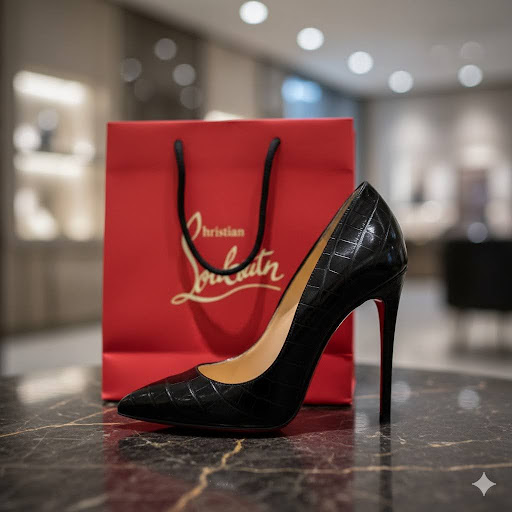
Imagine you are in an upscale store in Paris and your eyes come across an amazing pair of black heels with red soles. You see them before the brand is even on the market. That vivid red represents the highest quality of luxury and high fashion.
What happens when another designer takes on the same concept?
Is this inspiration, rivalry, or infringement of intellectual property rights?
For Christian Louboutin, the red sole is more than an embellishment; it’s one of the things that has made a difference in the brand’s immediate recognition. However, this otherwise simple fact comes with a tricky legal question: Is there a way for a fashion brand to claim ownership of a particular color, and does that ownership extend to all of Europe?
FLJ Insider Pro is open: live fashion law jobs and internships, five career guides and two roadmaps. Early bird USD 12/month. See what's inside
Fashion moves easily between cities such as Paris, Milan, London, and Amsterdam. However, legal systems don’t always move in the same way. Although the European Union has developed uniform standards for intellectual property rights, the international legal framework in the UK post-Brexit complicated things even more.
The case of the red sole is an example of how fashion’s creative expression conflicts with legal parameters.
The Red Sole That Went to Court
So things got quite interesting in Christian Louboutin and Christian Louboutin SAS v Van Haren Schoenen BV (C-163/16) (CJEU) on June 12, 2018.
The whole issue started in the Netherlands when Louboutin went up against a retailer named Van Haren for selling high-heeled shoes with red soles.
What was at the core of the legal battle was a seemingly simple question: Was Louboutin trying to preserve the shape of the shoe or just the red color on its sole? Why does it matter?
Well, European trademark law has certain rules for certain shapes, especially shapes that add value to products, protecting those shapes.
The Court of Justice of the European Union (CJEU) eventually ruled that the trademark wasn’t only about shape as defined by relevant laws. Instead, it recognized that the red color adorned the sole, but it was clear where this color appeared based on the shoe’s outline.
In other words, the court made a very clear distinction between the shape of a shoe and the color of part of it.
But don’t get too carried away. This ruling doesn’t mean every shoe with a red sole automatically violates Louboutin’s rights. That trademark is broad and valid, and any context around possible infringements still matters
One Red Sole, Two Routes to Protection
Let’s imagine a fashion brand to protect its distinctive design in all European countries. Should it go for one trade mark that covers the entire EU or register its mark in each country separately?
The European Union has two options: an EU trade mark is registered through the European Union Intellectual Property Office (EUIPO) and typically includes all EU Member States. On the other hand, a national trade mark has protection only in the country where it is filed.
You can think of an EU trade mark as one big umbrella covering the whole EU, while national trade marks are individual umbrellas that protect specific markets.
For a brand selling shoes across France, Italy, Germany and Spain, an EU-wide registration might be appealing. But a smaller designer focusing mainly on Italy might prefer national protection.
There is no one-size-fits-all solution for any business; what is good for every business depends on where the brand is operating, what’s the right price for that brand to spend, and what kind of protection they want from their clients.
Here’s the twist! Even if laws are uniform across countries, there are special little things in each case. A brand needs to lay out its rights and why the law should stop a competitor from using its branding.
Just having a well-known logo or that iconic red sole isn’t enough to guarantee protection!”
Can Anyone Own a Colour?
Imagine this.
A young designer is starting off her new line. She creates beautiful red-soled heels, not to copy Louboutin or anything, but because that red just fits perfectly with what she’s got going on.
There is the tricky question: can one brand actually stop another from using the same color?
That is where trademark law has to tread carefully.
Companies need protection on one hand, but not on the other side of that. If customers start to associate a specific sign with one particular business, competitors should not just swoop in and take advantage of that connection unfairly.
On the flip side, colors appear in fashion’s common language. Red, black, white, gold, and silver are everywhere. Letting one brand have too much control over a color could really complicate things for other designers.
In Europe, trademark law allows color protection if certain legal circumstances are met. The color should be such that it is able to differentiate one company’s products from another’s and should satisfy certain rules on representation and distinctiveness.
Sometimes it is crucial to show that consumers associate a particular color with a brand.
The main takeaway is this: just because you’re known for a color doesn’t mean you own every possible use of it.
For me, that’s the most interesting part of the whole red-sole discussion. Fashion thrives on recognizable trademarks but also on creative freedom. The law should safeguard genuine brand identities without turning commonly used colors into someone’s personal playground.
Brexit: When the Legal Runway Splits in Two
For fashion brands, Brexit was a game changer not only for shipping logistics and customs forms but also for the way that trademark protection works between the UK and the EU.
Prior to Brexit, trademarks registered in the EU automatically covered the UK as part of the EU framework. But once the transition period concluded on December 31, 2020, such EU trademarks would no longer automatically have protection in the UK as they do for other EU countries. Instead, existing registrations would be converted into equivalent UK trademarks.
Now, if a brand wants to protect its name in both regions, it has to think about getting separate registrations for the EU and the UK.
Just a luxury shoe brand launching a new line at the same time in Paris and London, its marketing might be spot on in both cities, and its shoes could be identical down to those iconic red soles. But when it comes to legal matters, they have to navigate two different systems.
The UK has its own trademark laws under the Trade Marks Act 1994. While UK law and EU trademark regulations have many similarities, each system needs to be assessed on its own.
So what is the takeaway from Brexit? A fashion brand can have a global presence without relying on one all-encompassing intellectual property right.
Same Shoes, Different Courtroom?
Paris to Amsterdam: The EU-wide dispute
So a competitor decides to start selling red-soled heels across several EU countries. Louboutin could lean on its EU trademark, but how it all plays out hinges on the details of that registration and whether the legal criteria for infringement are met.
Milan: The National Dispute
In one EU country, a designer is using a national trademark. And this is where the court is able to assess that local right and the harmonized EU regulations at work. But remember the details of the evidence and context still matter.
London: The Post-Brexit Dispute
In the UK, the retailer has some similar heels on offer. The claimant needs to prove their relevant UK rights and evaluate any infringement according to UK law. Just having an EU registration is not enough; they also need to consider what protections exist in the UK.
These situations illustrate a key point: shoes may not change when crossing borders, but the legal issues they generate do.
Fashion brands need to look beyond what’s trending on the runway, I think. And a smart design approach should be paired with an equally wise intellectual property strategy.
Should Fashion Brands Be Allowed to Own Their Signature Look?
Designers go back to classic shapes, colors, patterns, and styles. If intellectual property rights are too broad, they may actually stifle the very creativity they’re supposed to support.
Trademarks can be renewed forever as long as certain conditions are met. And registered designs protect how a product looks under different legal rules and for a set amount of time.
This distinction is important. A brand’s identity, the look of a shoe, and its technical features may need different kinds of protection.
Louboutin should have the right to protect its red sole when it is an important brand identifier. But that shouldn’t turn into an unrestricted claim over all red shoes.
After all, fashion would be pretty boring if every designer had to seek approval before using a common colour.
Fashion Has No Borders, but the Law Still Does
In this case, the conversation really goes on beyond a single pair of shoes.
Fashion is creativity, reinvention, and inspiration. Designers go back to classic shapes, colors, patterns, and styles. If intellectual property rights are too broad, they may actually stifle the very creativity they’re supposed to support.
Trademarks can be renewed forever as long as certain conditions are met. And registered designs protect how a product looks under different legal rules and for a set amount of time. This distinction is important. A brand’s identity, the look of a sho,e and its technical features may need different kinds of protection.
Louboutin should have the right to protect its red sole when it is an important brand identifier. But that shouldn’t turn into an unrestricted claim over all red shoes. After all, fashion would be pretty boring if every designer had to seek approval before using a common colour.
The issue for courts is balancing genuine brand recognition with the need to prevent established fashion brands from gaining an unfair leg up on new designers.
FASHION LAW JOURNAL INSIDER
Join designers, brand founders and fashion lawyers who get the biggest brand battles, IP fights and career moves in fashion law, straight to their inbox.