No member of the Cartier family owns Cartier. The Paris jeweller founded in 1847 is a wholly owned part of Compagnie Financière Richemont SA, a Swiss group whose shares trade on the SIX Swiss Exchange but whose votes are controlled by a partnership led by South African billionaire Johann Rupert. Who owns Cartier, then, has two answers: the company that holds the business, and the family that controls the company. This guide follows that chain using Richemont’s 2026 annual report, lists the group’s maisons and explains why the structure matters to anyone suing, licensing or selling in Cartier’s name.
Short answer: Cartier is owned by Compagnie Financière Richemont SA, the Swiss luxury group, which holds it through wholly owned subsidiaries. Richemont is publicly listed, but Compagnie Financière Rupert, the partnership led by chairman Johann Rupert, held 50.60% of the votes and only 10.18% of the capital at 31 March 2026. Public investors own most of the capital but do not control the company.
Key takeaways
- Richemont’s 2026 accounts list Société Cartier, Cartier et Compagnie and Cartier Limited among its subsidiaries, each with a 100% effective interest.
- Compagnie Financière Rupert owns 537,582,089 ‘B’ shares and 6,418,850 ‘A’ shares. Richemont’s directors name it as the group’s controlling party.
- The four Jewellery Maisons, led by Cartier and Van Cleef & Arpels, made €16.5 billion of the group’s €22.4 billion sales in the year to March 2026. Richemont does not publish Cartier’s own figure.
- Richemont sold Baume & Mercier to the Damiani Group in 2026 and was reported in October 2026 to be in talks to join a bid for De Beers.
Who owns Cartier?
Compagnie Financière Richemont SA does. The 2026 annual report names Cartier as one of four Jewellery Maisons, and its list of principal group companies shows the legal entities underneath. In France these are Société Cartier, Cartier et Compagnie and Cartier Joaillerie International SAS. In Britain it is Cartier Limited, and in the Netherlands Cartier Europe B.V. All are shown at 100.0% effective interest, so there is no outside minority in those companies.
Richemont itself has its registered office in Bellevue, Geneva. Its shares are listed on the SIX Swiss Exchange and included in the Swiss Market Index, and its ‘A’ shares have a secondary listing on the Johannesburg Stock Exchange. FLJ’s brand case study of Cartier covers the house’s early history and its famous designs.
FLJ Insider Pro is open: live fashion law jobs and internships, five career guides and two roadmaps. Early bird USD 12/month. See what's inside
How did the Rupert family end up with Cartier?
Through tobacco. Anton Rupert’s South African group Rembrandt licensed cigarette brands from Rothmans and then invested in it, and Rothmans went on to take stakes in Dunhill and Cartier, according to the company history published on Encyclopedia.com. Cartier had by then been out of family hands for some years. The three branches of the business, in Paris, London and New York, were sold by the family’s heirs and put back together in the 1970s by a group of investors around Robert Hocq and Joseph Kanoui, who later led Vendôme.
| Year | What happened |
|---|---|
| 1847 | Louis-François Cartier puts his name on a Paris workshop |
| 1972 to 1976 | Investors around Robert Hocq and Joseph Kanoui buy Cartier Paris, then London (1974) and New York (1976) |
| 1979 | Cartier Monde is formed to unite the three houses |
| 1988 | Johann Rupert founds Compagnie Financière Richemont by spinning off international assets from Rembrandt Group |
| 1993 | Luxury holdings, including Cartier and Dunhill, move into the new UK-listed Vendôme Luxury Group; tobacco becomes Rothmans International |
| 1998 | Richemont buys out Vendôme’s minority shareholders and takes 100% |
| 1999 | Rothmans merges with British American Tobacco; Richemont buys 60% of Van Cleef & Arpels |
The later years are set out in Richemont’s own history page. It shows a tobacco and luxury holding turning, over two decades, into a pure luxury group. The exit from pay television and the run-down of its British American Tobacco interest began in 2000, and non-core investments were moved into Reinet Investments in 2008.
Who controls Richemont?
Richemont has two classes of share, issued in equal number, and the design is the whole point. There are 537,582,089 ‘A’ shares with a par value of CHF 1.00 and 537,582,089 ‘B’ shares with a par value of CHF 0.10. The ‘A’ shares are the listed ones. The ‘B’ shares are unlisted, and dividends follow the par value, so one ‘A’ share earns the same as ten ‘B’ shares. The holdings disclosed in the accounts fit one vote per share, which is why a holder of every ‘B’ share has half the votes for about a tenth of the capital.
| Holder at 31 March 2026 | ‘A’ shares | ‘B’ shares | Capital | Votes |
|---|---|---|---|---|
| Compagnie Financière Rupert | 6,418,850 | 537,582,089 | 10.18% | 50.60% |
| Parties associated with Johann Rupert and Compagnie Financière Rupert | 2,921,335 | None disclosed | Not stated | 0.27% |
Compagnie Financière Rupert is a Swiss partnership limited by shares, based at Bellevue, Geneva. Johann Rupert is its general managing partner, and Anton Rupert, a non-executive director of Richemont, is a partner. Note 38 to the accounts states the position plainly: the directors regard it as the group’s controlling party. In practice, a takeover of Richemont would need his agreement.
The structure has been tested once in public. At the annual meeting in September 2022, activist investor Bluebell asked ‘A’ shareholders to back former LVMH executive Francesco Trapani for their board seat and to give the two share classes equal board representation. Reuters reported that sitting director Wendy Luhabe won 83.97% of the ‘A’ share vote against 9.5% for Trapani, and that the governance proposals failed.

Which maisons does Richemont own?
The table uses the segments in the 2026 report. Baume & Mercier was still listed there at 31 March 2026, but the sale to the Damiani Group was announced as complete on 1 July 2026, so it is left out. Sales are for the year to 31 March 2026 and include Baume & Mercier in the watch segment.
| Segment | Maisons | Sales | Operating result |
|---|---|---|---|
| Jewellery Maisons | Buccellati, Cartier, Van Cleef & Arpels, Vhernier | €16.5bn | €5.0bn profit (30.5% margin) |
| Specialist Watchmakers | A. Lange & Söhne, IWC Schaffhausen, Jaeger-LeCoultre, Panerai, Piaget, Roger Dubuis, Vacheron Constantin | €3.1bn | €107m profit (3.4% margin) |
| Other | Alaïa, Chloé, Delvaux, dunhill, G/FORE, Gianvito Rossi, Montblanc, Peter Millar, Purdey, Serapian, Watchfinder | €2.7bn | €96m loss |
Not every maison is held outright. Richemont shows a 70.0% effective interest in Gianvito Rossi S.r.l., with a put option liability over the remainder. It also no longer owns YOOX NET-A-PORTER: that business went to Mytheresa on 23 April 2025, leaving Richemont with 36% of the renamed LuxExperience B.V. For comparison with the other big groups, see FLJ’s guide to French luxury brands and the groups that own them.
How much of Richemont is Cartier?
Richemont does not say. Its accounts report jewellery as one segment, so any number for Cartier alone is an analyst’s estimate. What the full-year results do show is the weight of the segment. Group sales were €22.42 billion, about US$26.0 billion at the report’s average rate of €1 to US$1.16, and jewellery provided €16.54 billion, or about US$19.2 billion. That is nearly three quarters of sales. In the first quarter of the current year group sales rose 20% at constant rates to €6.33 billion, with jewellery up 24%. Interim results are due on 13 November 2026. FLJ looks at why the category has pulled ahead in luxury jewellery growth in 2026.
Who runs Cartier and Richemont?
Johann Rupert is Richemont’s chairman, Nicolas Bos is group chief executive and Burkhart Grund is chief finance officer. At Cartier, Louis Ferla succeeded Cyrille Vigneron as chief executive from 1 September 2024. Ferla had joined Richemont in 2001, worked at Cartier from 2006 and ran Vacheron Constantin from 2017.
Why does Cartier’s ownership matter legally?
It decides who sues. Enforcement runs through the group, not through a Cartier shop. A trademark complaint filed in Massachusetts on 27 August 2026 against Victoria’s Jewelers names Richemont International SA, Van Cleef & Arpels and Cartier together as plaintiffs, according to the court docket. Those are allegations at this stage. Earlier wins include a judgment of about $37.4 million against a New York manufacturer in 2011, and a $150,000 order against a Florida retailer in 2019. FLJ covered another Cartier dispute in Société Cartier International AG v Goussin Jeweler.
It shapes the law itself. In Britain, Cartier International AG led the group of luxury brand owners in the website blocking case that reached the Supreme Court. In Cartier v British Telecommunications [2018] UKSC 28, the court held that rights holders should indemnify internet providers for the reasonable cost of carrying out blocking orders.
It tells counterparties who decides. A licensee, landlord or supplier may sign with a local subsidiary such as Cartier Limited or Richemont North America Inc., but the parent’s listing, reporting and governance rules sit above it. An investor buying Richemont ‘A’ shares buys a claim on the profits of Cartier without any route to control. That is a very different position from owning a stock in a company with a single share class. Other watch and jewellery houses take a different route again, as FLJ’s guide to who owns Audemars Piguet, Rolex and Patek Philippe shows.
Could any of this change? Control is not in question, but the portfolio keeps moving. On 15 October 2026 Reuters reported, citing a source, that Richemont was in talks to join a consortium bidding for Anglo American’s 85% stake in De Beers. Richemont did not comment and nothing has been agreed.
Frequently asked questions
Does LVMH own Cartier?
No. Cartier belongs to Compagnie Financière Richemont SA, a separate Swiss group. Richemont’s 2026 annual report lists the Cartier companies as subsidiaries with a 100% effective interest, and the Rupert partnership holds 50.60% of Richemont’s votes, so it has the last word on the group.
Is Cartier owned by a South African family?
In effect, yes, for control. Richemont was created in 1988 from the international assets of South Africa’s Rembrandt Group, and Johann Rupert leads the partnership that holds half of its votes. But that partnership owns only about 10.18% of the capital, and it is based in Switzerland.
Who is the CEO of Cartier?
Louis Ferla has been chief executive of Cartier since 1 September 2024, succeeding Cyrille Vigneron. He previously ran Vacheron Constantin, another Richemont maison. Nicolas Bos is the chief executive of the wider Richemont group and Johann Rupert is its chairman.
Does Richemont own Van Cleef & Arpels?
Yes. Richemont bought 60% of Van Cleef & Arpels in 1999, raised that to 80% in 2001 and took full ownership in 2003. It reports the house alongside Cartier, Buccellati and Vhernier in its Jewellery Maisons segment.
Can you buy shares in Cartier?
Not directly. Cartier is not listed on its own. The nearest route is Richemont’s ‘A’ shares, which trade on the SIX Swiss Exchange with a secondary listing in Johannesburg. Those shares cover the whole group, and they do not give their holders control of it.
Is Cartier French or Swiss?
Both, in different senses. The house was founded in Paris in 1847, and its main company, Société Cartier, is still French. Its parent, Richemont, is Swiss, and the partnership that controls Richemont is a Swiss entity led by a South African businessman.
This article is general information, not legal advice or investment advice. Shareholding figures are taken from Richemont’s Annual Report and Accounts 2026 and are as of 31 March 2026; they may have changed since. US dollar conversions use the report’s average rate for the year.
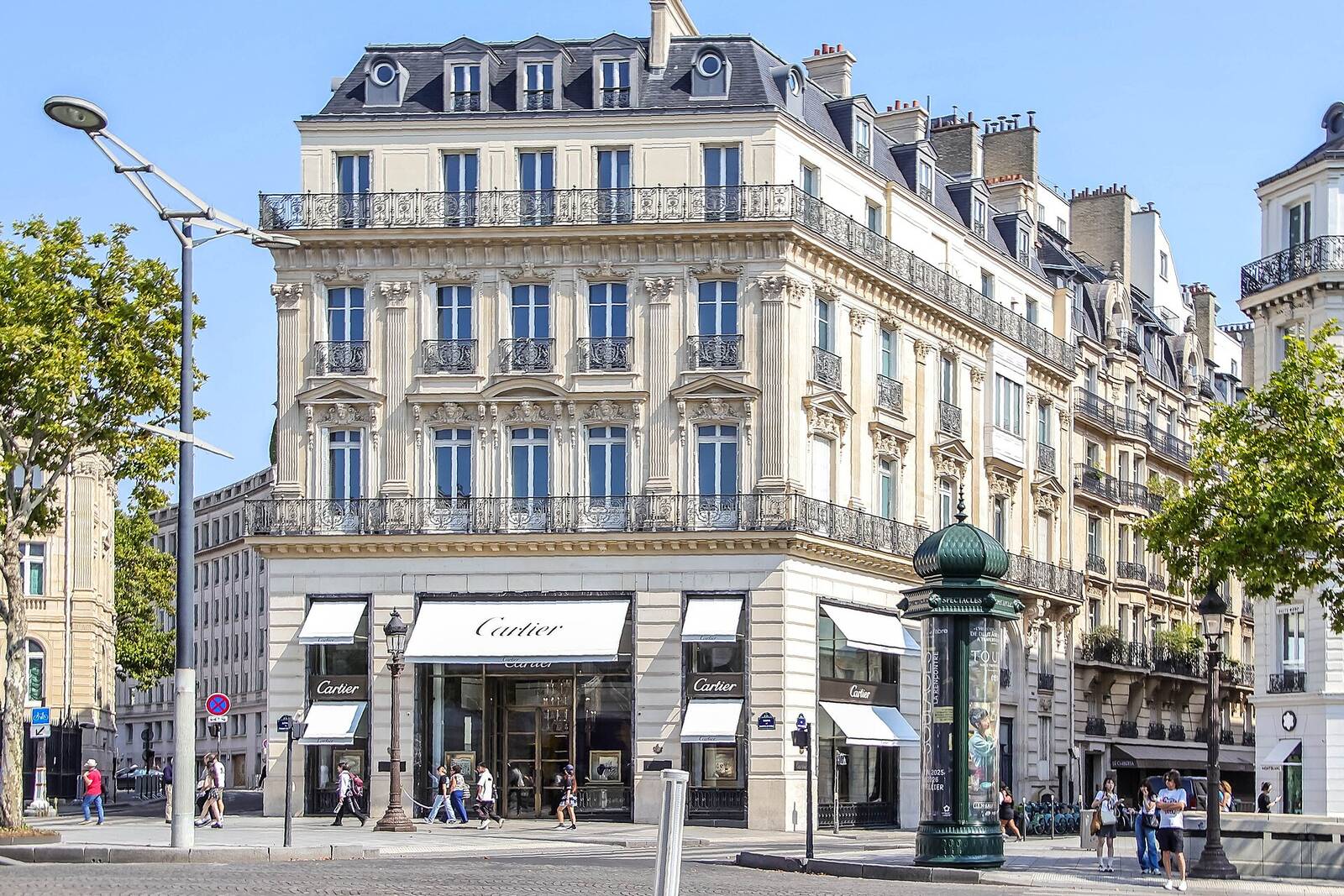
Featured image: Photo: Dr. Thomas Liptak via Wikimedia Commons, CC BY-SA 4.0
FASHION LAW JOURNAL INSIDER
Join designers, brand founders and fashion lawyers who get the biggest brand battles, IP fights and career moves in fashion law, straight to their inbox.