

Coco Chanel built one of the most valuable names in fashion and spent much of her life fighting over who owned it. The house she founded is now worth billions to a family she once tried to push out of her business, using laws that targeted Jewish property during the German occupation of France. Her story is usually told through the little black dress, the tweed suit and Chanel No. 5. This profile follows the contracts instead: the 1924 perfume deal, the wartime attempt to take it back, the 1947 settlement, the 1954 comeback that handed the whole house to the Wertheimer family, and the trade marks that still carry her name and initials.
Short answer: Coco Chanel (1883 to 1971) founded her house in Paris in 1910. In 1924 she licensed her name to Parfums Chanel, owned 70% by Pierre and Paul Wertheimer, keeping 10%. She tried to use wartime anti-Jewish laws to seize it, settled in 1947, and in 1954 the Wertheimers financed her comeback and took control of Chanel. The family still owns it.
Key takeaways
- Chanel opened Chanel Modes at 21 rue Cambon in 1910 and bought 31 rue Cambon in 1918, still the house’s address in Paris.
- The 1924 Parfums Chanel deal gave the Wertheimers 70%, Galeries Lafayette founder Théophile Bader 20% and Chanel 10%, a split she spent decades trying to change.
- Historians, including Hal Vaughan in 2011, have documented her wartime relationship with a German diplomat and her registration as an Abwehr agent.
- Since 1954 the Wertheimer family has controlled the Chanel name across all products; Alain and Gérard Wertheimer own the company today.
Who was Coco Chanel before the fashion house?
Gabrielle Chanel was born on 19 August 1883 in Saumur, in the Loire Valley, according to Encyclopaedia Britannica. Her parents were unmarried, and after her mother died she and her sisters were sent to an orphanage at Aubazine. As a young woman in Moulins she sang in a café, and a song about “Coco” is believed to be the source of her nickname, according to the Encyclopedia of Clothing and Fashion.
Two men gave her the start in business. The racehorse breeder Étienne Balsan let her use his Paris apartment to make hats from 1908, and her lover Arthur “Boy” Capel financed her first premises on rue Cambon. Capel died in a car accident in 1919. Chanel’s early business was her own; her most profitable product would not be.
FLJ Insider Pro is open: live fashion law jobs and internships, five career guides and two roadmaps. Early bird USD 12/month. See what's inside
How did the house of Chanel begin?
The house’s own timeline records that Chanel opened a hat boutique, Chanel Modes, at 21 rue Cambon in 1910, followed by a boutique in Deauville selling jersey sportswear and, in 1915, her first couture house in Biarritz. In 1918 she bought the building at 31 rue Cambon and moved her couture house there. Jersey, until then used mainly for men’s underwear, became her signature.
FLJ’s luxury brand study of Chanel covers the brand’s design legacy in more detail, including the pieces that followed in later decades, such as the 2.55 bag.
What was the 1924 Chanel No. 5 deal with the Wertheimers?
Chanel created No. 5 in 1921 with the perfumer Ernest Beaux, according to the house’s timeline. To sell it beyond her own boutiques, she needed a partner who could make and distribute it at scale. Théophile Bader, founder of the Galeries Lafayette department store, introduced her in 1922 to Pierre Wertheimer, who with his brother Paul ran Bourjois, then France’s largest cosmetics and fragrance maker.
The result, in 1924, was the Société des Parfums Chanel. According to the company history in the International Directory of Company Histories, the Wertheimers took 70%, Bader took 20% and Chanel received 10% for the use of her name. In legal terms, she had licensed her most valuable asset, her name, to a business she did not control.
| Year | Event | Effect on control of the Chanel name |
|---|---|---|
| 1910 | Chanel Modes opens at 21 rue Cambon | Chanel’s own business, built with Capel’s financial help |
| 1921 | Chanel No. 5 created with Ernest Beaux | Sold through Chanel’s own boutiques |
| 1924 | Société des Parfums Chanel founded | Wertheimers 70%, Bader 20%, Chanel 10% |
| 1935 | Chanel hires lawyer René de Chambrun to renegotiate | The Wertheimers block the attempt |
| 1940 to 1941 | Wertheimers leave for the US; Chanel invokes anti-Jewish property laws | Control had already passed to a non-Jewish proxy, so the attempt fails |
| 1947 | Settlement with Pierre Wertheimer | Chanel receives $400,000 and a 2% royalty; Parfums Chanel keeps the business |
| 1954 | Couture comeback financed by Pierre Wertheimer | Wertheimers secure rights to the Chanel name across all products |
| 1971 | Chanel dies at the Ritz in Paris | Wertheimer family owns the whole business |
How did Chanel try to use wartime laws to regain the perfume business?
Chanel resented the 1924 split for years, and in 1935 she hired the lawyer René de Chambrun to renegotiate it, without success. In 1939, at the start of the Second World War, she closed her couture house, keeping only the boutique at 31 rue Cambon open to sell perfume and accessories.
After France fell in 1940, the Wertheimers, who were Jewish, left for the United States. Under the occupation’s “Aryanisation” rules, Jewish-owned businesses could be taken out of their owners’ hands, and Chanel tried to use those rules to claim Parfums Chanel for herself, as AFP reported in a 2021 review of the record. The attempt failed because the brothers had already transferred control to a non-Jewish French businessman before leaving. In the US, the Wertheimers moved production of No. 5 to New Jersey, PRI’s The World reported, and when Paris was liberated, American soldiers queued outside 31 rue Cambon to buy it.
For a fashion lawyer, the episode is a lesson in how ownership structures protect a business. A pre-emptive transfer to a trusted third party, later reversed, kept the company out of reach of both the occupation authorities and its own licensor.
What is documented about Coco Chanel’s conduct during the war?
Chanel lived at the Hôtel Ritz in Paris from 1937, and stayed there when the Germans requisitioned it. During the occupation she had a relationship with Baron Hans Günther von Dincklage, an attaché at the German embassy who was 13 years younger and, according to AFP, a spy. Hal Vaughan’s 2011 book Sleeping with the Enemy, drawing on French, German, British, Italian and Polish archives, concluded that she was registered in 1941 as an agent of the Abwehr, German military intelligence, under the number F-7124 and the codename “Westminster”. He also described her part in a failed 1943 scheme to carry a peace message from senior SS officers to Winston Churchill through Madrid. Earlier biographies and reporting by L’Express in 1995 and Der Spiegel in 2008 had pointed in the same direction.
After the liberation of Paris in 1944 she was arrested and released within hours, reportedly after Churchill intervened, and soon left for Switzerland. She did not return to rue Cambon for almost a decade. The Wertheimer family, who own Chanel today, have denied that she was antisemitic and have said there is “an element of mystery” about what she did during the war, AFP reported.
What did the 1947 settlement give Chanel?
The quarrel over the perfume business outlasted the war. In 1947 Pierre Wertheimer settled it. According to the International Directory of Company Histories, he paid her $400,000 and a 2% royalty, and gave her limited rights to sell her own perfumes from Switzerland. In practice she stopped making perfume and received a monthly allowance. The settlement made her wealthy, but it left Parfums Chanel, and the commercial use of her name in perfume, firmly with the Wertheimers.
How did the 1954 comeback put the whole house in Wertheimer hands?
Chanel reopened her couture house with a show on 5 February 1954. Much of the press criticised the show, but the American press received it well, and the tweed suit, the 2.55 bag and the two-tone pump followed within a few years. Pierre Wertheimer financed the comeback. In return, the Wertheimers secured the rights to the Chanel name for all products, not only perfume, and later bought back Bader’s 20% stake. The South China Morning Post describes the arrangement as Pierre taking full control of Chanel in exchange for paying her bills and taxes for the rest of her life.
So the woman who had fought for thirty years to win back her name ended by selling the rest of it, on terms that let her design until the end. She died on 10 January 1971, in her suite at the Ritz, while preparing her spring collection.
Who owns Chanel today, and how does it protect the name and the CC logo?
Chanel is privately owned by the brothers Alain and Gérard Wertheimer, Pierre’s grandsons, who took over in the 1970s. In May 2026 the company reported 2025 revenue of $19.3 billion, up 2% at constant currency, and operating profit of $4.7 billion, Reuters reported. Leena Nair is chief executive and Matthieu Blazy, who showed his first collection in October 2025, is creative director. FLJ’s guide to French luxury brands and the groups that own them sets Chanel alongside the other French houses and their owners.
The Chanel name and the interlocking double C monogram are registered trade marks, including in France, and the company enforces them hard. In February 2024 a US jury found the reseller What Goes Around Comes Around liable on all of Chanel’s claims over its use of Chanel trade marks and awarded Chanel $4 million, Fashion Dive reported; FLJ covers the case in Chanel v WGACA. Not every fight succeeds. In April 2021 the EU General Court rejected Chanel’s opposition to a Huawei logo, holding that the two interlocking-curve marks had to be compared as registered and were not similar. The bottle of No. 5 has its own design protection history, covered in FLJ’s piece on Chanel No. 5 and perfume bottle designs.
Frequently asked questions
When was Coco Chanel born and when did she die?
She was born Gabrielle Chanel on 19 August 1883 in Saumur, France, and died in Paris on 10 January 1971, aged 87, in her suite at the Hôtel Ritz.
Did Coco Chanel own Chanel No. 5?
She created it with Ernest Beaux in 1921, but from 1924 it was made and sold by Parfums Chanel, in which she held 10%. The Wertheimers held 70% and Théophile Bader 20%.
Who owns Chanel now?
Chanel is privately owned by Alain and Gérard Wertheimer, grandsons of Pierre Wertheimer, Chanel’s partner in the 1924 perfume company. It is not listed on any stock exchange.
Was Coco Chanel a Nazi agent?
Archival research published by Hal Vaughan in 2011 found she was registered as Abwehr agent F-7124, codenamed “Westminster”, and took part in a failed 1943 peace mission. She was arrested briefly in 1944 and then moved to Switzerland.
Why did the Wertheimers end up owning the whole house?
Pierre Wertheimer financed Chanel’s 1954 comeback. In exchange, the family secured the Chanel name for all products and took control of the house, while paying her expenses for life.
What does the interlocking CC logo mean legally?
It is a registered trade mark that Chanel uses against counterfeits and misleading resale, as in the 2024 WGACA verdict. It does not stop every logo built from interlocking curves, as the 2021 Huawei case in the EU General Court showed.
This profile summarises published historical and legal sources as of 9 November 2026. Accounts of Chanel’s wartime conduct rely on archival research that continues to be debated, and nothing here is legal advice.
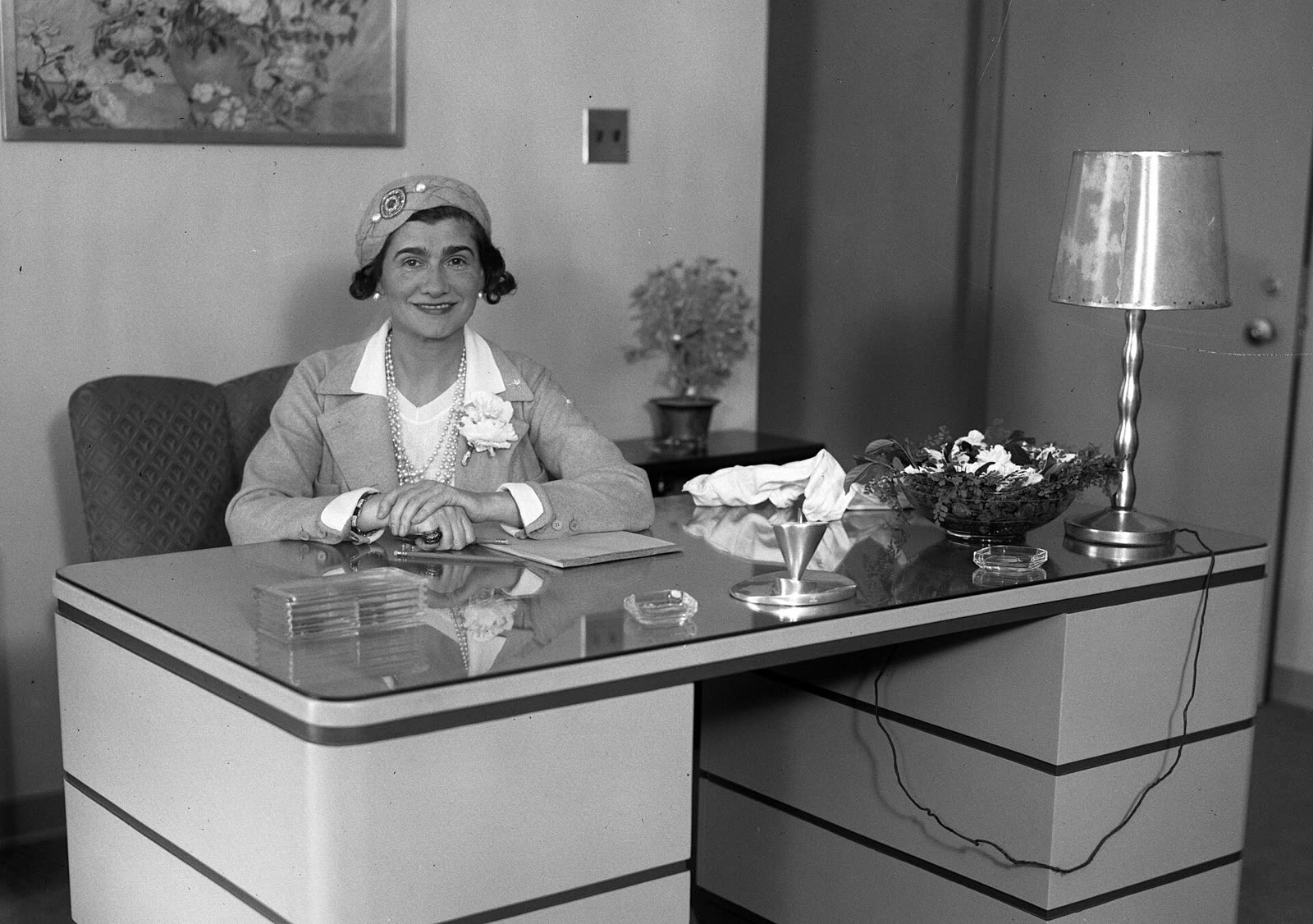
Featured image: Photo: Los Angeles Times via Wikimedia Commons, CC BY 4.0
FASHION LAW JOURNAL INSIDER
Join designers, brand founders and fashion lawyers who get the biggest brand battles, IP fights and career moves in fashion law, straight to their inbox.