


Can a brand own the words fashion uses to describe its own calendar? The EU General Court has said no, at least when the words are “mid season”. In a judgment delivered on 7 October 2026 in Milestone Sportswear Handels GmbH v EUIPO (Case T-9/26), the Court annulled a decision of the EU Intellectual Property Office (EUIPO) that had kept alive a trademark for the slogan “MID season For When It’s Not Quite Cold Not Quite Warm”, registered for clothing, bags and fashion retail.
The Seventh Chamber (Judges Kecsmár, Nihoul and Truchot) found that EUIPO’s Second Board of Appeal had misread what “mid season” means to people who buy and sell clothes, and that this mistake undermined its whole assessment of the mark.
Quick answer: On 7 October 2026, the EU General Court annulled EUIPO’s decision upholding the trademark “MID season For When It’s Not Quite Cold Not Quite Warm” (Case T-9/26, Milestone Sportswear v EUIPO). The Court held that “mid season” is a recognised fashion term for clothing worn in spring and autumn, so the slogan describes the goods and lacks distinctive character. The mark is not cancelled yet: EUIPO must now decide the invalidity application again.
- Court: EU General Court, Seventh Chamber
- Decision date: 7 October 2026
- Parties: Milestone Sportswear Handels GmbH v EUIPO, with mark owner John Peter Srl intervening
- Goods: Clothing, leather goods and fashion retail (Classes 18, 25 and 35)
- Outcome: EUIPO Board of Appeal decision R 239/2025-2 annulled
The mark at the centre of the dispute
The contested sign is an EU figurative mark filed on 2 December 2022 and owned by John Peter Srl, an Italian company based in Asti. It shows the word “MID” in heavy capitals above the word “season”, with two arrows pointing inwards between them, and the tagline “For When It’s Not Quite Cold Not Quite Warm” set underneath.
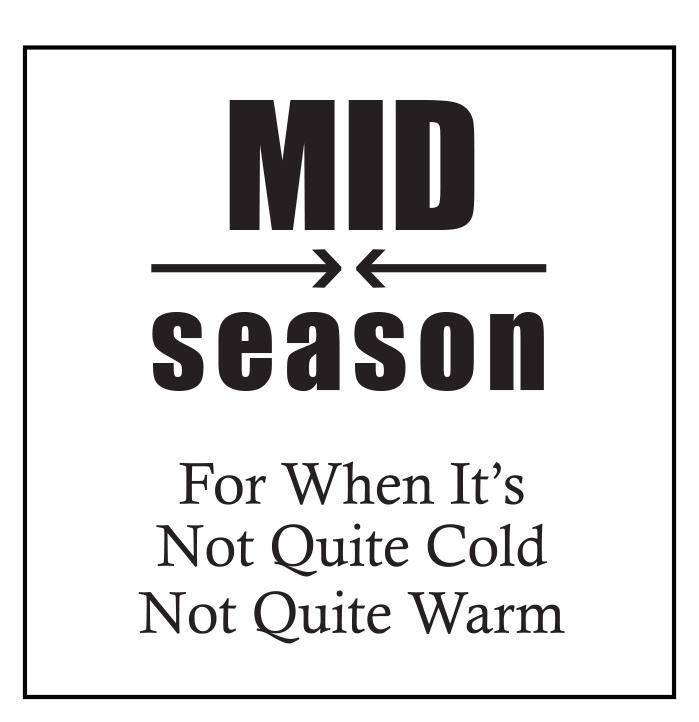
The registration is broad. It covers leather goods in Class 18, including handbags, cross-body bags, wallets, purses, briefcases and suitcases; clothing in Class 25, including jackets, coats, raincoats, fur and leather garments, trousers, skirts, shoes, gloves and hats; and, in Class 35, retail, online retail and wholesale services for clothing and leather accessories.
How the case reached the General Court
On 18 December 2023, Milestone Sportswear, a company based in Lenting, Germany, asked EUIPO to declare the mark invalid. It relied on two absolute grounds under the EU Trade Mark Regulation: that the mark was descriptive of the goods and services (Article 7(1)(c)) and that it lacked distinctive character (Article 7(1)(b)).
Milestone lost twice at EUIPO. The Cancellation Division rejected its application on 31 January 2025. On appeal, the Second Board of Appeal dismissed the case on 12 November 2025 (R 239/2025-2). The Board held that “mid season” had no specific meaning in the clothing sector and would be read literally as the “middle of the spring, summer, autumn and winter”. Even with the tagline, the Board said, the mark was at most allusive, and so it was capable of identifying the trade origin of the goods.
Before the General Court, EUIPO and John Peter Srl defended that outcome. EUIPO argued that the phrase was so “impenetrable and opaque” that the public could not take any concrete descriptive meaning from it, and that Milestone had not proved that the fashion trade actually uses “mid season” to mean clothing for the period between summer and winter.
What the Court decided
The test. The Court restated the familiar rule: a sign is descriptive if it has a sufficiently direct and concrete link to the goods so that consumers immediately, and without further thought, see in it a description of the goods or one of their characteristics (para 17). Descriptive terms must stay free for all traders to use (para 18). Importantly, a sign must be refused if at least one of its possible meanings describes the goods (para 19). The relevant public was the English-speaking general public in the EU, together with trade professionals in clothing and leather goods retail (para 21).
The evidence. That last point decided the case. Milestone had filed dictionary definitions and numerous extracts from websites showing that “mid season” is commonly used in fashion for clothing and accessories suited to changing weather in transitional periods, such as spring and autumn, when it is cooler than summer but warmer than winter (paras 29 and 30). Having seen that material, the Board “was not entitled to disregard” this meaning (para 31).
The tagline. The words “For When It’s Not Quite Cold Not Quite Warm” did not rescue the mark. The Court held that they refer “implicitly but unequivocally” to weather that is neither very hot nor very cold, something English speakers would understand at once (para 32). If anything, the tagline confirmed the descriptive reading of “mid season”.
The result. By finding that “mid season” had no specific meaning in fashion, the Board “committed an error of assessment” (para 33). That error also infected its analysis of the link between the mark and the goods, so the Board infringed Article 7(1)(c) (paras 34 and 35). Because the Board’s finding of distinctiveness rested on the same wrong reading, it also infringed Article 7(1)(b) (paras 42 to 45). Both of Milestone’s pleas succeeded and the decision was annulled in full.
What happens next
The judgment does not cancel the trademark by itself. Milestone also asked the Court to declare the mark invalid, but the Court said it has no power to make that kind of declaratory ruling when reviewing EUIPO decisions (para 11). The case now goes back to EUIPO, which must decide Milestone’s invalidity application again in line with the Court’s reasoning. Given the findings on both grounds, John Peter Srl faces an uphill task in keeping the registration.
On costs, EUIPO and John Peter Srl must each bear their own costs and each pay half of Milestone’s.
The losing parties can still appeal to the Court of Justice on points of law, within two months and ten days of notification. However, appeals in EU trademark cases that have already been through an EUIPO Board of Appeal go forward only if the Court of Justice first allows them, and permission is granted only for issues significant to EU law.
What this means for brands
- Seasonal and weather words make weak brands. Terms like “mid season”, “transitional”, “trans-seasonal” or “all weather” tell shoppers when or how to wear a product. If you are choosing a label name, start with our guide to trademark vs copyright for fashion brands. EU trademark law keeps such terms free for every trader (see why fashion brands need international IP protection), and registrations built on them are open to challenge years later.
- One descriptive meaning is enough. It does not help that a phrase could also be read some other, non-descriptive way. If one plausible meaning describes the goods, the mark is at risk.
- Trade usage evidence wins invalidity cases. Milestone succeeded because it showed, with website extracts and dictionary definitions, how the industry actually uses the phrase. Brands challenging a competitor’s descriptive mark should build that record at the Cancellation Division stage, as material filed for the first time before the General Court may not be considered.
- A tagline can hurt, not help. Adding an explanatory slogan reinforced the descriptive message here instead of adding distinctiveness.
- Freedom to use descriptive language. Brands that use “mid season” on collections, hangtags, product pages or campaigns to describe what they sell can take comfort from this ruling, although each use should still be checked in its own context.
Frequently asked questions
What did the EU General Court decide in the MID season case?
On 7 October 2026, in Case T-9/26, the General Court annulled the EUIPO Board of Appeal decision that had upheld the EU trademark “MID season For When It’s Not Quite Cold Not Quite Warm”. It found the Board wrongly ignored that “mid season” is a fashion term for clothing suited to spring and autumn.
Is the MID season trademark cancelled?
Not yet. The General Court cannot declare a mark invalid itself. The case goes back to EUIPO, which must decide Milestone Sportswear’s invalidity application again in line with the judgment.
Who owns the MID season trademark?
The EU figurative mark, filed on 2 December 2022, is owned by John Peter Srl, an Italian company based in Asti. It covers leather goods, clothing and fashion retail services in Classes 18, 25 and 35.
Why was “mid season” considered descriptive?
Evidence showed the fashion industry commonly uses “mid season” for clothing worn in transitional seasons. Under EU law, a sign is refused if at least one of its possible meanings describes the goods, and the tagline about weather that is not quite cold or warm reinforced that meaning.
Can a slogan be registered as an EU trademark?
Yes, but only if consumers see it as an indication of commercial origin. A slogan that simply describes the goods, their purpose or when to use them lacks distinctive character and can be refused or declared invalid.
Can the judgment be appealed?
Yes, to the Court of Justice on points of law within two months and ten days of notification, but only if the Court of Justice first allows the appeal to proceed.
Related reading on FLJ
- Sneaker Wars: trademarks, designs and the battle for brand identity
- Word mark vs logo mark: why fashion brands trademark both
- TM vs ® symbol: when a fashion brand can use each
Source: Judgment of the General Court (Seventh Chamber), 7 October 2026, Milestone Sportswear Handels GmbH v EUIPO, Case T-9/26. Full text on EUR-Lex.
FASHION LAW JOURNAL INSIDER
Join designers, brand founders and fashion lawyers who get the biggest brand battles, IP fights and career moves in fashion law, straight to their inbox.