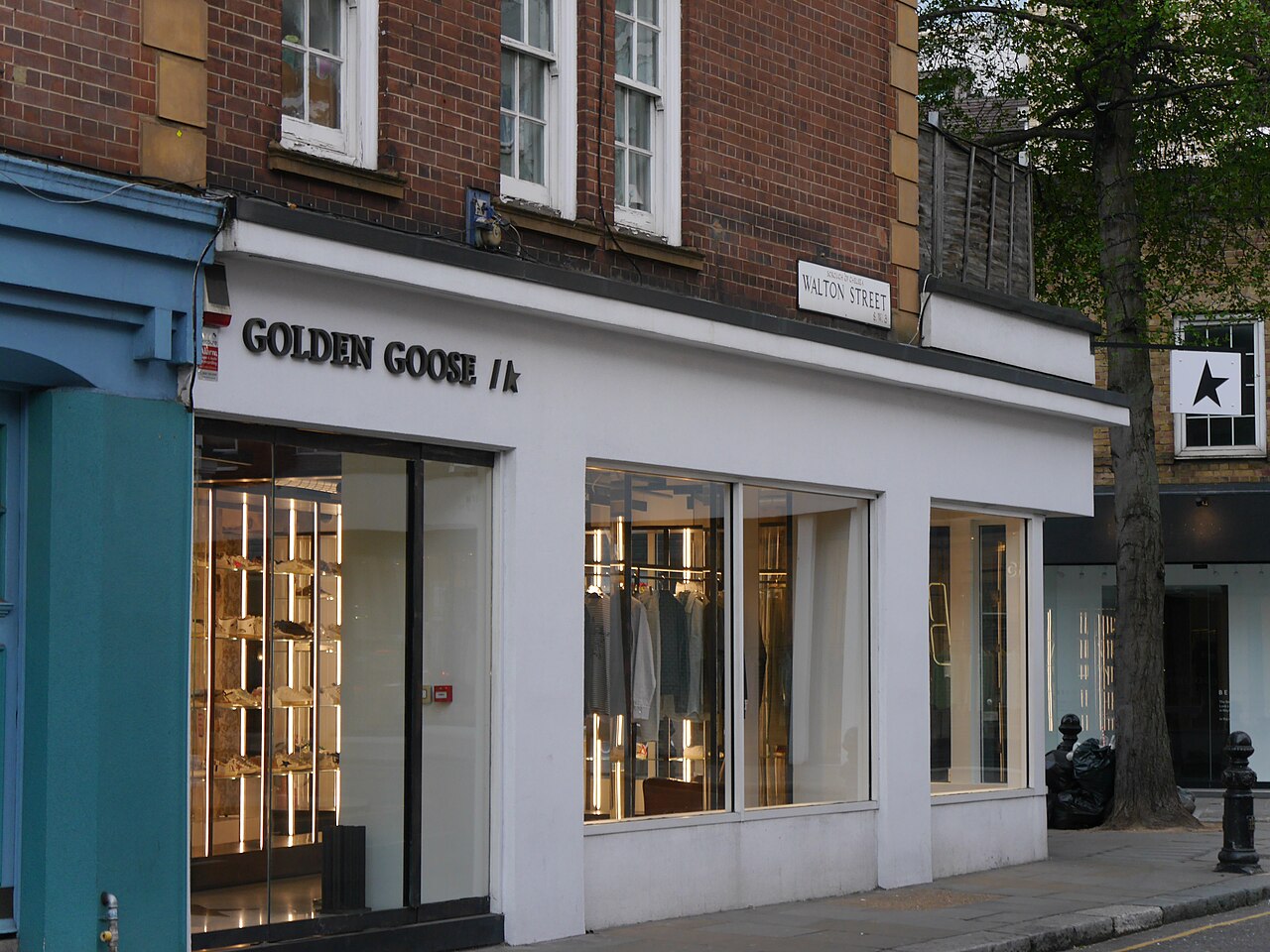
Golden Goose built a luxury business on sneakers that look as if they have already been worn for a year. Scuffed toes, a greyed rubber sole, a slightly crooked star on the side and a hand-written feel to the heel. That look sells at several hundred dollars a pair, which is exactly why Golden Goose dupes are everywhere, from fast fashion sites to marketplace listings promising the “same vibe” for a fraction of the price. Some of those shoes are perfectly legal. Others cross into trade mark infringement or plain counterfeiting. The difference rarely turns on the distressing itself and almost always turns on the star, the overall combination of features, and how the product is marketed.
Short answer: Golden Goose dupes are legal when they copy only the general idea of a pre-worn, low-top sneaker without the brand’s star, name or a confusingly similar overall design. They become infringing when they use a star like Golden Goose’s registered side star, copy enough distinctive features to confuse buyers, or are sold using the brand’s name and logos.
Key takeaways
- Golden Goose holds a US registration (No. 6,811,856) for a five-pointed star on the side of a shoe, registered in 2022 on the basis of acquired distinctiveness.
- A broader application for its tilted, cut-off star has been stuck in a Skechers opposition since 2018, with Skechers arguing the star is ornamental and aesthetically functional.
- Under Wal-Mart v. Samara Brothers, an unregistered product design is protected in the US only if it has acquired secondary meaning, and the distressed finish alone is a hard case to win.
- In the EU, a new and individual sneaker design can be protected as a registered or unregistered EU design, which is often the stronger tool against close copies.
What are Golden Goose dupes?
A dupe is a cheaper product that imitates the look of a more expensive one without, in theory, pretending to be it. Golden Goose dupes usually borrow the low-top leather silhouette, the deliberately dirtied sole and toe, contrast heel tab and a star or similar shape on the side. A counterfeit is different: it carries the brand’s own name or logo, or a mark so close to it that buyers are meant to think it is genuine. FLJ’s explainer on what a dupe is and when dupes break the law sets out the general line, and dupes vs counterfeits covers the criminal side.
The distressing is the feature most dupe sellers advertise, and it has an origin story. On its Super-Star story page, Golden Goose says that by 2007 the company had existed for seven years without making sneakers, and that its founders took the worn-out look of Los Angeles skate shoes as the starting point. They used a second-hand pair bought at the Pasadena Flea Market as a prototype and recreated the wear in their studio in Marghera, Italy. The brand says each Super-Star takes four hours to craft by hand.
FLJ Insider Pro is open: live fashion law jobs and internships, five career guides and two roadmaps. Early bird USD 12/month. See what's inside
What does Golden Goose actually own in the US?
The clearest right is the star. The USPTO record for Registration No. 6,811,856, owned by Golden Goose S.p.A., covers footwear in Class 25 and describes the mark as a five-pointed star placed on the side of a shoe, with most of the top point cut off where the upper meets the throat and the bottom tip cut off where the upper meets the sole. It was registered on 9 August 2022 with a claim of acquired distinctiveness in whole, which means the USPTO accepted evidence that buyers see the star as a sign of Golden Goose rather than mere decoration. The record gives 2007 as the date of first use.
A second, broader filing has had a harder time. Application Serial No. 79/218,875, filed on 10 August 2017 through the Madrid system, covers “a tilted five-pointed star with the top point cut off and the tip of the lower right point cut off” for bags in Class 18 and clothing and footwear in Class 25. It was published on 16 January 2018 and has been the subject of an opposition at the Trademark Trial and Appeal Board ever since. When FLJ checked the USPTO record on 24 October 2026 it still showed the opposition as pending.
The opponent is Skechers. In a TTAB brief filed on 11 July 2025 in Opposition No. 91242446, Skechers argued that stars are common decorative motifs on shoes, that Golden Goose’s star is a minor variation on a basic five-pointed star, and that the shape is aesthetically functional because tilting a star and cutting off points lets a brand fit a larger star on the side panel. Whatever the board decides, the fight shows the weak point of any dupe defence: a star that sits where Golden Goose’s sits and looks like it is the riskiest thing a copier can add.
When does a sneaker look become trade dress?
Trade dress is the overall look of a product or its packaging, protected under section 43(a) of the Lanham Act even when it is not registered. For a product’s own design, the Supreme Court set a high bar in Wal-Mart Stores v. Samara Brothers, decided unanimously on 22 March 2000. The case concerned children’s seersucker outfits copied by Wal-Mart, and the Court held that “a product’s design is distinctive, and therefore protectible, only upon a showing of secondary meaning”. In other words, the brand must prove that buyers associate the design itself with a single source.
The brand also carries the burden on functionality. Section 43(a)(3) of the Lanham Act says that for unregistered trade dress, the person claiming protection must prove the matter is not functional. For more on how fashion brands use this tool, see FLJ’s guide to trade dress in fashion.
Golden Goose knows these rules from the other side. In August 2023, New Balance sued Golden Goose in the US District Court for the District of Massachusetts, alleging that the Golden Goose Dad-Star sneaker copied the trade dress of New Balance’s 990, a model launched in 1982, Fashion Dive reported. Golden Goose moved to dismiss in November 2023, arguing that New Balance had no registration for the claimed trade dress and had to show the features were non-functional and identified source. New Balance agreed to dismiss the case in April 2024, so there was no ruling on the merits.
Is the distressed, pre-worn look aesthetically functional?
That is the hardest question for any brand trying to own a finish. In Qualitex v. Jacobson Products (1995), the Supreme Court said a feature is functional, and cannot serve as a trade mark, if it is essential to the use or purpose of the article or affects its cost or quality, that is, if exclusive use would put competitors at “a significant non-reputation-related disadvantage”. Aesthetic functionality applies that idea to looks that consumers want for their own sake.
A pre-worn finish is a style that many brands have used, from vintage-wash denim to “dirty” skate shoes. A court would ask whether letting one company monopolise scuffed soles and greyed edges would stop others competing in a style that buyers want independently of who made it. That argument favours dupe makers. The more a claim focuses on a specific combination, such as a particular star shape, heel tab, lettering placement and sole pattern together, the stronger it becomes, because competitors can sell distressed sneakers without copying that whole package.
FLJ could not find a reported US court decision in which Golden Goose has enforced the distressed finish on its own as trade dress. Registered marks are usually the stronger starting point in sneaker cases, a theme in our analysis of Vans v. MSCHF.
How does EU design law treat sneaker dupes?
Europe offers a tool the US mostly lacks for fashion: design rights that protect appearance without any need to prove consumer recognition. Since the EU design reform that applied from 1 May 2025, what used to be the registered Community design is now the registered EU design, and the rules have since been codified in Regulation (EU) 2026/715. To qualify, a design must be new and have individual character. According to EUIPO’s design FAQ, a registered EU design lasts five years from filing and can be renewed in five-year blocks up to 25 years, and a designer can file up to one year after first disclosing the design without destroying novelty.
Unregistered EU design protection is automatic and lasts three years from first disclosure in the EU, but to stop a counterfeiter the holder has to prove the design was actually copied. For a brand that releases new colourways and variations every season, that short, automatic right is a practical way to act against close copies of a specific model, even where trade mark law would struggle. The question in each case is whether the dupe produces the same overall impression on an informed user, which leaves room for shoes that share a general style but differ in their detail.
What separates a legal dupe from an infringing one?
The table below sets out how the main features of Golden Goose dupes map onto the law. It is a guide to risk, not a guarantee, because courts look at the product as a whole and at how it is sold.
| Feature of the dupe | Lower risk | Higher risk |
|---|---|---|
| Distressed sole and toe | Generic wear effect on an ordinary low-top | Copied together with Golden Goose’s specific sole, tab and lettering layout |
| Side motif | No star, or a clearly different shape | A tilted five-pointed star with cut-off points placed on the side panel |
| Brand names and logos | Own brand clearly shown on the shoe and box | “Golden Goose”, “GGDB” or a similar mark on the shoe, tag or packaging |
| Marketing | Describes the style, for example “vintage-look leather sneaker” | Uses Golden Goose’s name, product names or images to sell the shoe |
| EU sales | Different overall impression from any recent Golden Goose model | Near-identical copy of a model first shown in the EU in the last three years |
Marketing is where many dupe sellers trip up. Using a brand’s name to say “comparable to” can sometimes be lawful comparative or descriptive use, but putting the brand’s name in product titles, hashtags or ads in a way that suggests a connection invites a false association claim. FLJ’s report on Lululemon v. Costco shows how a brand can attack a retailer’s dupe marketing as well as the product.
Is it illegal to buy Golden Goose dupes?
Buying a lawful dupe, a shoe that copies a general style but carries its own branding, is legal everywhere. The legal exposure in trade mark and design law sits mainly with the manufacturers, importers and sellers. The picture changes if what you buy is a counterfeit carrying Golden Goose’s name or star. Enforcement focuses on sellers and importers, but US Customs and Border Protection regularly seizes parcels of counterfeit fashion goods shipped from overseas, so a cheap “Golden Goose” bought from a foreign site can simply never arrive.
There are practical risks too. Dupes and fakes are usually sold without the returns, materials disclosures or quality checks that a brand’s own channels provide, and marketplace sellers can disappear once listings are removed. If a listing uses the words “Golden Goose” and the price is a fraction of retail, assume it is either a counterfeit or a dupe being marketed in a way the brand can challenge.
This article is general information, not legal advice.
Frequently asked questions
Are Golden Goose dupes legal?
Many are. A sneaker that copies the general distressed, low-top style without Golden Goose’s star, name or a confusingly similar overall design is usually lawful. Dupes that copy the star or use the brand’s name in marketing carry real legal risk.
Is the Golden Goose star trademarked?
Yes, in the US a five-pointed star on the side of a shoe is registered to Golden Goose S.p.A. for footwear under Registration No. 6,811,856, granted in August 2022. A separate application for its tilted, cut-off star across clothing and bags faces a pending Skechers opposition.
Can Golden Goose trademark the dirty, worn-in look?
It would be difficult. Product design trade dress needs secondary meaning under Wal-Mart v. Samara Brothers, and a common style such as a pre-worn finish faces aesthetic functionality arguments. A specific combination of features is easier to protect than the distressing alone.
Did New Balance sue Golden Goose?
Yes. In August 2023 New Balance sued in federal court in Massachusetts, alleging the Golden Goose Dad-Star copied the trade dress of its 990 sneaker. New Balance agreed to dismiss the case in April 2024, so no court ruled on the claims.
What is the difference between a Golden Goose dupe and a fake?
A dupe imitates the style under its own brand. A fake, or counterfeit, carries Golden Goose’s name, star or another mark so close to the original that it is meant to pass as genuine. Selling counterfeits can lead to civil and criminal liability.
Are sneaker designs protected in Europe?
Yes, if they are new and have individual character. A registered EU design can last up to 25 years, and an unregistered EU design gives three years of protection against copying from first disclosure in the EU.
Featured image: Photo: Edwardx via Wikimedia Commons, CC BY-SA 4.0
FASHION LAW JOURNAL INSIDER
Join designers, brand founders and fashion lawyers who get the biggest brand battles, IP fights and career moves in fashion law, straight to their inbox.