

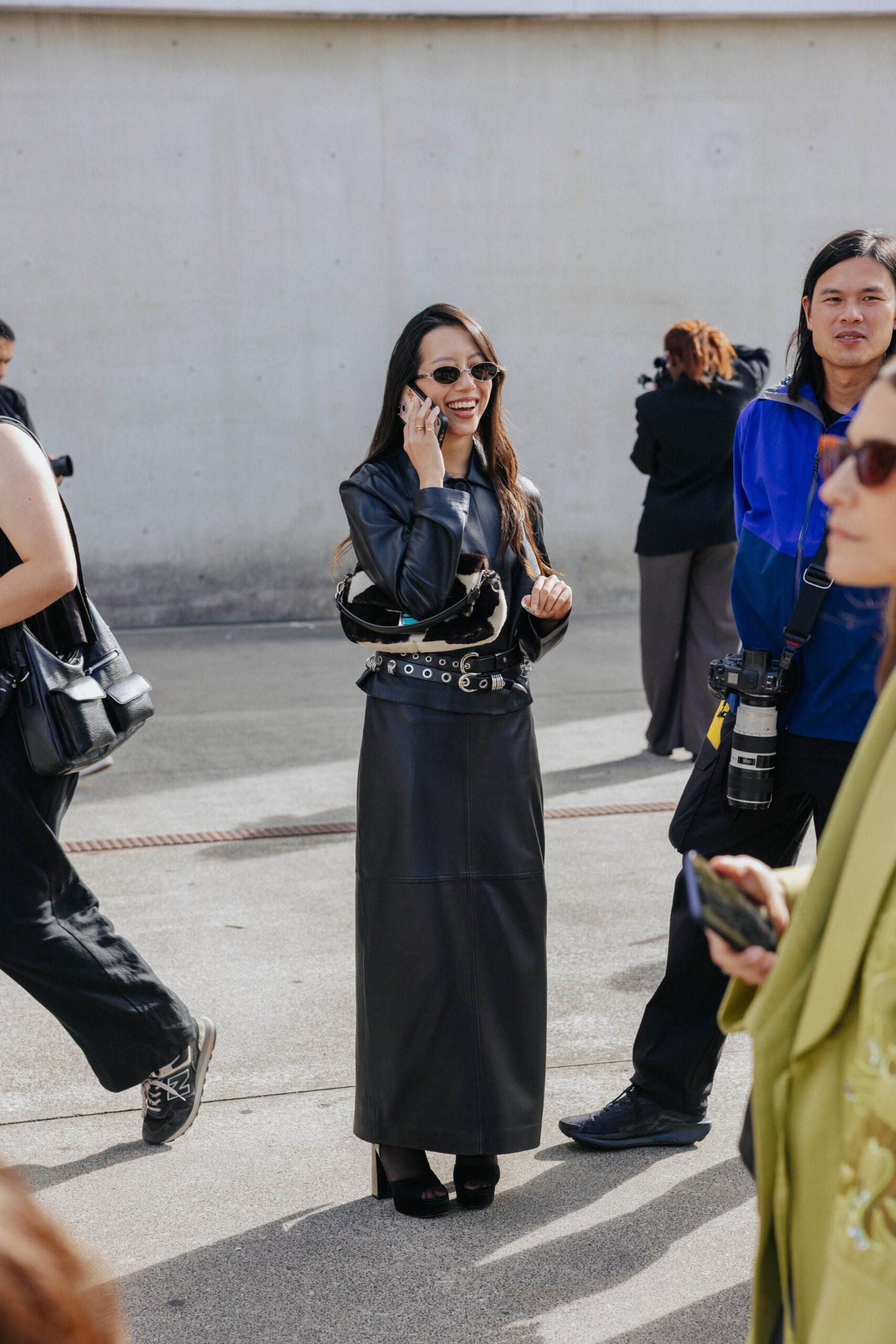
Gladys Lai on writing, custodianship and the future of fashion media
When Gladys Lai described her role as Head of Brand at Vogue Australia as that of a “custodian”, my mind went to The Lord of the Rings.
There is a scene in The Lord of the Rings: The Fellowship of the Ring, where Gandalf stands alone on the Bridge of Khazad-dûm, suspended above a dark abyss, as the rest of the Fellowship races through the Mines of Moria. As the Balrog descends upon them, Gandalf raises his staff and declares, “You shall not pass.”
While Lai’s remit is less apocalyptic, the comparison is not such a far cry.
As Head of Brand, she is responsible for safeguarding the voice of Vogue Australia: deciding what belongs within its world, what must go, and what shall not pass. And yet, she is not simply guarding the bridge.
She is building one of her own, framing fashion through the lens of history, politics and aesthetic theory, and bringing her distinctive way of seeing to an institution she has been entrusted to preserve.
I sat down with Lai to discuss the craft behind her editorial voice, the making of a career in fashion media, and what it takes to preserve the authority of a legacy title in an era of collapsing attention spans.
 On Writing as Her First Love
Long before Lai entered fashion media, she was a devoted reader.
By the age of nine, she had already fallen in love with Jane Austen, Virginia Woolf and Tolkien. Writing grew alongside that appetite for literature.
“Writing was my first love,” she tells me, “and I think it really has underpinned everything that I have come to love in the years since.”
When I ask who her style icons were growing up, Lai tells me she was drawn less to celebrities than to imagined worlds: the medieval armour, elaborate headdresses and costumes of The Lord of the Rings, Disney princesses, ancient Egyptian jewellery and the clothing preserved in art and history.
“I feel like all of those style influences were drawn from areas that weren’t strictly, conventionally fashion,” she says. “It was clothing in the sense of a study of how people used to dress and what it says about a culture and a time.”
That instinct still shapes her work. Lai does not treat fashion as an isolated subject, but as a way of reading culture, history, politics and aesthetics.
On Studying Law
 When I ask whether she had always imagined a career in fashion media, Lai laughs and shakes her head.
“I never considered it as a career path,” she says. “I don’t think it was painted out as possible for me. No one I knew worked in fashion.”
Her understanding of the industry was, by her own admission, limited to The Devil Wears Prada. The life she pictured for herself was quieter.
“I wanted to work in a library or an archive somewhere,” she confesses, “somewhere decidedly maybe unfashionable and a bit naff.”
When I ask why she initially pursued law, Lai is clear that it was never the dream. Neither, at first, was journalism. She had planned to study arts and pursue history or art history, but conversations about prestige, employability and the apparent waste of good marks pushed her towards a combined law degree.
“I had conversations with people about the so-called prestige of studying a law degree alongside an arts degree, and how I would be, quote unquote, ‘wasting the marks that I got’ if I just did an arts degree,” she says.
She is less diplomatic about that logic now.
“That is obviously such a backwards way of thinking. It is not how anything works, and it is really regressive.”
The promise attached to law was familiar: stability, professional legitimacy and a career path visible from the outside. Lai describes it as the “safety net” she had been told she needed, although the metaphor looks less convincing in retrospect.
“At the stage of my life where I am now, I think it is very funny that a safety net is a five-year degree in which you need to do another year of practice before you get admitted,” she says.
She remains grateful for the degree. Law taught her resilience, though her interest lay in the parts of the curriculum that rewarded argument, interpretation and the written word.
“It was the historian in me that found the most interest in the least fiscally attractive parts of a law degree,” she says. “I loved writing essays.”
Throughout her degree, writing remained the constant.
“I had considered writing secondary to all of these other things and all of my other interests,” she says. “Then I thought, what if just the craft of writing was the job?”
On Her First Day at Vogue
Lai’s entry into Vogue came when she was about 19, midway through her degree, after the kind of chance encounter that sounds as though it belongs in a film. She met the then editor-in-chief at a networking event; they spoke, and Lai was asked to send through her résumé. An interview followed soon after.
 For the occasion, she wore a black woollen turtleneck, gingham cigarette trousers and a pair of little black Repettos she still owns.
“It was very Audrey Hepburn, Roman Holiday kind of style,” she says. “Very straightforward. I was not trying to do anything. It was just a little bit more put together.”
The romance of the beginning soon gave way to discipline. Lai interned for a year while studying full-time and working two other jobs. Some days began at seven in the morning and ended with lectures or tutorials late in the evening. Her weekends belonged to her second job.
“I would literally never do that again,” she says. “I don’t know why I did that to myself.”
The internship itself was unusual. On her first day, rather than being relegated to coffee runs, Lai was asked to review a Louis Vuitton Cruise show. She had never written about a runway before.
“Completely fresh,” she says. “I just launched into it. I had no clue what I was doing. I just started writing.”
The piece was published, and more assignments followed.
“I was writing from day one,” she says.
Years of reading had already given her an instinct for structure, even if the subject was new.
“I think I understood what structure was demanded of me by the task,” she says. “It came pretty naturally.”
On Becoming Head of Brand

Lai did not arrive at the Head of Brand role through one swift promotion. She noticed what was missing, then began doing it.
“I have, and still do have, a tendency to overexert myself and overextend myself into other parts of the job,” she says. “If I see a gap in a workflow, I will just fill it.”
As a content editor, that meant taking on work that sat beyond the formal limits of her title.
“I naturally took on all of these other responsibilities that no one else was claiming,” she says. “I was like, ‘Well, I would like to have my title reflect that difference.’”
Her interest was never limited to the page. The writing mattered most, but so did the machinery around it: where money came from, how editorial decisions were made, how an audience behaved and how commercial interests shaped the work.
“The purely creative part of the writing is always going to be what drives me,” she says. “But I was also interested in how the business ran, where money came from, how money influenced what we wrote, and just having a more 360-degree picture of the business.”
That curiosity led her into strategy, data and analytics, then into a Head of Brand role at GQ and later Vogue Australia.
“It is a very widely spread-out role,” she says.
Writing, interviewing and editing remain central. Lai fields pitches, helps writers shape and structure stories, and decides whether an idea belongs within the editorial world of Vogue. The role also extends into social strategy, audience development, community building, video production and commercial partnerships.
“I have a very clear understanding of what is off brand, and how to make something that is off brand on brand, or whether it should not be a Vogue topic,” she says.
Custodianship, in this sense, involves knowing the institution intimately enough to recognise its boundaries and knowing when those boundaries should move.
On How to Write for Vogue

Fashion media has a reputation for opacity, and Lai does little to dispute it.
“It is not very clear how to get into it,” she nods.
Her advice is simpler: reach out.
She answers DMs, meets aspiring writers for coffee and encourages people to cold email, cold message, and be “a bit annoying”. “If one person responds, it is great.”
The path into publishing is also less dependent on being chosen by a magazine than it once was. Substack and social platforms allow writers to build a body of work on their own terms. Still, Lai says the modern editor must be more than a writer. “I do not think anyone is a straight writer anymore,” she says.
A colleague recently used the term “creative generalist”, which Lai thinks captures the shift. A writer should understand narrative, but also visual direction, video, audience, packaging, commerce and platform behaviour.
“All of that is important,” she says, “and it bolsters your writing.”
On the Future of Fashion Media

The most difficult part of Lai’s role is not celebrity, pressure or the demand to produce at speed. It is the instability of the industry around her.
“Traditional media has never been in a more volatile position,” she says.
For years, digital publishing was seen as the answer to the decline of print. That certainty has disappeared.
“People were talking about the death of print for ages,” Lai says. “Now it is even really the death of digital media.”
The line between old and new media has narrowed, while advertising money has shifted towards platforms and individual creators. Vogue must participate in that system without becoming indistinguishable from it.
“The most difficult part of the job is: how do you evolve a brand while keeping true to its roots, but also understanding that technology and consumer behaviour are shifting radically in a really short period of time?”
That question returns to the idea of custodianship. Preserving authority does not mean insisting that the future must resemble the past. It means recognising what must remain intact when everything around it changes.
Ultimately, Lai’s role places her at that threshold: between the magazine and the platform, the archive and the feed, the past and the future.
___________________________________________________________
Behind the Seams is a series by Chloe Lei that explores the paths of those who began in law before finding their way into fashion.
Through conversations with fashion founders, designers and creatives, the series offers a glimpse into what it really takes to step away from the conventional path and follow the pull of fashion.
FASHION LAW JOURNAL INSIDER
Join designers, brand founders and fashion lawyers who get the biggest brand battles, IP fights and career moves in fashion law, straight to their inbox.