
When the Met announced a Galliano retrospective last month, this column asked what the choice revealed about fashion’s selective memory. The exhibition never opened. Here is what happened between the announcement and the withdrawal, and what it leaves unresolved.
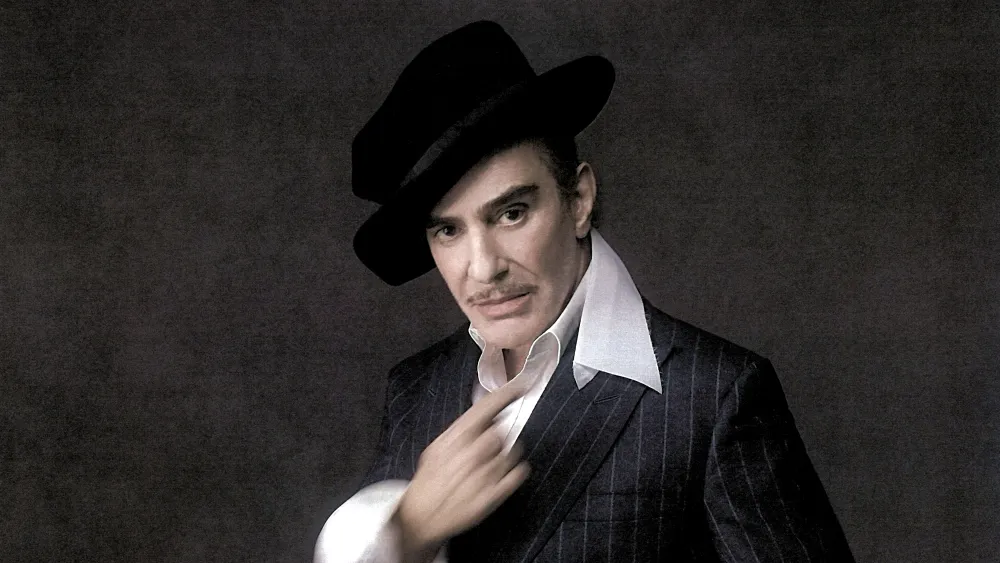
Last month, when the Metropolitan Museum of Art announced a full retrospective for John Galliano titled “Horizons,” this column argued that the name mattered almost as much as the designer, since a museum can frame an artist’s history as a straight line forward, or as a record with a rupture running through it. The Met had clearly picked forward. That honour is rare enough to explain why the announcement made news in the first place: only two other living designers, Yves Saint Laurent in 1983 and Rei Kawakubo in 2017, have ever received a full solo Costume Institute retrospective. Then, on August 31, 2026, Galliano withdrew from the show, and the Met’s Costume Institute has since confirmed that the retrospective, planned for May 2027, will not proceed as announced. What follows is not a verdict on whether that outcome was right. It is an account of what actually happened, and a look at why the same industry has answered this exact question differently before.
What John Galliano Said When He Withdrew From the Met
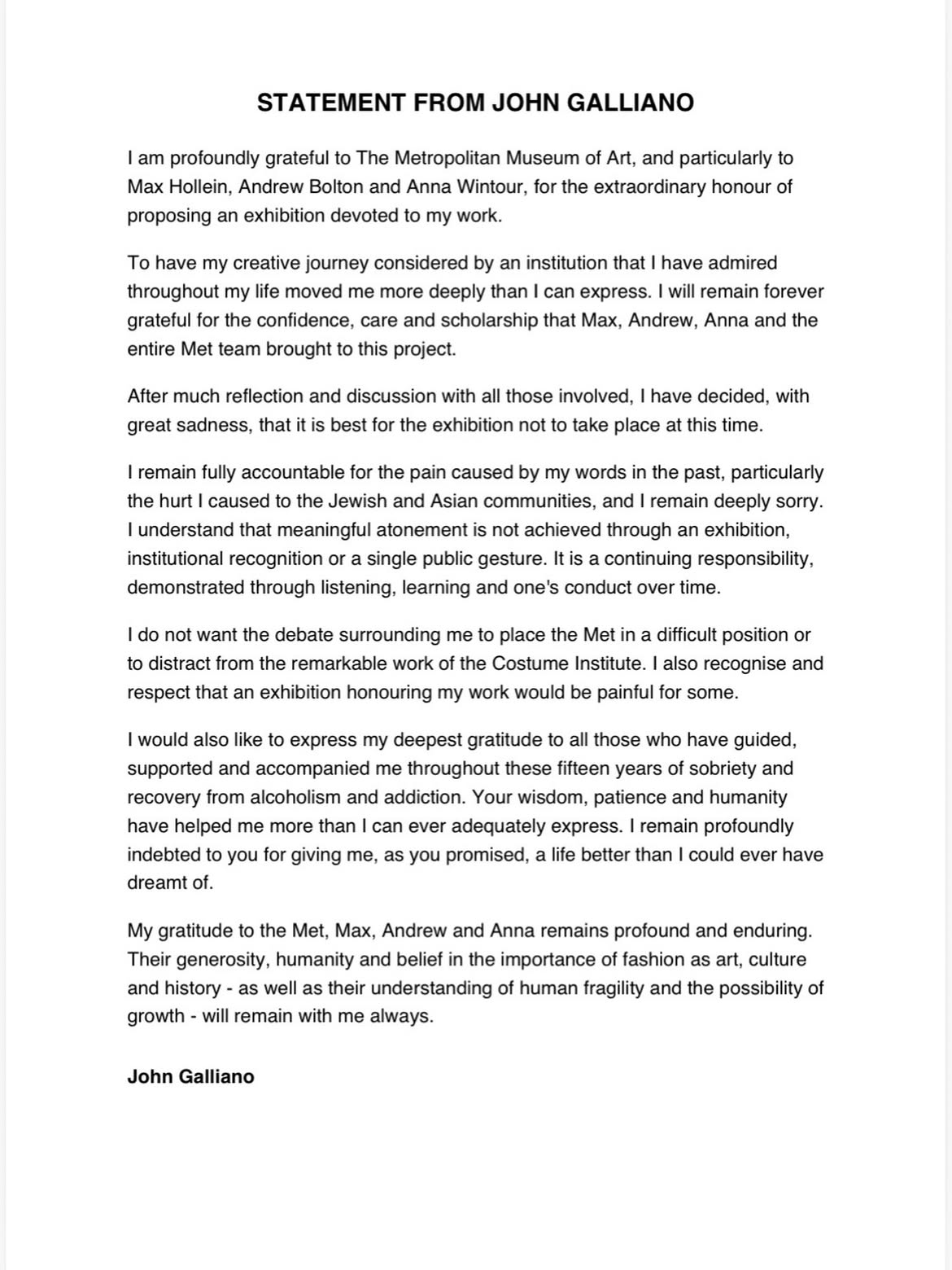
Galliano’s own statement did not read like a man forced out. “After much reflection and discussion with all those involved, I have decided, with great sadness, that it is best for the exhibition to not take place at this time,” he wrote, adding that he remained “fully accountable for the pain caused by my words in the past, particularly the hurt I caused to the Jewish and Asian communities,” and that he remained “deeply sorry.” Andrew Bolton, the Costume Institute’s curator, publicly backed the decision. “I believe deeply in the responsibility of museums to examine difficult histories with rigor, candor, and care,” he said. “I also recognize the pain and concern this exhibition has caused.” Anna Wintour, who had defended the original announcement by saying Galliano’s career “isn’t defined by a moment” and that he was “deserving of an exhibition of this scale,” called the withdrawal itself “very courageous and a measure of the man he is.” Two different moments, two different Galliano stories, both endorsed by the same person, in the same year.
John Galliano’s Full Timeline, From the 2011 Scandal to the Met Cancellation
Strip away the arguments on either side and a plain sequence of dates remains. Christian Dior and his own namesake label fired Galliano in March 2011, after footage surfaced of him hurling antisemitic and racist remarks at Géraldine Bloch and Philippe Virgitti at a bar in the Marais district of Paris. A French court convicted him that June of publicly insulting the pair over their ethnic and religious identity, and it ordered him to pay a fine and cover the complainants’ legal costs. By July, Kate Moss had worn a Galliano gown to marry Jamie Hince, and Vogue’s September issue covered the wedding. Two years later, Galliano sued Dior and his own label for unfair dismissal, arguing the companies knew about his substance abuse and had piled on the professional pressure that led to it, and seeking between 2.4 million and 13 million euros in damages. A French labour court rejected the claim in November 2014 and ordered him to pay each company a symbolic one euro. He joined Maison Margiela as creative director in 2014 and stayed for a decade, culminating in a Spring 2024 Artisanal collection that much of the industry called one of the great runway shows of the last twenty years. None of these dates is in dispute. What people disagree on is what they add up to.
Who Opposed the Galliano Met Exhibition, and Who Defended It
The most unexpected early voice against the exhibition belonged to Dana Thomas, the journalist who literally wrote the book on Galliano. Her 2015 biography, “Gods and Kings,” remains one of the definitive accounts of his rise and fall, and on August 6, 2026, she used a New York Times guest essay to argue the Met was making, as her headline put it, “a very bad mistake”. That essay is widely credited with turning a simmering online debate into a story the museum’s own trustees could no longer avoid. New York City Council Speaker Julie Menin led the public opposition that followed, noting that the city gives the Met over three million dollars a year in discretionary grants and calling the exhibition “a grave mistake” that had not been “thoroughly vetted and discussed by the full board.” She said honoring “someone who has a longstanding history of deeply offensive, antisemitic and anti-Asian remarks is not acceptable.” Donor Alice Tisch reportedly called the planned show a whitewash. Anti-Defamation League CEO Jonathan Greenblatt struck a more layered note, saying the organization had “long since accepted” Galliano’s apology but that honoring him now, with antisemitism at what he called crisis levels, was “the wrong move at the wrong moment.” Rabbi Rick Jacobs offered something closer to the middle, saying Galliano had shown “the contrition necessary to earn his return to the fashion world” while stopping short of endorsing a museum retrospective specifically.
On the other side, Wintour and much of the fashion press argued that a four-decade body of work should not be erased by one recorded incident, however serious. They pointed to the unglamorous parts of Galliano’s rehabilitation that rarely made headlines: years of sobriety, and quiet meetings with Jewish community leaders that were never staged for publicity. Supporters also noted that Galliano had not demanded a return to the spotlight. He rebuilt his career through smaller, less ceremonial design roles for years before Maison Margiela ever gave him a namesake stage again.
Karl Lagerfeld’s Met Gala Retrospective: Why His Show Wasn’t Cancelled
Fashion has already answered a version of this question, and it answered differently. In 2023, the Met’s Costume Institute mounted “Karl Lagerfeld: A Line of Beauty,” a full retrospective spanning the designer’s decades at Chanel and Fendi. Lagerfeld’s public record is not exactly quiet on its own. In a 2017 French television appearance, he defended Angela Merkel’s refugee policy by saying “one cannot, even if there are decades between them, kill millions of Jews so you can bring millions of their worst enemies in their place,” a comment many read as both antisemitic and Islamophobic. He also dismissed the #MeToo movement by telling models “if you don’t want your pants pulled about, don’t become a model,” and back in the early 1990s printed verses from the Quran onto dresses purely as decoration, a controversy that trailed him for years afterward. Somehow, none of it stopped the 2023 exhibition from opening as planned, gala and all. There was public criticism at the time, including from commentators who argued directly that the Met was ignoring his Islamophobia and misogyny in order to celebrate his silhouettes, but the show went ahead anyway. Lagerfeld, to be fair, never faced a criminal conviction the way Galliano did, and his comments came in the relative safety of interviews rather than a drunken outburst caught on tape, distinctions his defenders leaned on. Still, fashion had already answered the underlying question, whether a museum should stage a celebratory retrospective for a designer with a documented history of bigoted remarks, three years before Galliano’s case ever put it back on the table.
The Chuck Close Precedent: When Museums Have Cancelled Exhibitions Before
The pattern is not unique to fashion. In January 2018, the National Gallery of Art in Washington postponed a planned exhibition of photorealist painter Chuck Close after multiple women accused him of sexual harassment, alleging he asked them to pose nude unexpectedly and made explicit comments about their bodies during studio sessions, according to NPR. Close disputed the characterisation, saying, “I acknowledge having a dirty mouth, but we’re all adults,” while denying he had intentionally made anyone uncomfortable. The museum’s spokesperson said only that it was “not the appropriate time to present these installations.” Close’s case differs from Galliano’s in one significant way: the alleged misconduct tied directly to the making of the art itself, happening inside the same studio sessions that produced the celebrated portraits. Galliano’s remarks happened at a bar, far from a runway or a sketchbook. Whether that distinction should matter to a museum deciding what to honour is itself part of the debate, not a settled answer to it.
Separating the Art From the Artist: The Case for Gauguin, Picasso, and Galliano
Defenders of keeping controversial figures on museum walls tend to reach for the same handful of names, and the names are hard to argue with on their own terms. Paul Gauguin’s Post-Impressionist paintings remain fixtures of major collections even though his years in Tahiti involved sexual relationships with teenagers, a history most museums now handle through wall text rather than removal. Biographers have spent decades documenting Pablo Picasso‘s treatment of the women in his life, and yet he’s still routinely described as one of the most important artists of the twentieth century, his retrospectives largely untouched by that personal history. The logic behind these examples is simple enough: start removing every artist whose personal conduct wouldn’t survive today’s scrutiny, and entire wings of major museums would empty out, taking with them work that shaped how later generations learned to paint and design. Critics push back on that logic, though. A wall label, they argue, is one thing. A solo retrospective, complete with a gala thrown in its honour, is another matter entirely.
What John Galliano’s Met Gala Cancellation Really Means for Fashion
“Horizons” was always a strange word to put on a show that ended up defined by its past rather than its forward motion. The Met now says it will announce a new theme for its May 2027 gala, and Galliano continues to work at Maison Margiela, where none of the donors or city officials objecting to the museum retrospective has called for his removal. That gap, between what an industry will let a person do for a living and what a civic institution will let it call an honour, is where this story actually sits. Lagerfeld got his celebration. Close did not get his. Galliano, for now, gets neither the exhibition nor a clear answer about what would have made one acceptable. The Met’s silence on that last point may turn out to be the most consequential thing anyone said this year.
Sources
Fashion Law Journal: The Horizons We Choose to Forget
CNN: The John Galliano 2027 Met Gala has been canceled
WWD: The Met’s Costume Institute Cancels John Galliano Exhibition
The Zoe Report: John Galliano Says His 2027 Met Gala Exhibit Will Not Take Place
JTA: John Galliano bows out of Met exhibition as backlash over antisemitism mounts
Yahoo News Canada: NYC Council Speaker Says Met’s Galliano Exhibit Was a “Grave Mistake”
Fashionista: John Galliano Loses Unfair Dismissal Case Against Dior and His Namesake Label
Times of Israel: John Galliano’s Journey From Hatred to Repentance
The New Arab: The Met Gala is ignoring Karl Lagerfeld’s Islamophobia and misogyny
NPR: National Gallery Delays 2 Upcoming Shows After Sexual Misconduct Allegations
Dana Thomas: The Metropolitan Museum of Art Is Making a Very Bad Mistake
theJasmineBRAND: Anna Wintour Defends 2027 Met Gala Theme Honoring John Galliano
The Hollywood Reporter: Kate Moss Wears John Galliano Dress to Wedding
The Metropolitan Museum of Art: Karl Lagerfeld: A Line of Beauty
JTA: Designer Karl Lagerfeld Slams Germany for Welcoming Jews’ ‘Worst Enemies’
The Hollywood Reporter: Karl Lagerfeld #MeToo Comments
W Magazine: A Look Back at Karl Lagerfeld’s Biggest Runway Controversies at Chanel
Highsnobiety: Why Maison Margiela SS24 Was the Best Couture Show in Years
The Horizons We Choose to Forget: What the 2027 Met Gala Says About Fashion’s Selective Memory
FASHION LAW JOURNAL INSIDER
Join designers, brand founders and fashion lawyers who get the biggest brand battles, IP fights and career moves in fashion law, straight to their inbox.