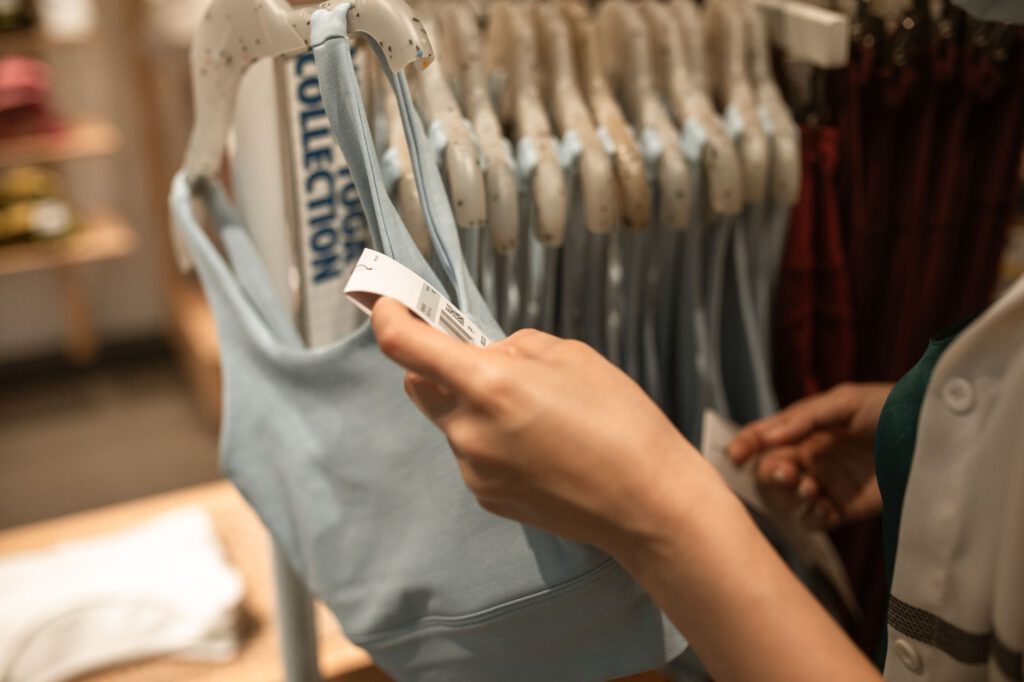


Sustainability is no longer tucked away on a brand’s corporate responsibility page. It now appears on clothing tags and product pages, shaping not only how a garment is sold, but also how buying it is supposed to make us feel. Yet the environmental story an advertisement tells is often much easier to understand than the reality behind the garment. A claim may highlight recycled fibres while saying little about production, or present a limited “conscious” collection as evidence of a wider commitment. This does not mean that every sustainability campaign is misleading. Fashion brands should be able to communicate genuine progress. The difficulty lies in deciding whether the impression created by the marketing is proportionate to the evidence behind it. Where does legitimate sustainability marketing end and greenwashing begin?
A green claim is any message suggesting that a garment, or the business behind it, has a reduced or positive impact on the environment. Not every green claim is written out. Sometimes a leaf logo or an earthy colour palette does the work quietly, leading shoppers towards an environmental conclusion before they have read a single detail. This is why looking only for a false sentence misses much of the problem. What matters is the advertisement’s overall impression, which can reach further than any carefully worded claim. Greenwashing can be an outright lie, but often it lies in that gap. At times, the language is simply too vague to verify. In other cases, the evidence is missing or important context has been withheld. What is implied may therefore matter as much as what is actually said.
Fashion is especially vulnerable to greenwashing because much of a garment’s environmental impact is hidden from the person buying it. Its story may span several countries and many stages of production, making a simple claim hard to test at the point of sale. A fabric described as “better” may perform well in one respect while creating different costs elsewhere in the product’s life cycle. This complexity gives broad terms such as “responsible” considerable persuasive power, even when their meaning is unclear. Limited sustainable ranges raise a related problem. A conscious collection is not inherently deceptive, and it may reflect genuine progress. The impression becomes questionable when a brand uses that small selection to suggest that its wider operations have changed. In fashion, the gap between a product-level improvement and the scale of the business can therefore be easy to blur.
Green marketing often works less by making one dramatic promise than by arranging small signals so that they all point in the same direction. A jacket might be described as “responsible” because part of its outer fabric is recycled, while the rest of its composition receives little attention. The statement may be narrowly true, but the surrounding presentation encourages a much broader conclusion. Qualifications do not necessarily correct that impression when they are buried in small print or placed behind a link that the shopper must actively open. Visual language can do similar work without making a claim that can be tested. Research on bio-fashion has found that colours associated with nature can influence whether consumers perceive a product as ecological. A brand-created leaf emblem may add another layer of apparent authority, particularly when it resembles independent certification. Each element may appear modest on its own. Put together, these details can make one improved feature feel like the story of the whole garment. The effect comes as much from where the campaign directs our attention as from what it quietly leaves at the edge of the frame.
The legal risk begins when creative persuasion crosses into consumer deception. In the European Union, misleading environmental marketing can already be assessed under the rules on unfair commercial practices. Directive (EU) 2024/825 brings that line into sharper focus. The deadline for national transposition was 27 March 2026, with the new rules due to apply from 27 September 2026. Among the practices added to the EU blacklist is the use of a generic environmental claim when a trader cannot demonstrate recognised excellent environmental performance relevant to it. The Directive also targets sustainability labels that are neither based on a certification scheme nor established by a public authority. This matters for fashion brands because familiar language and self-created symbols can no longer be treated as harmless decoration when they shape consumer decisions. The United Kingdom offers an earlier practical example. Following an investigation by the Competition and Markets Authority, ASOS, Boohoo and George at Asda signed formal undertakings in March 2024 concerning how they present their environmental credentials. The commitments require claims to be accurate and prominent, and fabric descriptions must explain what terms such as “recycled” mean for the product. Criteria for environmental ranges must also be disclosed. Although the undertakings involved no admission of wrongdoing, they show that legal scrutiny can reach the full architecture of a campaign, not merely an isolated slogan.
I do not think fashion brands should be discouraged from marketing real environmental progress. Sustainability can be a legitimate reason to choose one product over another, but the message should remain proportionate to the evidence behind it. If a garment contains recycled material, the brand should state the percentage rather than letting the word “recycled” speak for the entire product. If an improvement concerns only one stage of production, that limit should be visible where the claim is made. Evidence should not be hidden several clicks away. The same honesty is needed at company level: a better capsule collection is not proof that the wider business has become sustainable. To me, these qualifications do not make marketing weaker. They make it more believable. A carefully framed claim may sound less impressive in the moment, but it gives consumers a reason to trust the next claim, too.
The line between a legitimate green claim and greenwashing is not drawn by how prominently sustainability appears in a campaign. It depends on whether the environmental impression the brand creates is supported by evidence. Brands should not stay silent about progress, but they should resist making it carry more meaning than the evidence allows. Precision may take some shine off a campaign, but it gives the brand something more valuable in return: trust. Sustainable marketing should not be a contest over who looks greenest. The real question is whether consumers have enough information to believe what they are being told.
Sources:
- Julia Adamkiewicz, Ewa Kochańska, Iwona Adamkiewicz and Rafał M Łukasik, ‘Greenwashing and Sustainable Fashion Industry’ (2022) 38 Current Opinion in Green and Sustainable Chemistry 100710, https://doi.org/10.1016/j.cogsc.2022.100710
- Magali A Delmas and Vanessa Cuerel Burbano, ‘The Drivers of Greenwashing’ (2011) 54(1) California Management Review, https://innovation.luskin.ucla.edu/wp-content/uploads/2019/03/The_Drivers_of_Greenwashing.pdf
- Competition and Markets Authority, ‘Complying with Consumer Law When Making Environmental Claims in the Fashion Retail Sector’ (18 September 2024), https://www.gov.uk/government/publications/complying-with-consumer-law-when-making-environmental-claims-in-the-fashion-retail-sector/complying-with-consumer-law-when-making-environmental-claims-in-the-fashion-retail-sector (accessed 28 August 2026)
- Luise Ende, Marc-Andre Reinhard and Lorena Göritz, ‘Detecting Greenwashing! The Influence of Product Colour and Product Price on Consumers’ Detection Accuracy of Faked Bio-fashion’ (2023) 46(2) Journal of Consumer Policy 155-189, https://doi.org/10.1007/s10603-023-09537-8
- Directive (EU) 2024/825 of the European Parliament and of the Council of 28 February 2024 amending Directives 2005/29/EC and 2011/83/EU as regards empowering consumers for the green transition through better protection against unfair practices and through better information [2024] OJ L 2024/825, https://eur-lex.europa.eu/eli/dir/2024/825/oj/eng
- European Commission, Directorate-General for Justice and Consumers, ‘Questions & Answers – Directive on Empowering Consumers for the Green Transition’ (30 June 2026), https://commission.europa.eu/document/download/3c257883-bb2a-4dd9-a6dc-501d587bb34f_en?filename=faq-empowerting-consumers-gtd.pdf (accessed 28 August 2026)
- Competition and Markets Authority, ‘Green Claims: CMA Secures Landmark Changes from ASOS, Boohoo and Asda’ (27 March 2024), https://www.gov.uk/government/news/green-claims-cma-secures-landmark-changes-from-asos-boohoo-and-asda (accessed 28 August 2026)
- Federal Trade Commission, ‘Green Guides: Guides for the Use of Environmental Marketing Claims’ (16 CFR pt 260, 2012), https://www.ftc.gov/legal-library/browse/rules/green-guides (accessed 28 August 2026)
Author: Simona Petromirova Stoycheva
Disclaimer: The views expressed in this article are those of the author and do not necessarily reflect the views of Fashion Law Journal
FASHION LAW JOURNAL INSIDER
Join designers, brand founders and fashion lawyers who get the biggest brand battles, IP fights and career moves in fashion law, straight to their inbox.