

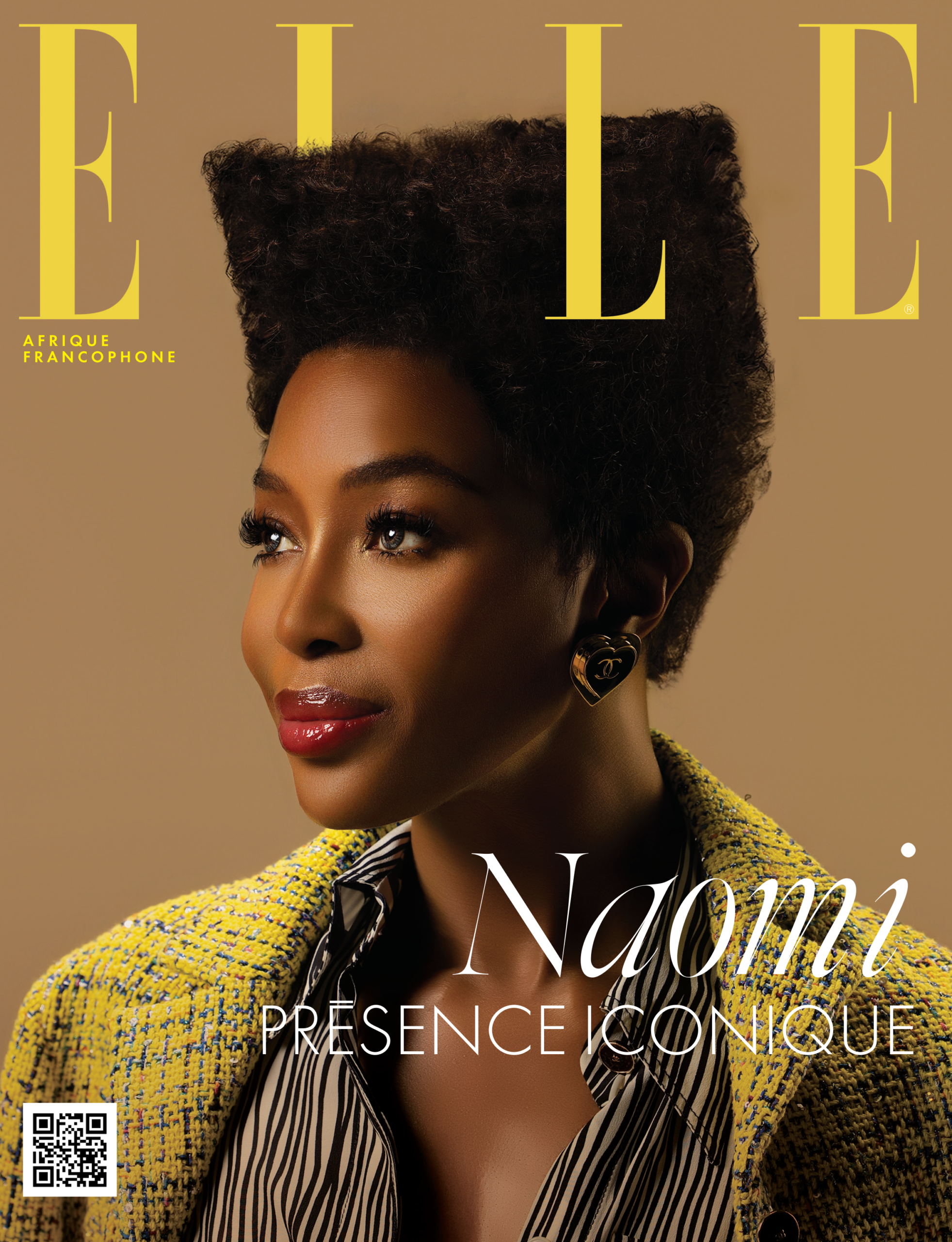
As ELLE Afrique Francophone expands the reach of a title once centered on Côte d’Ivoire, its evolution raises a larger question: can an industry fully claim its creative power without the institutions that document, critique and remember it?
In March 2026, a new edition of ELLE appeared across five Francophone African markets. Naomi Campbell was on the cover. The magazine had been conceived, produced and printed on the continent, with a pan-African editorial team spanning Benin, Cameroon, Côte d’Ivoire, Gabon and Senegal. ELLE Afrique Francophone had formally succeeded ELLE Côte d’Ivoire.
A national publication becoming regional is easy to read as a story of expansion. Frédérique Nanan, CEO and Publisher of ELLE Afrique Francophone, describes the decision differently.
After four years at the helm of ELLE Côte d’Ivoire, she had noticed that the creators the magazine followed and the conversations it opened were already moving beyond national borders. More importantly, she had become increasingly interested in where those conversations were being authored.
FLJ Insider Pro is open: live fashion law jobs and internships, five career guides and two roadmaps. Early bird USD 12/month. See what's inside
“The fashion of Francophone Africa is still largely narrated from elsewhere,” Nanan told me in written responses prepared for this article. “From Paris most often, sometimes from Lagos or Johannesburg. Rarely from Abidjan, Dakar or Douala.”
For her, the transition was therefore also a question of narrative power.
“It was not about securing a better place in someone else’s narrative, but about holding the pen.”
The distinction is consequential. Fashion industries are usually discussed through the visible parts of their ecosystem: designers, collections, fashion weeks, retailers, celebrities and consumers. Far less attention is paid to the institutions that decide what gets recorded, reviewed, contextualized and eventually remembered.
Yet a fashion industry cannot fully mature on talent alone. It also needs institutions capable of documenting, legitimizing, critiquing and remembering that talent.
That makes the evolution of ELLE Afrique Francophone interesting beyond publishing. It offers a way to examine the infrastructure that surrounds creative power, and what happens when part of that infrastructure begins to be built from within the markets it covers.
Talent Is Not an Infrastructure
There is no shortage of evidence that African fashion has creative momentum.
UNESCO’s first continent-wide report on the sector, published in 2023, described African fashion as a rapidly developing ecosystem shaped by a young population, urbanization, digital technology and strong local creative traditions. It identified cities including Abidjan, Casablanca, Dakar, Johannesburg, Lagos and Nairobi as important fashion and design hubs. Fashion weeks were operating in 32 African countries, while textile, clothing and footwear exports from the continent were valued at approximately $15.5 billion annually.
But the same report identified persistent constraints: insufficient investment, fragmented policy environments, limited training opportunities, difficulties sourcing materials, gaps in intellectual property protection and a lack of structured infrastructure. Roughly 90 percent of businesses in the sector are small and medium-sized enterprises.
Frédérique Nanan sees a related imbalance in the media environment.
“The talent existed without its infrastructure,” she says of Francophone African fashion, contrasting its media and critical ecosystem with more established structures she observes around fashion in parts of Anglophone Africa.
It is worth resisting an overly neat Anglophone-Francophone divide. Abidjan and Dakar have long-standing creative scenes, media organizations, designers, photographers and fashion events of their own, just as infrastructure varies considerably within Anglophone markets. Africa is far too heterogeneous for a simple binary.
Her broader argument, however, is harder to dismiss: creative production and institutional recognition do not necessarily develop at the same speed.
A designer can produce remarkable work without a robust fashion press. What becomes harder is building the surrounding record. Who documented the first collection? Who interviewed the designer before international attention arrived? Where are the reviews, profiles, campaign credits, production histories and dated images? Who recorded the names of the craftspeople whose work made the garment possible?
Those questions concern visibility. They also concern memory.
And, occasionally, law.
The Fashion Magazine as Evidence
“A media outlet is not only an amplifier,” Nanan argues. “It is a producer of evidence.”
For a fashion publication, that is an unusually legal way of describing editorial work. It is also worth taking seriously.
A dated magazine article does not create intellectual property ownership simply because it exists. Nor does press coverage automatically establish authorship, entitlement to a design or an enforceable right. The legal effect of any publication will depend on the right at issue, the applicable jurisdiction and the facts of the dispute.
What documentation can do is establish a record.
An archived article can help demonstrate that a design, technique, collection or collaboration existed at a particular moment. Reporting may preserve names, photographs, dates, locations and accounts of creative processes. Those materials can later become relevant to questions of chronology, attribution, provenance and, depending on the legal framework, prior disclosure or evidentiary history.
This documentary function extends beyond the fashion press. Across the continent, a broader institutional ecosystem is beginning to take shape around the legal and policy dimensions of fashion. The Fashion Law Institute Africa, for instance, has developed research and policy initiatives alongside the Journal of African Fashion Law, Policy & Innovation, a peer-reviewed publication building a scholarly record of the legal questions shaping African fashion. Its inaugural issue examines subjects ranging from intellectual property and indigenous textiles to informal economies, trade, artificial intelligence and supply chains. These initiatives perform a different function from a magazine such as ELLE Afrique Francophone, but they respond to the same underlying need: an industry requires a record of itself.
The issue becomes particularly significant when creative practices have historically been transmitted outside formal systems of documentation.
Nanan points to the embroiderers, weavers, dyers and beadworkers whose contributions often disappear behind the name of a designer or brand. “These forms of know-how are transmitted orally, rarely documented, and consequently very poorly protected,” she says.
The World Intellectual Property Organization has spent years examining precisely this tension. Its work on traditional cultural expressions includes textiles, attire, ornaments, symbols, designs and handicrafts, and it specifically treats documentation as a complex intellectual property issue. Recording traditional knowledge can help with preservation and evidence, while poorly designed documentation can also create new risks for communities by making culturally sensitive material easier for outsiders to access or appropriate. Documentation, in other words, needs governance alongside preservation.
That nuance matters for fashion.
An archive cannot substitute for an adequate legal framework. A magazine cannot solve the protection of communal knowledge. What it can do is make disappearance less likely.
For a sector in which influence travels rapidly and references are constantly recycled, the simple act of recording who made what, where and when has more value than fashion publishing sometimes acknowledges.

Beyond the “African Fashion” Category
There is another kind of infrastructure that media creates: a vocabulary for taking an industry seriously.
Nanan believes African fashion remains too often confined to two editorial frames. One is folkloric, where fashion is read primarily through heritage, symbolism and cultural reference. The other is developmental, where a label is presented through employment, empowerment, sustainability or social impact.
Both subjects can be important. Neither captures an industry in full.
Fashion is also manufacturing capacity, textile sourcing, logistics, financing, retail strategy, contracts, intellectual property, distribution and the ability to scale.
UNESCO’s analysis reaches a similar conclusion from an economic perspective. Its report treats African fashion as an interconnected value chain encompassing textiles, garment production, high fashion, fine crafts and accessories. It notes that access to affordable, high-quality textiles, production capacity, investment and reliable infrastructure can determine whether creative businesses remain small operations or expand sustainably.
This may be one of the more important functions of a maturing fashion press: allowing African designers to be discussed with the same analytical vocabulary routinely applied to houses in Paris, Milan, London or New York.
A Senegalese label should be able to receive serious criticism of its collection. An Ivorian beauty company can be examined through formulation, regulation and market positioning. A Cameroonian textile business can be discussed through supply-chain capacity. Success does not have to be filtered through a story of uplift before it becomes editorially interesting.
“Neither indulgence nor exoticism,” Nanan says of the standard she wants applied. “The same rigor, the same critical demands and the same seriousness applied to any other creative industry.”
That standard may ultimately matter more than the geography of a masthead.
The Business Problem Behind the Editorial One
Building a regional fashion publication also means confronting a far less glamorous side of media.
Distribution across several countries is difficult. Payment systems differ. Currencies and regulatory environments vary. Campaigns need to be sold, delivered and measured across markets that advertisers may still evaluate separately.
For Nanan, one obstacle is particularly important: audience measurement.
International brands may be interested in Francophone African consumers, she argues, while still struggling to compare media investments internally when standardized, independently verified measures are fragmented across markets and formats.
There is already significant audience research in the region. Kantar’s Africascope, for example, measures radio and television consumption across eight Sub-Saharan Francophone African countries and also tracks internet behavior. Its 2025 study covered 25 million people aged 15 and older in the surveyed capitals, with 62 percent of the population connecting to the internet daily.
That infrastructure should not be overlooked. At the same time, a television and radio measurement system does not by itself solve the commercial problem facing a fashion publisher trying to offer advertisers comparable evidence across print, websites, social platforms, branded content and several national markets.
This is where discussions about representation meet the mechanics of advertising.
A brand may genuinely want to invest. Someone inside that company still has to justify the allocation, compare performance and report the result.
The future of African fashion media therefore depends partly on cultural authority and partly on rather ordinary market plumbing: circulation, distribution, measurement, verification and payments.
Creative sovereignty still needs a business model.
A Reader Without a Sense of Periphery
The audience at the center of that model is changing as quickly as the publications trying to reach her.
Nanan describes the Francophone African female reader she observes as young, mobile-first, multilingual and comfortable consuming local and global culture simultaneously.
“There is no sense of periphery,” she says. “They do not see themselves as a secondary audience of global fashion.”
That idea deserves attention.
For decades, international fashion media operated through identifiable centers of authority. Collections originated in a handful of capitals. Trends moved outward. Regional editions interpreted a global conversation that had often been established elsewhere.
Digital culture has made that geography much messier.
A young woman in Abidjan can encounter Dior, a Senegalese designer, a beauty creator in Douala, Jacquemus, a Nigerian campaign and a TikTok microtrend within the same hour. She may distinguish among them by taste, relevance or price, without organizing them into a hierarchy of “global” and “local.”
The numbers support at least part of that shift. UNESCO found that the proportion of Africans purchasing goods online rose from 13 percent in 2017 to 28 percent in 2021. Kantar’s more recent research shows internet use continuing to occupy a substantial share of daily media consumption in the Francophone markets it studies.
A regional fashion publication built for that reader cannot simply reproduce a Parisian fashion hierarchy with African faces inserted into it. Nor can it assume that every African reader wants an explicitly pan-African story attached to every garment.
Sometimes she wants the story.
Sometimes she wants the dress.
Treating both impulses seriously may be part of what mature representation looks like.
From Publication to Institution
Nanan’s ambition for ELLE Afrique Francophone is ultimately less about geographic reach than permanence.
“I want the title to have become an institution rather than a publication,” she says when asked what success would look like in five years.
Her definition is revealing. An institution, she explains, is something whose absence would be noticed, whose archive is consulted and whose authority extends beyond its immediate readership.
That ambition places ELLE Afrique Francophone inside a much larger experiment.
The publication launched with the advantages and responsibilities of one of fashion media’s most recognizable names. Lagardère describes it as an edition published under licence by Abidjan-based INNSAEI SARL, produced by a pan-African team and intended to combine ELLE’s international standards with contemporary African creativity.
Whether it ultimately becomes the institution Nanan describes will depend on what follows the launch: consistency, editorial independence, commercial sustainability, criticism that earns trust, archives that remain accessible and a capacity to develop authority across markets without flattening their differences.
Nanan offers an unusually demanding measure of her own success.
“A title that still depended on me in five years would be a failure, whatever its apparent success.”
That may also be a useful way to think about creative infrastructure more broadly.
Industries become durable when their stories no longer depend on one designer, one editor, one fashion week, one founder or one moment of international attention. They become durable when structures exist to carry knowledge forward.
Who gets to tell Africa’s fashion story is therefore only the first question.
Holding the pen matters. The harder work is building the institutions that make sure the story is documented, questioned, preserved and, eventually, impossible to overlook.
FASHION LAW JOURNAL INSIDER
Join designers, brand founders and fashion lawyers who get the biggest brand battles, IP fights and career moves in fashion law, straight to their inbox.