
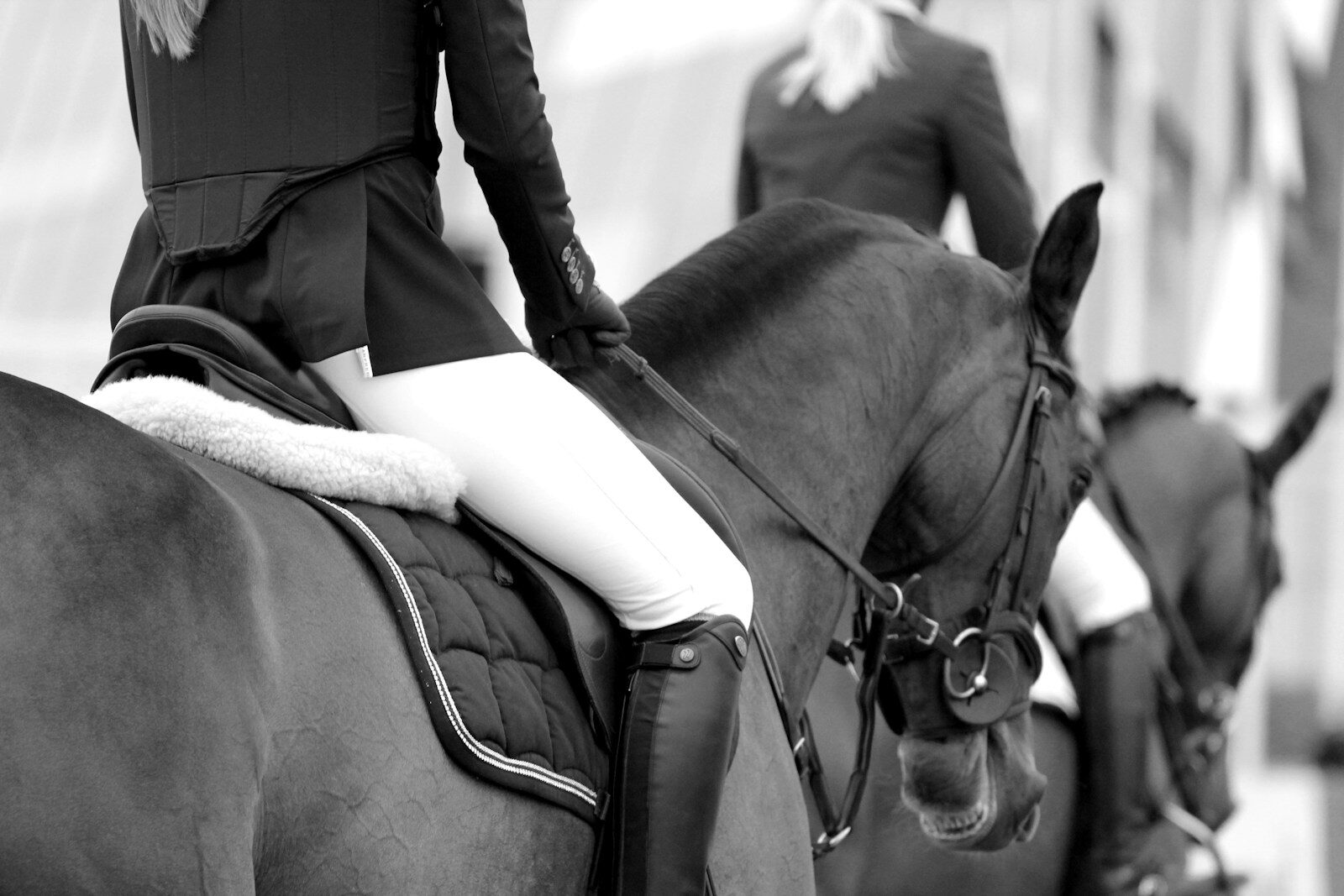
The equestrian silhouette has outlived nearly every trend that came after it. What is newer, and stranger, is that luxury houses no longer merely borrow the aesthetic. Several of them now own the sport.
There is a particular kind of boot that appears on pavements in cities with no stables in them. Tall, close-fitting, unadorned, with a heel low enough to be practical for a purpose the wearer has never once had. It is worn with something tailored above it, in a colour that would not frighten a horse, and it never looks like a costume. This is the strangest thing about equestrian dress: it survives translation out of its own context better than almost any other functional wardrobe in existence.
The riding jacket has held its shape for a century and a half. Jodhpurs return every few seasons and never truly leave. The quilted gilet, the collarless shirt, the leather glove, the tie that keeps everything closed at the throat: all of it engineered for balance, weather, and the specific requirement of sitting still on an animal that may decide otherwise. Every element of the look began as a solution to a problem, which is precisely why it refuses to date. Clothes designed for a purpose age far more gracefully than clothes designed for a season.
That much is well understood, and has been written about beautifully by people who ride. What is less examined, and rather more interesting, is what has happened underneath the aesthetic in the last two decades. The houses drawn to this world are no longer content to borrow its vocabulary. Several of them have quietly moved from admiring the sport to organising it.
FLJ Insider Pro is open: live fashion law jobs and internships, five career guides and two roadmaps. Early bird USD 12/month. See what's inside
The calendar, and who writes it
Consider what it means to create a championship.
In 2013, Rolex established the Rolex Grand Slam of Show Jumping, binding together four existing competitions, the CHIO Aachen, the CSIO Spruce Meadows Masters, the CHI Geneva and, from 2018, the Dutch Masters, into a single prize awarded to any rider who wins the Grand Prix at three of them consecutively. Before 2013, those events existed independently. After 2013, they constituted a structure, with a summit, a narrative arc, and a name belonging to a Swiss watchmaker.
This is not sponsorship as most people understand it. A sponsor buys visibility at an event that would happen anyway. What Rolex did was supply the sport with its competitive architecture, and the architecture carries the brand’s name in perpetuity.
None of this began in 2013. Rolex has kept the company of horses for more than sixty years, since 1957, when a British show jumper named Pat Smythe became the first rider the house ever placed its name beside, at a moment when women were only beginning to be admitted to that level of the sport at all. Since 2000 it has held the title of the Grand Prix at CHI Geneva. In 2024 it drew seven further competitions into a series of its own, from the Florida winter circuit to the Piazza di Siena in Rome, La Baule in spring, Falsterbo through the Swedish summer.
Set out as a list, that is a sponsorship portfolio. Set out on a map, it is a season. And a season, unlike an afternoon, has an owner.
Longines got there earlier still, and more quietly. Its association with the sport dates to 1878, with a chronograph engraved with a jockey and mount, and it has been present at international show jumping since 1912. More than a century spent timing horses, which is a claim almost nobody else in luxury can make about anything at all.
Polo is the more candid arrangement. Cartier and Hublot arrive at the Queen’s Cup and at Gstaad, and at least one observer of the watch trade has described the arrangement plainly as brand visibility and cultural alignment rather than any deep tie to the sport. That is a fair description and not an insult. Polo delivers a particular audience standing in a particular field on a particular kind of afternoon, and any house would be foolish not to want to be seen among them.
But it leaves the question that hangs over all of it, and that nobody standing at the rail is ever asked. When a house takes its place beside a horse, what exactly is it claiming?
Inherited, or acquired
Here the field divides, and it divides more sharply than good manners usually permit.
Hermès began in 1837 in a Paris workshop making harnesses and bridles for carriages, and everything the house has become was learned in that room. The saddle stitch, worked by hand with two needles so that a broken thread cannot unravel the seam, exists because a strap that fails at speed injures the horse and whoever is behind it. The buckles, the hardware, the instinct for objects that must survive weather and use and several decades of both- all of it was solved for animals long before it was ever applied to a handbag. The Arceau watch of 1978 takes the shape of its lugs from a stirrup, which is less a design reference than a family resemblance.
So when the house staged the Saut Hermès in 2010, putting show jumping back under the glass of the Grand Palais and returning the sport to the centre of Paris after most of a century away, it was not acquiring an association.
It was going home.
The distinction is not snobbery. It is a straightforward observation about what the association is doing in each case. Hermès at a horse show is a firm returning to the reason it exists. A watchmaker at a horse show is a firm purchasing proximity to a set of associations, quite legitimately, and at considerable expense, because those associations are not otherwise available for sale.
Jaeger-LeCoultre occupies an interesting middle position. The Reverso, created in 1931, was designed for polo players who needed to protect a watch face during a match, which is why the case swivels. That is a genuine functional origin, arrived at because someone was breaking their watch on a field. A century later, the Reverso is worn overwhelmingly by people who have never held a mallet, and its equestrian provenance survives as a story rather than a requirement.
Which is, when you think about it, the exact condition of the entire aesthetic.
What we are all actually buying
The riding boot on a city pavement and the watch brand on a paddock rail are doing the same work, at different scales, and it is worth naming that work honestly.
Equestrian style endures because it is the last widely legible uniform of inherited money. Not new money, which announces itself, but the older, quieter kind, which is signalled by good boots, a coat that has been repaired rather than replaced, and an entire absence of anything that could be mistaken for effort. The clothes carry an implication about land, about time, about access to an expensive animal and the hours required to be any good with it. They suggest a childhood.
You cannot buy a childhood. You can buy the boots.
And a house that wants to be understood in those terms has broadly two options. It can spend a hundred and eighty years making saddles, which is difficult, or it can sponsor the Grand Prix, which is merely expensive. Both routes end with the brand standing next to a horse. Only one of them explains why the horse is there.
None of this makes the sponsorship dishonest. Equestrian sport is costly to stage, and the money is welcome, and the watch on the rail is paying for the arena. But it does explain why the association feels different depending on the name attached to it, and why an audience that could not articulate the reason nevertheless senses one. Heritage that was built reads differently from heritage that was booked.
The last honest thing about it
What redeems the whole arrangement, and makes it more interesting than a straightforward exercise in borrowed prestige, is that the clothes themselves remain completely sincere.
A riding jacket is still cut for a body in motion above an animal. A tall boot still protects a calf against a stirrup leather. The reason the aesthetic translates so gracefully to a street it was never designed for is that every line in it was solved, once, by someone trying to stay on a horse. Fashion did not invent this look. It found it, fully formed, in a working wardrobe, and has spent a century declining to improve it because there is nothing to improve.
So the horse can be rented, and the calendar can be bought, and the name on the arena can change hands for a sum nobody publishes. The boot cannot be argued with. It was right the first time.
FASHION LAW JOURNAL INSIDER
Join designers, brand founders and fashion lawyers who get the biggest brand battles, IP fights and career moves in fashion law, straight to their inbox.