







Goth clothing has a particular way of resurfacing in fashion conversations without ever truly disappearing. While many styles cycle in and out of relevance, goth seems to maintain a steady presence, influencing silhouettes, materials, and attitudes across decades. Its persistence is not the result of nostalgia alone, but of a deeper compatibility with how fashion evolves.
Rather than existing as a frozen subculture, goth clothing has proven remarkably adaptable. It absorbs change without losing its identity, which explains why designers, stylists, and everyday wearers continue to draw from it, often without explicitly labeling their references as “goth”.
A Style Built on Structure, Not Trends
One of the reasons goth clothing continues to influence modern fashion is its foundation. Unlike trend-driven aesthetics that rely on novelty, goth is built around structure. Long lines, sharp tailoring, heavy fabrics, and deliberate silhouettes form a visual language that remains effective regardless of the era.
Modern collections regularly revisit these elements. Dark monochrome palettes, elongated coats, fitted tops, and strong footwear appear season after season, sometimes stripped of overt symbolism, sometimes embraced more fully. The influence is subtle, but consistent. Goth clothing offers designers a vocabulary that feels serious, controlled, and timeless.
The Enduring Appeal of Black
Black plays a central role in goth clothing, but its influence goes far beyond color preference. In goth fashion, black is used to emphasize form, texture, and contrast rather than decoration. This approach has naturally found its way into contemporary fashion, where restraint and clarity are increasingly valued.
Modern minimalism, for example, often borrows from goth’s understanding of black as a foundation rather than a statement. The result is clothing that feels grounded, versatile, and intentional. Even outside explicitly goth contexts, this influence is evident in the way black continues to dominate runways and wardrobes alike.
Materials That Carry Weight
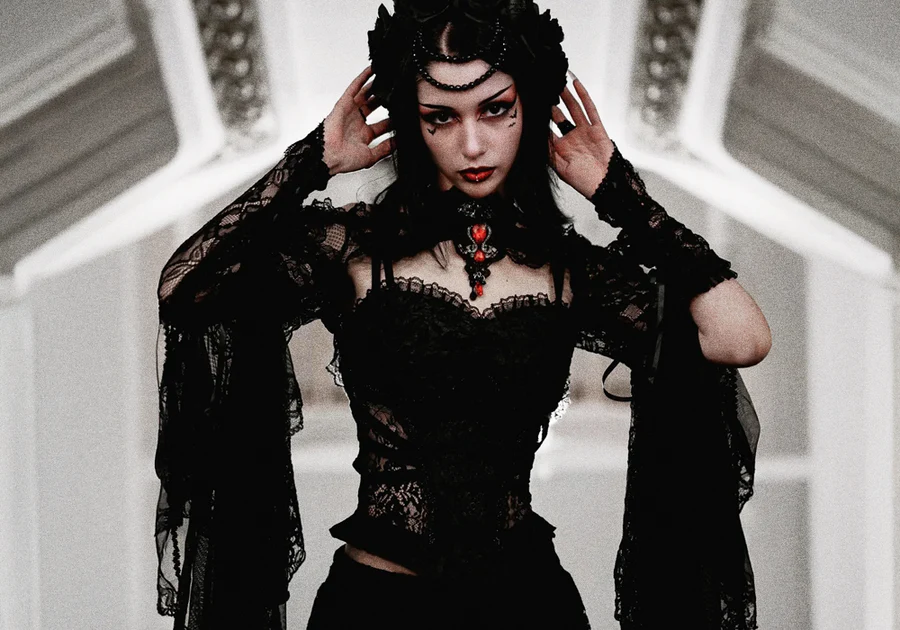
Another reason goth clothing resonates in modern fashion lies in its relationship with materials. Leather, lace, velvet, heavy cottons, and structured synthetics are chosen not for trend appeal, but for their ability to hold shape and convey presence.
Contemporary fashion frequently returns to these materials when seeking depth or seriousness. Whether softened or reinterpreted, they bring a tactile quality that contrasts with lighter, more disposable fabrics. Goth clothing’s emphasis on material weight aligns naturally with current discussions around longevity and quality.
A Focus on Silhouette Over Decoration
Goth clothing has always prioritized silhouette over surface-level detail. Clean lines, defined waists, elongated shapes, and controlled proportions create impact without relying on excess embellishment.
This principle has become increasingly relevant in modern fashion, where the overall shape of a garment often matters more than prints or logos. Designers influenced by goth aesthetics tend to focus on how clothing frames the body, moves, and occupies space. The result is fashion that feels intentional and enduring rather than ornamental.
From Subculture to Reference Point
While goth clothing originated within a distinct cultural context, its influence today extends far beyond subcultural boundaries. It has become a reference point rather than a fixed identity. Stylists may draw from goth silhouettes without adopting its full aesthetic, and wearers may integrate individual elements into otherwise neutral wardrobes.
This flexibility explains why goth clothing continues to feel relevant. It doesn’t demand total commitment. Instead, it offers components that can be adapted, layered, and reinterpreted. Specialized platforms focused on goth fashion, such as Killstar, Dollskill or Goth Apparel, reflect this evolution by presenting the style as a cohesive wardrobe rather than a costume or statement.
A Counterbalance to Fast Fashion
In a fashion landscape dominated by speed and constant renewal, goth clothing offers a counterbalance. Its emphasis on repetition, durability, and visual consistency stands in contrast to fast fashion cycles.
This doesn’t mean goth clothing rejects change. Rather, it integrates it slowly. Pieces are worn repeatedly, adapted over time, and valued for their staying power. This approach aligns with a growing desire for wardrobes built around continuity rather than constant replacement.
Why the Influence Endures
Goth clothing continues to influence modern fashion because it addresses something fundamental. It provides structure in an environment that often feels visually saturated. It offers seriousness without rigidity, and expression without excess.
Its influence is not always obvious, but it is deeply embedded in how contemporary fashion approaches color, silhouette, and material. Goth clothing doesn’t dominate trends, it underpins them.
Conclusion
The lasting influence of goth clothing is not accidental. It persists because it was never designed to follow fashion cycles. Built on structure, materiality, and consistency, it offers a framework that remains relevant regardless of shifting trends.
As modern fashion continues to balance expression with restraint, goth clothing remains a quiet but powerful reference. Not as a revival, but as a foundation that continues to shape how fashion looks, feels, and endures.