
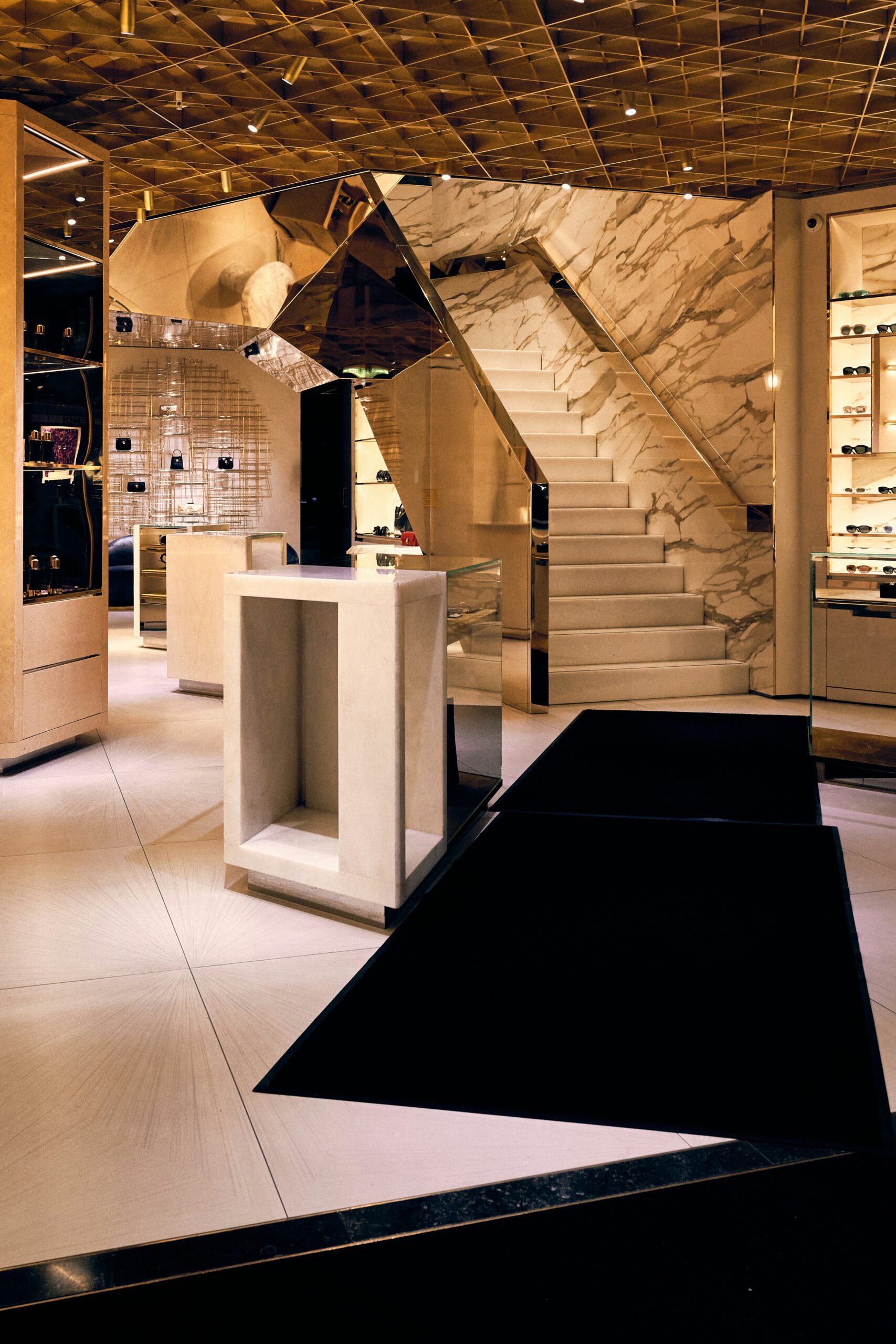
Kering’s third quarter contains one line nobody put in a headline. Store traffic fell while conversion rates and average transaction values rose. With fifty million consumers gone from the luxury market in two years, that sentence describes a different industry from the one running five years ago.
Kering’s third quarter was, on the face of it, unremarkable. Revenue of €3.345 billion, flat as reported and down one per cent like-for-like. Gucci down six. Jewellery up eleven, eyewear up four, Saint Laurent holding. Luca de Meo called Gucci’s recovery the top priority and said the transformation would take several seasons. Note the unit. Seasons do not appear on any financial calendar, and a chief executive answering a question about quarters in the language of collections is asking, courteously, for a different clock.
Buried in the commentary is a sentence that deserved more attention than it got. Store traffic declined. Conversion rates and average transaction values improved.
Fewer people came in. The ones who did bought more.
FLJ Insider Pro is open: live fashion law jobs and internships, five career guides and two roadmaps. Early bird USD 12/month. See what's inside
That is not a quarterly wobble. It is what the business has turned into while everybody was reading the Gucci line, and the same document says so again a few paragraphs later, in the flat register these releases reserve for their largest decisions. Kering will close at least 125 stores on a net basis this year.
Hold those two facts beside each other, because they are the same decision. A company watching its footfall fall and its conversion rise is a company that has stopped competing for volume. Closing a hundred and twenty-five doors while the remaining doors convert better is not retrenchment. It is a deliberate narrowing, and every house in the sector is making some version of it.
The context arrived two years ago, and the industry has been slow to say it out loud. Bain and Altagamma counted roughly fifty million luxury consumers leaving the market within twenty-four months, a figure Claudia D’Arpizio described as people who had either opted out or been forced out, with the pointed addition that this was a signal for brands to readjust their value propositions. Fifty million is not a slump. It is a structural subtraction, and nobody has replaced them.
So the industry has done the arithmetic available to it. If you cannot widen the base, you deepen it.
What that looks like is visible from the shop floor, if you know to watch for it. The woman selling to you has fewer people to sell to than she did three years ago. Which is why she has time to learn your name. Why is there a chair? Why the second thing she brings out costs rather more than the first, and why nobody is hovering behind her waiting for the till. Attention of that quality is not generosity, and it is not a change of philosophy. It is what happens to a sales floor when the footfall thins and the targets do not move.
This is the part worth sitting with. For twenty years luxury grew by recruitment. More stores, more cities, more entry-price objects, more people who had never owned anything from the house before buying their first wallet or their first bottle. The whole architecture of the business, the pyramid with the perfume at its base funding the couture at its top, depended on a permanent supply of new arrivals at the bottom.
That supply has thinned, and the industry has switched from recruitment to extraction. Not as a philosophy. As the only move left on the board.
The uncomfortable consequence is that the customer who stayed is now carrying the ones who left. Every price rise of the last five years, every repositioning upward, every closure of a store in a secondary city, asks a smaller group of people to produce the revenue a larger group used to produce. And the group that walked away was precisely the aspirational tier the pyramid was built to convert. Luxury lost the bottom of its own funnel and is attempting to make up the difference at the top.
For a while that works, because the top of the market is genuinely insulated and the conversion gains are real. Kering’s traffic may be down, but its average transaction value is up, and jewellery grew eleven per cent while fashion fell. The money is still in the building. There is simply less of it walking in the door, and it is being worked harder once it arrives.
The question nobody at a results presentation wants put to them is what happens in ten years. A business with no entry tier has no pipeline. The woman who bought her first branded thing at twenty-five is the woman who buys the bag at forty, and if she never buys the first thing she does not arrive for the second. An industry can live off its best customers for a decade. It cannot do it for a generation.
Which is why the line about conversion rates is the most revealing sentence in the release. It is being presented as an operational improvement, and it is one. It is also the sound of a business that has stopped expecting more people to come, and has begun engineering around the ones already inside.
The stores are getting better at selling because they have to. There is less to sell to.
FASHION LAW JOURNAL INSIDER
Join designers, brand founders and fashion lawyers who get the biggest brand battles, IP fights and career moves in fashion law, straight to their inbox.