

Most of what people picture when they think of 1950s fashion, from nipped waists and full skirts to gloves, hats and neat tailored suits, began with a single show in Paris on 12 February 1947. Christian Dior’s first collection made his house famous overnight and set the silhouette for a decade. It also made Dior the most copied designer in the world, and the couture houses spent the 1950s trying to control who could reproduce their designs, on what terms and how fast. This guide covers the key looks and designers of the decade and the copying wars behind them, including the court cases that still shape how fashion design is protected in the US.
Short answer: 1950s fashion grew out of Dior’s New Look of 1947: rounded shoulders, a cinched waist and long, full skirts. Balenciaga, Givenchy, Chanel and American designers such as Claire McCardell and Charles James pushed it in new directions. Paris houses sold toiles and patterns for licensed copying while fighting piracy through contracts and lawsuits, because US copyright gave dress designs little protection.
Key takeaways
- Dior launched his house on 12 February 1947 at 30 Avenue Montaigne with the Corolle and En 8 lines, which Harper’s Bazaar editor Carmel Snow christened the “New Look”.
- The decade moved from the fitted New Look towards looser shapes, including Dior’s H-line of 1954, Balenciaga’s sack dress of 1957 and Yves Saint Laurent’s Trapeze line for Dior in 1958.
- Paris houses earned money from copying by selling toiles, paper patterns and models to US stores under reproduction contracts, while suing pirates who sketched their shows.
- US courts would not protect dress designs on their own: Cheney Bros. (1929) refused, and the Supreme Court struck down the industry’s own anti-copying boycott in 1941.
What was Dior’s New Look?
Dior presented his first collection, for spring and summer 1947, on 12 February 1947 in his salons at 30 Avenue Montaigne. He called the two lines Corolle, after the petals of a flower, and En 8, for a figure-of-eight shape. The V&A records that Carmel Snow, editor of American Harper’s Bazaar, christened the look on the spot as the “New Look”.
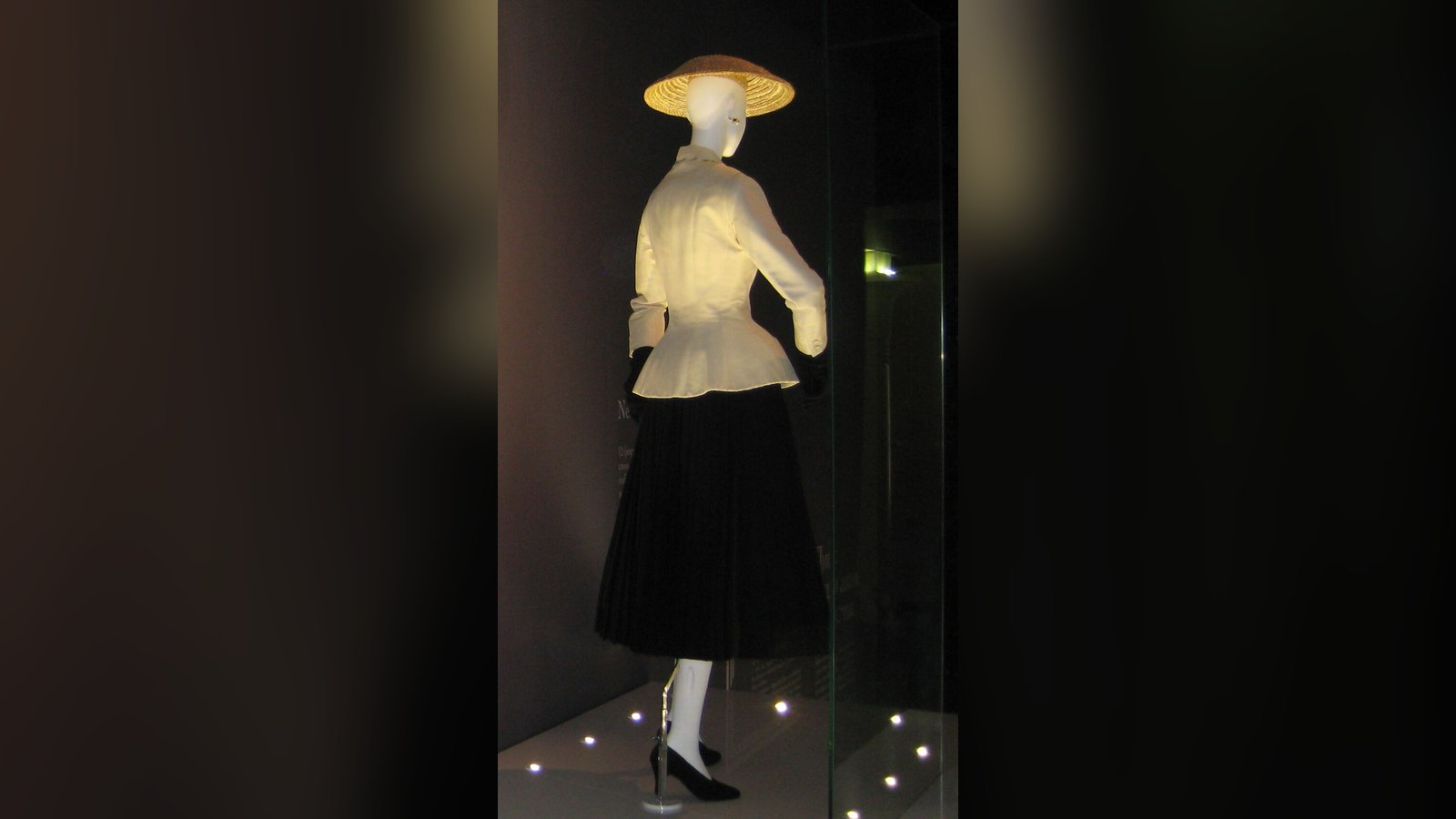
The best known outfit is the Bar suit: a pale silk jacket with a padded, flared peplum over a long black pleated skirt. According to the V&A’s record of the Bar suit, the jacket alone used 3.7 metres of silk shantung, and a typical New Look day dress needed about 15 metres of wool, with up to 25 metres for a short taffeta evening dress. Rationing was still in force in Britain, and the Board of Trade tried to discourage the style, but it spread anyway. By the early 1950s the New Look was the basic shape of Western womenswear, worn by shoppers who would never set foot in a couture salon.
FLJ Insider Pro is open: live fashion law jobs and internships, five career guides and two roadmaps. Early bird USD 12/month. See what's inside
Which designers and silhouettes defined 1950s fashion?
The decade did not stand still. Dior launched a new line each season, and rivals offered very different answers to the question of where the waist should be.
| Designer | Key 1950s moment | Year |
|---|---|---|
| Christian Dior | H-line, nicknamed the “runner bean” line for its straight, flat silhouette | 1954 |
| Cristóbal Balenciaga | Sack dress with no defined waist, and the high-waisted baby doll dress | 1957 |
| Hubert de Givenchy | Opens his own house; dresses Audrey Hepburn for Sabrina in 1954 | 1952 |
| Gabrielle Chanel | Reopens her couture house with a show on 5 February; launches the 2.55 bag in 1955 | 1954 |
| Charles James | “Four-Leaf Clover” ball gown, first made for the Eisenhower inaugural ball | 1953 |
| Claire McCardell | American sportswear built on practical designs such as the 1942 “Pop-over” dress | 1940s to 1950s |
| Yves Saint Laurent for Dior | Trapeze line, his first collection after Dior’s death on 24 October 1957 | 1958 |
The Metropolitan Museum’s essay on Balenciaga dates his sack dress to 1957 and his chemise to 1958, both with no visible waist, the opposite of Dior’s corseted start. Chanel, then in her seventies, came back in 1954 with a collection that opened with a jersey ensemble and was well received by the American press; her trimmed tweed suit followed in 1956. FLJ tells the business side of her return in our Coco Chanel profile.
In New York, two very different designers mattered. Charles James made sculptural ball gowns; the Met’s essay on Charles James notes that Dior, a friend, reportedly credited the New Look to an idea of his, and that in 1957 Dominique de Menil wrote that many Paris dresses “can be traced back to Charles James”. Claire McCardell went the other way, designing affordable ready-to-wear. The Met records that her 1942 “Pop-over” wrap dress, made by Townley Frocks, sold in the thousands at $6.95. For how this decade fits into the wider timeline, see FLJ’s guide to fashion era names.
How did Paris couture houses sell their designs to be copied?
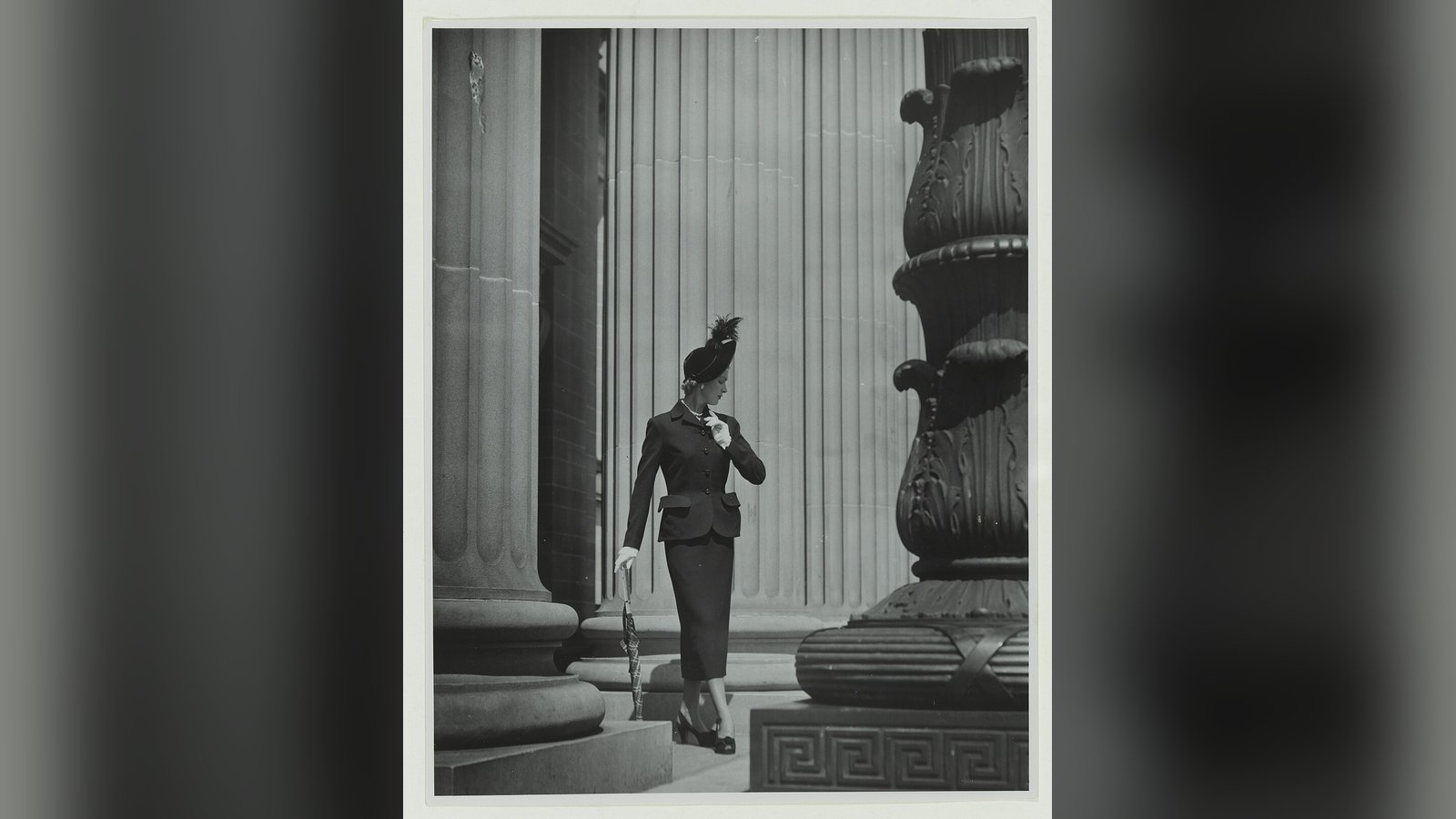
Copying was not only tolerated in the 1950s; it was part of the business model. Buyers from US stores such as Macy’s and I. Magnin travelled to the Paris shows to buy finished garments, paper patterns or muslin toiles, which they took home to reproduce. Stores advertised the results as “line-for-line copies” or “American editions of Paris originals”, sometimes naming the house, as the FIDM Museum’s study of 1950s couture copying shows. Buyers often simplified the design or changed fabric and colour for American customers.
The V&A holds a Dior toile from 1954, a calico skirt in a Dior-labelled envelope, catalogued as a “pattern for licensed copying”. Its label explains that buyers bought toiles, patterns or original models that “could only be copied a limited number of times”, and the museum also holds an August 1954 Chambre Syndicale de la Couture Parisienne contract for reproduction rights in a model supplied in fabric or as a canvas pattern.
Dior took this further than anyone. Licensing deals for furs, stockings and perfume followed from 1948, and in 1952 the house agreed with the Sydney label House of Youth to reproduce exclusive Christian Dior New York models for Australia, according to the National Gallery of Victoria. The NGV says Dior went on to account for half of all French haute couture exports. The Chambre Syndicale was uneasy about licensing, which it saw as cheapening couture, but the money was hard to ignore.
How did the couture houses fight unauthorised copyists?
Authorised copying only paid if unauthorised copying could be stopped. The houses used contracts and surveillance more than intellectual property law.
- Contracts at the door: guests were admitted by invitation only and agreed not to copy or pass on the models through photographs, sketches or descriptions. Buyers signed sales contracts, used by the plaintiffs in the Dior case from about 1948.
- Watching the room: according to the Chartered Institute of Trade Mark Attorneys’ account of Dior’s IP history, the house hired three or four people at each show to spot sketching, and journalists signed a guarantee before the Chambre Syndicale.
- Secret marks: to trace “model renters”, who bought originals through intermediaries and lent them out in New York for copying, Dior and others marked garments in indelible ink. Dior wrote that no dress left his house without it.
- Delaying the press: in 1956 Balenciaga barred journalists from the first private shows for clients and buyers and showed them the collection about a month later, after buyers’ orders had been made and delivered. He did so because published sketches let manufacturers copy without paying.
What was the Dior v. Milton case?
The best documented legal battle of the decade was in New York. Dior and three other Paris houses sued Frederick L. Milton and two New York companies that ran a “sketch service”, selling drawings of the Paris collections to subscribing manufacturers. The houses alleged that the defendants got into the shows by false statements and false promises, persuaded staff to break their obligations and sold reproductions of the designs.
In July 1956, in Dior v. Milton, 155 N.Y.S.2d 443, Justice Henry Clay Greenberg of the New York Supreme Court refused to dismiss the case. The claim rested on unfair competition and interference with the houses’ licensing contracts, not on copyright. He described the defendants’ “unconscionable business practices and their invasion of the moral standards even of the market place”, and rejected arguments based on free speech and restraint of trade. The point was that the houses could protect the secrecy of their shows and their contracts, even if they could not own the designs themselves.
Why couldn’t designers rely on US copyright law?
Because US law treated most dress designs as unprotected. Two earlier cases set the frame for the 1950s.
Cheney Bros. v. Doris Silk Corp. (1929). A silk maker whose seasonal patterns were copied asked the court for protection without a patent or copyright. On 21 October 1929 the Second Circuit, in an opinion by Judge Learned Hand, refused. Without a patent, copyright or other recognised right, the designer’s property extends only to the physical goods, and others may copy. Hand added that “Congress might see its way to create some sort of temporary right, or it might not”. The full opinion is short and still widely taught.
Fashion Originators’ Guild of America v. FTC (1941). Denied help by the courts, American dress and textile makers tried self-help. The Guild ran a design registration bureau, sent “shoppers” to inspect stores and organised a boycott of retailers that sold copies, which about 12,000 retailers signed up to. On 3 March 1941 the Supreme Court upheld the FTC’s order against the scheme as an unlawful combination, noting that the members admitted their designs were neither copyrighted nor patented.
That left the Paris houses with contracts, trade secrets and unfair competition claims such as Dior v. Milton. The gap has narrowed only a little since. In Star Athletica v. Varsity Brands in 2017, the Supreme Court held that artistic features of clothing can be copyrighted if they can be imagined separately from the garment, but the cut and shape of a dress still cannot. FLJ explains the modern position in Star Athletica v. Varsity Brands and does fashion design qualify for copyright protection.
What is the 1950s legacy for fashion law today?
Much of the modern fashion business started in this decade. Dior’s licensing model, which turned a couture name into stockings, perfume and ready-to-wear, is the template for luxury brands now. The fight over runway images, once about sketches smuggled out of a salon, is now about photographs online within minutes of a show. And the US still has no general design right for clothing, so brands lean on trade marks, trade dress and contracts, much as Dior did. For how couture itself is defined and regulated, see FLJ’s guide to what makes a fashion house.
Frequently asked questions
What was the main style of 1950s fashion?
The dominant shape was Dior’s New Look: rounded shoulders, a small cinched waist and a long, full skirt. Later in the decade, looser lines such as Balenciaga’s sack dress and Saint Laurent’s Trapeze offered an alternative.
When did Dior launch the New Look?
On 12 February 1947, at 30 Avenue Montaigne in Paris. The collection’s lines were called Corolle and En 8, and Carmel Snow of Harper’s Bazaar named it the New Look.
Who were the most important 1950s fashion designers?
Christian Dior, Cristóbal Balenciaga, Hubert de Givenchy and Gabrielle Chanel led Paris, while Charles James and Claire McCardell were among the most influential in the US. Yves Saint Laurent took over at Dior after Dior’s death in 1957.
Was copying couture legal in the 1950s?
Authorised copying was legal and common: US stores bought toiles and patterns under reproduction contracts. Unauthorised copying was harder to stop, because US copyright did not protect dress designs, so houses relied on contracts and unfair competition claims.
What did Dior v. Milton decide?
In 1956 a New York court refused to dismiss a suit by Dior and three other Paris houses against a sketch service that sold drawings of their shows, allowing unfair competition and contract interference claims to proceed.
Can you copyright a dress design in the US today?
Only partly. Since Star Athletica in 2017, artistic features such as prints or graphic elements can be protected if they can exist separately from the garment, but the overall cut and silhouette of a dress cannot.
Historical dates are taken from museum and court records as cited. This article is general information, not legal advice.
Featured image: Photo: shakko via Wikimedia Commons, CC BY-SA 3.0, adapted
FASHION LAW JOURNAL INSIDER
Join designers, brand founders and fashion lawyers who get the biggest brand battles, IP fights and career moves in fashion law, straight to their inbox.