






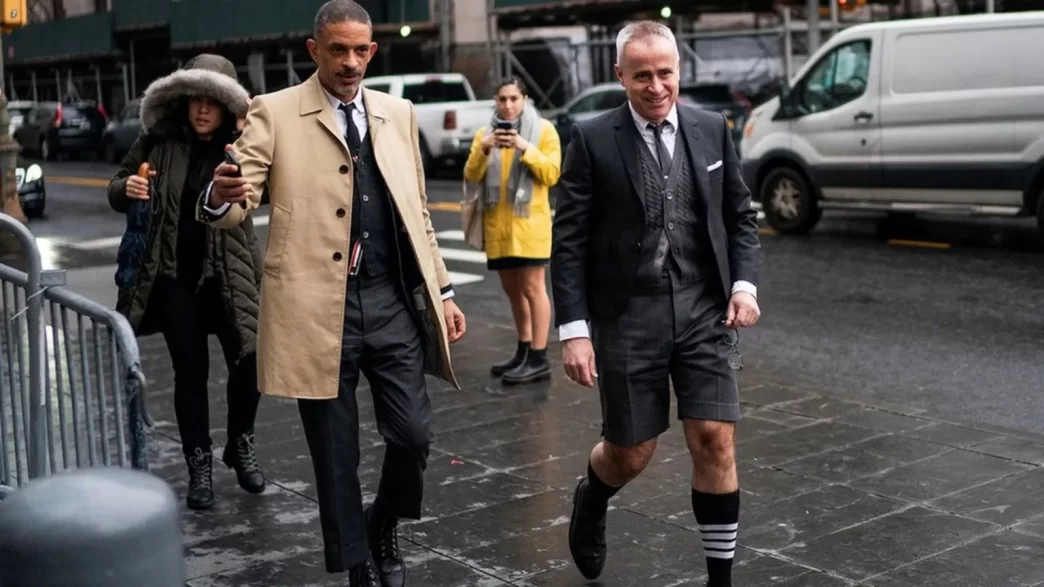
A dispute spanning over a decade, on Thom Browne Inc.’s four-bar and Adidas AG’s three-stripe motif, has gone global and culminated in a collection of landmark case law on position mark disputes:
Introduction
The case of Thom Browne Inc v Adidas AG was finally settled in the Court of Appeal (Civil Division) last week, with Peter Jackson LJ, Arnold LJ and Falk LJ affirming the decision of Judge Joanna Smith.
Case Summary, Thom Browne Inc v Adidas AG [2024] EWHC 2990 (Ch)
The initial case was brought by Thom Browne Inc, challenging sixteen trademarks registered by Adidas under s. 46 of the Trade Marks Act 1994. Adidas retaliated, claiming trademark infringement and passing off by the brand in relation to its expansion into sportswear, utilising its four-bar logo under s10(2) and (3) of the same act.
Adidas’s trademark registrations would be subject to revocation if there was uncertainty about the range they covered, creating an unfair monopoly if the ordinary person could not understand them. Several trademarks were found to lack the precision and clarity required by the Dyso case, leading to a partial or total revocation for several trademarked items. However, it was conceded that the brand’s marks had assumed a distinctive character; the argument made by Thom Browne Inc. against this for non-use was rejected.
The case of infringement against Thom Browne Inc. hinged on post-sale confusion and whilst degrees of similarity were considered between articles of the opposing brands clothing, what Judge Smith found most compelling was that no material evidence of confusion or loss could be provided by Adidas, the quality of their evidence (a collection of 19 Instagram comments, supposedly showing confusion between Thom Browne and Adidas collections)was criticised by Judge Smith for being irrelevant to their jurisdiction and on inspection, not actually in their favour. Further critiques of their evidence included a “blatant breach of requirements”, “heavily over-lawyered” witnesses, and “highly speculative” arguments.
The evidentiary task would be a fashion archivist’s dream, with 2015 Vogue spreads, Met Gala looks, and vintage sportswear providing the demonstrative basis of origin, inspiration and aesthetic for Thom Browne Inc., proving that the brand’s foray into athleisure was organic and not a material leap that Adidas could challenge. Thom Browne’s Compression Range figures were also shared, with Judge Smith remarking that it was “extremely unsuccessful…. selling just 327 pieces since its launch”, an embarrassing but necessary admission to show that Thom Browne’s foray into sportswear does not encroach on Adidas’s market share or value.
Appeal, [2025] EWCA Civ 1340
Adidas appealed on four grounds:
- That Judge Smith had misunderstood the Dyson case in her application of it.
- Misinterpretation of their trademarks and their variations
- Dispute over the relevance of pictorial accuracy and clarity in trademark filings
- Failure to consider the original message of their brand
Finding no error on all counts, the appeal was dismissed.
‘The New York Proceedings’
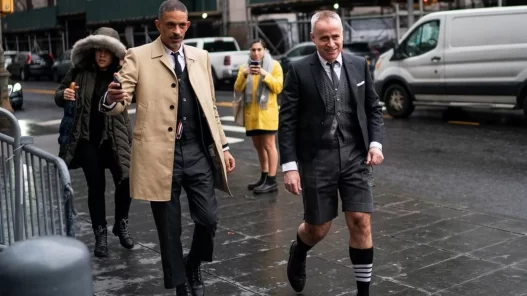
Adidas’s complaints crossed the Atlantic and were filed, also, in New York. The classic flair and showmanship we have come to expect of American legal proceedings were in full force, with Thom Browne turning the courthouse pavement into his personal catwalk. A charisma and confidence that was not lost on jurors, his evident passion for his craft was considered a moving factor amongst some commentators. Even the supervising judge seemed affected, engaging in some humorous back-and-forth with the designer during his oral testimony. With similar reasoning to its UK counterpart case, the New York court also dismissed Adidas’s claims. Thom Browne emerged triumphant from the New York courts, celebrating his win as a victory for both designers, creative freedom and brand integrity.
Both Judge Smith and Judge Rakoff’s comments had underlying currents of distaste and disapproval for the Adidas camp, criticising them both on prior procedure and evidentiary issues. Could it be symptomatic of a fatigue in the legal world of an almost bullying and excessive employment of the courts by Adidas? Using them as a stomping ground (90 lawsuits and 200 settlements have occurred since 2008 in relation to the three-stripe logo) to extend their industry monopoly instead of having any concern for the actual artistic integrity of their intellectual property.
Germany
Even in Germany, the brand’s home ground, Adidas lost its footing. Notably, the Nuremberg-Furth court emphasised that the target demographic and the context of sale of a brand are a considering factor in trademark disputes. Thom Browne’s target of luxury consumers, assumedly informed on fashion, and their predominantly online storefront provide sufficient distinction in the market against Adidas to prevent any post-sale confusion and any violation of unfair competition law; furthermore, the difference in their motifs – the number of stripes and their proportions – was significant enough to not be a trademark infringement.
Conclusions and Cultural Commentary
The three-stripe challenge has been resoundingly quashed across three jurisdictions. In an industry so fundamentally global, what are the shared takeaways from these judgments?
Primarily, precision is your protection. In an attempt to solidify their hold on the market, Adidas cast their net too wide – achieving the opposite of domination and instead facing a reduction of their trademarks for being too vague and far-reaching.
Adidas’s representation commented after the New York result that they were: “disappointed with the verdict and will continue to vigilantly enforce our intellectual property, including filing any appropriate appeals.”
Adidas may instead want to focus on greater diligence in the filing of its trademarks, instead of possible infringements; the media attention from these court proceedings will have more far-reaching consequences for Adidas. Adidas has presented as a faceless conglomerate, in contrast with Thom Browne, who has become an almost folk hero of the fashion world and defender of designers.
Adidas is at risk of developing a reputation for corporate greed. Criticism also arose after they threatened to file an action against the social justice movement ‘Black Lives Matter’ for also employing three stripes in their logo. This was quickly dropped after swift backlash from consumers. In times of widening economic disparity, even just the appearance of corporate greed is not an endearing quality for a brand. It is something consumers are becoming increasingly aware of and distasteful of – with duping culture on the rise, Adidas may want to be vigilant and not aid in pushing their consumers into the arms of counterfeits and copies for the sake of a boycott.
Robert T. Maldonado, a legal representative for Thom Browne Inc., made one of the most encapsulating comments that cut across all the cases: “Adidas does not own stripes”. Something the courts have clearly resonated with.
Author: Elisa Terra
Elisa Terra is a second-year Scots Law with Spanish student at the University of Glasgow. She is excited to expand and apply her interests in intellectual property and fashion in a global context as she pursues her third year abroad in Spain.