If you have bought a pre-owned designer bag online recently, there is a fair chance an AI checked it before you did. Entrupy is the best-known name in machine authentication: a reseller scans a bag with a phone, an algorithm compares the images with its records, and an “Authentic” result comes with a certificate and a money-back guarantee. This guide looks at how Entrupy works, what its accuracy figure does and does not prove, and what its certificate is worth if the bag turns out to be fake.
Short answer: Entrupy is a New York company, founded in 2012, that sells AI authentication to businesses. It claims 99.86% accuracy and backs each certificate for a year, but that figure is its own and no independent audit has been published. Its guarantee covers the subscribing business, not the end buyer, and brands are not bound by its findings.
Key takeaways
- From 18 May 2026 Entrupy began moving customers to a phone-only app, ending the loaned iPhones and lens attachments it supplied for handbags.
- The 99.86% accuracy rate is Entrupy’s own claim; earlier marketing and press used 99.1%, and the founders’ 2017 research paper reported about 98% per image.
- The financial guarantee runs to the business that holds the subscription. Under its terms, a buyer holding a certificate is sent back to the seller.
- A certificate does not shield a seller from liability: US courts in Nike v StockX and Chanel v What Goes Around Comes Around held resellers responsible for the fakes they sold.
What is Entrupy?
Entrupy is a New York technology company, founded in 2012, that sells authentication as a subscription. Vidyuth Srinivasan is its co-founder and chief executive. The approach came out of research by Srinivasan, Ashlesh Sharma, Vishal Kanchan and Lakshminarayanan Subramanian, who is also affiliated with New York University. Their 2017 paper, “The Fake vs Real Goods Problem: Microscopy and Machine Learning to the Rescue”, set out the idea: genuine goods share tiny material details that counterfeiters struggle to copy, and a machine can learn them from magnified images.
The service is sold to businesses, not shoppers. Entrupy’s FAQ says it is “only available to organizations” with a business licence and a working website or verified social media accounts. Users include resellers, consignment shops, pawnbrokers and marketplaces.
FLJ Insider Pro is open: live fashion law jobs and internships, five career guides and two roadmaps. Early bird USD 12/month. See what's inside
How does Entrupy authentication work?
For most of its history, handbag checks needed Entrupy’s own kit: the 2017 paper describes a microscope attachment giving 100 to 300 times magnification, and Entrupy later loaned customers iPhones and iPods with a lens. In its notice on the new Entrupy experience, the company says that from 18 May 2026 it is “moving from device-based microscopic authentication to a completely device-free authentication system”.
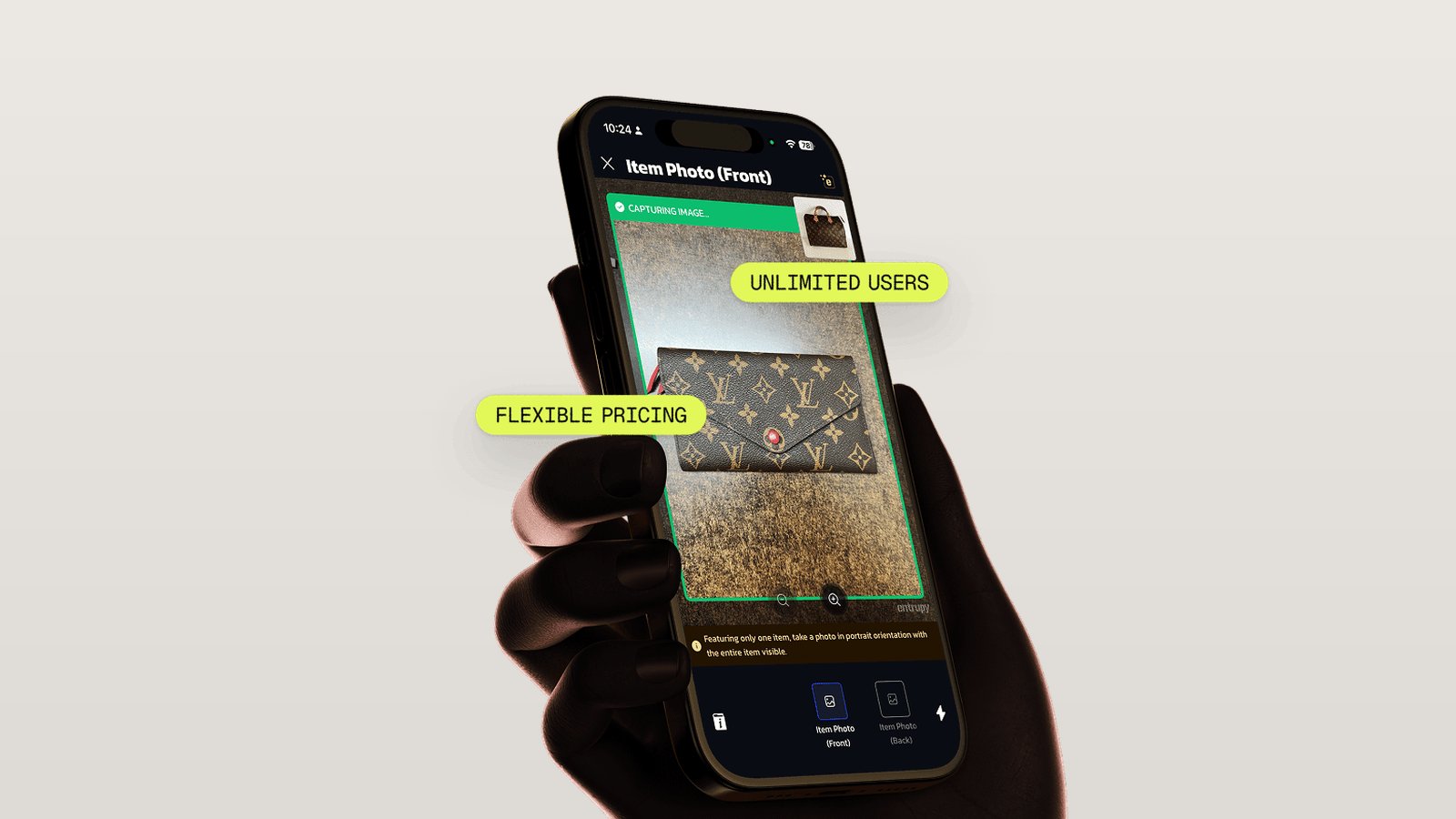
Today the user picks the brand and material in the Entrupy app on their own iPhone or Android phone, then follows prompts to photograph set areas of the item: the exterior, logo, hardware, material, interior and date code. The AI compares the images with its database and returns “Authentic” or “Unidentified”. Entrupy “does not classify items as counterfeit”, so Unidentified means the system could not confirm the item, not that it is proven fake. Results usually arrive within minutes, though some “ultra prestige” pieces can take up to 24 hours.
Plans run on tokens: Petit costs $139 a month for 25 tokens, Moyen $599 for 125 and Grand $1,049 for 250, with an Enterprise tier priced on request. A bag uses 2 to 20 tokens depending on its tier, so one prestige bag on the entry plan costs roughly $45.
Which brands does Entrupy cover, and who uses it?
Entrupy covers bags and leather goods from more than 20 houses, including Chanel, Louis Vuitton, Hermès (select styles), Dior, Gucci, Prada, Goyard and Coach. It also checks sneakers (Nike, Jordan, Adidas and others), streetwear, eyewear and jewellery. The sneaker service has stricter rules: both shoes must be scanned, the original box is required, and Entrupy says it “only guarantees accuracy for new products”.
The clearest public endorsement comes from TikTok Shop. Its US pre-owned products rules require every pre-owned luxury handbag listed (minimum list price $200) to carry a certificate of authenticity, uploaded within 24 hours of purchase, from an approved service. Entrupy is on the approved list alongside Real Authentication, LegitMark, LegitApp and CheckCheck. Fashionista reported in 2019 that Goodwill was a nationwide partner, and Entrupy’s homepage displays logos of businesses including ShopGoodwill, Clothes Mentor and Style Encore.
The brands keep their distance. Entrupy’s handbag page states that it “is not sponsored by or affiliated with any of the designers” and that they “may not honor any certificates of authenticity provided by Entrupy”.
Is Entrupy accurate?
Entrupy says its authentication “has a 99.86 percent accuracy rate”. Press coverage in 2019 and 2023 quoted 99.1%. None comes with published test data, a definition of accuracy (how often a fake passes versus how often a genuine bag is left Unidentified) or an outside audit. We found no independent test of the current system.
The closest thing to evidence is the founders’ own 2017 paper, which reported classification accuracy of “more than 98%” on single microscopic images across materials such as leather, fabric and plastic. The paper is candid about limits. It says a counterfeiter “with access to very high precision manufacturing machinery” could copy the visual features, and that the system is “not designed to detect” fakes made by someone who has infiltrated the genuine supply chain. It also predates the switch to ordinary phone cameras.
The supply-chain point is not theoretical. In the Chanel v What Goes Around Comes Around case, the court’s final judgment lists counterfeit bags carrying serial numbers from authenticity cards and labels stolen from the Renato Corti factory on 29 November 2012, which Chanel had voided. Human experts face the same problem, so provenance matters as much as stitching; FLJ’s guide to spotting counterfeit luxury before buying sets out the checks a buyer can make.
What does an Entrupy certificate mean legally?
An Entrupy certificate is a private company’s statement that its system found the item authentic. It sits at a unique cert.entrupy.com link, so a buyer can check it has not been altered. It is not a brand certificate or a warranty given to the buyer.
The Entrupy guarantee terms make the legal position plain. The guarantee “is only offered directly to” the licensee, the business that paid for the subscription. It cannot be transferred, and anyone else holding a certified item who contacts Entrupy is referred back to that business. Cover lasts one year from the certificate’s issue date. If Entrupy re-examines the item and finds it not authentic or inconclusive, it pays the licensee the documented purchase price for an outright purchase, but only the commission earned on a consignment or marketplace sale, and a flat $100 for authentication sold as a service. If the item proves authentic, the business pays a dispute fee of $100 to $250. Entrupy can also revoke a certificate at any time for suspected fraud or irregular use.
So if a certified bag turns out to be fake, your claim is against the seller, not Entrupy. A reseller’s own authenticity promise is also its own legal risk. The final judgment in Chanel v What Goes Around Comes Around, entered on 26 February 2025, bars the reseller from “certifying, guaranteeing, or otherwise making any advertising claims” that a Chanel item is genuine where it has “no records of its own authentication” to support that claim (Final Judgment, Dkt 505). It also ordered $4 million in statutory damages after a February 2024 jury verdict.
Can resellers sell genuine designer bags without the brand’s permission?
Yes, if the goods are genuine and accurately described. In the US this is the first sale doctrine. In Chanel v The RealReal, Judge Vernon Broderick repeated the general rule that the Lanham Act does not impose liability for “the sale of genuine goods bearing a true mark even though the sale is not authorized by the mark owner” (Opinion and Order, 30 March 2020). He dismissed Chanel’s infringement claim over the use of its name to sell genuine items. FLJ explains why the first sale doctrine protects resellers.
The protection stops at three points. It does not cover fakes. It does not cover items the brand never released, such as stolen stock or voided serial numbers. And it does not cover implying a link with the brand: the WGACA judgment requires a disclaimer on every Chanel product page saying the reseller “is not affiliated with Chanel”. EU and UK law reach a similar result through exhaustion of rights, which applies only to goods the brand has put on the market (in the EEA for EU law; in the UK or EEA for UK law) itself or with its consent.
Are platforms liable when an authenticated item is fake?
Increasingly, where the platform controls the sale. In Nike v StockX, Judge Valerie Caproni held StockX liable in March 2025 for distributing 37 pairs of counterfeit Nikes, despite its “Verified Authentic” tags; the case settled in August 2025, as FLJ’s StockX guide explains. In Chanel v The RealReal, the court let Chanel’s counterfeiting and false advertising claims proceed. It held that The RealReal, which takes possession of goods and decides in its “sole discretion” what to sell, is “more than a platform”, unlike eBay in Tiffany v eBay. It called the promise that every item is “100% the real thing” an “unambiguous representation of fact”. The case is still running in 2026.
In the EU, the Court of Justice ruled in Louboutin v Amazon (22 December 2022) that a marketplace operator can itself be treated as using a trade mark in third-party listings where users would link the sign to the operator’s own services. The Digital Services Act also removes a marketplace’s liability shield under consumer law where it presents a product so that an average consumer would think the platform itself is selling it. See FLJ on who is liable for fakes on resale platforms.
What can buyers do in the UK and EU?
When you buy from a business, a fake sold as genuine is not “as described”. In the UK, section 11 of the Consumer Rights Act 2015 requires goods to match their description, and the short-term right to reject gives you 30 days for a full refund. Online purchases usually also carry a 14-day right to cancel under the Consumer Contracts Regulations 2013. In the EU, the Sale of Goods Directive (2019/771) makes the seller liable for lack of conformity that shows within two years, although member states may let the seller and consumer agree a shorter period for second-hand goods, of no less than one year. These rights run against the trader, whatever certificate came with the bag, and generally do not cover private sales between individuals.
For why luxury houses fight resale fakes so hard, the Brand Case Study Pack looks at how Chanel, Hermès and Louis Vuitton protect scarcity and pricing power.
How does Entrupy compare with human authenticators and brand-side tech?
| Feature | Entrupy (AI) | Human authenticators | Brand-side tech (QR, NFC, digital passports) |
|---|---|---|---|
| Who checks | Algorithm trained on Entrupy’s image database, with staff review for some items | Trained staff at a reseller, platform or independent service | The brand, which records the item at manufacture |
| Method | Guided phone photos of set areas, compared by AI | Physical or photo inspection of materials, hardware, stamps and codes | A tag, chip or code linked to a brand record; Aura (LVMH, Prada, Cartier) issues blockchain certificates |
| Speed | Usually minutes; up to 24 hours for ultra prestige | Varies by service | Instant scan, if the item has a tag |
| Published accuracy | 99.86% (company claim, not independently audited) | Rarely published | Not published |
| Brand backing | None; designers “may not honor” certificates | None unless the brand runs the service | Yes, issued by the brand |
| Guarantee | One year, to the subscribing business only | Depends on the platform or service | Not a guarantee; proof of origin from the brand |
| Coverage of older items | Supported brands and styles only | Any item the expert knows | Only items made after the brand added tags |
Sources: Entrupy’s product, pricing and guarantee pages and the Prada Group’s Aura announcement (20 April 2021), checked on 13 November 2026. The EU’s textile digital product passport, with rules planned for late 2027, is presented by the European Commission as a source of product, repair and recycling information rather than an authentication system. FLJ’s guide to QR code authentication for fashion brands explains how brand-side IDs work.
Frequently asked questions
Is Entrupy legit?
Yes. Entrupy is a real New York company, founded in 2012, used by resellers and approved by TikTok Shop as an authenticator for pre-owned luxury handbags. Its accuracy claims are its own and have not been independently audited.
Is Entrupy accurate?
Entrupy claims a 99.86% accuracy rate, and earlier quoted 99.1%. It has not published test data or an outside audit, and its founders’ own research says supply-chain leaks and very high-end fakes are hard to catch.
Can I use Entrupy as a private buyer?
Not directly. Entrupy’s FAQ says its service is only available to organisations with a business licence and a working website or verified social accounts. Private buyers rely on a seller or platform that subscribes.
What does “Unidentified” mean on Entrupy?
It means the system could not confirm the item as authentic. Entrupy says it does not classify items as counterfeit, so an Unidentified result is not proof of a fake, but it gives the seller no certificate to show the item is genuine.
Does an Entrupy certificate protect the buyer?
Only indirectly. The one-year guarantee is offered to the business that holds the Entrupy subscription, and buyers who contact Entrupy are referred back to the seller. Your legal claim for a fake is against whoever sold it to you.
Do luxury brands accept Entrupy certificates?
Not as a rule. Entrupy says it is not affiliated with any designer and that brands may not honour its certificates. A certificate is Entrupy’s opinion, not the brand’s confirmation.
Company, pricing and case information is as of 13 November 2026. Entrupy’s plans and terms change, so check the current versions before relying on them. This article is general information, not legal advice.
Featured image: Photo: Entrupy
FASHION LAW JOURNAL INSIDER
Join designers, brand founders and fashion lawyers who get the biggest brand battles, IP fights and career moves in fashion law, straight to their inbox.