
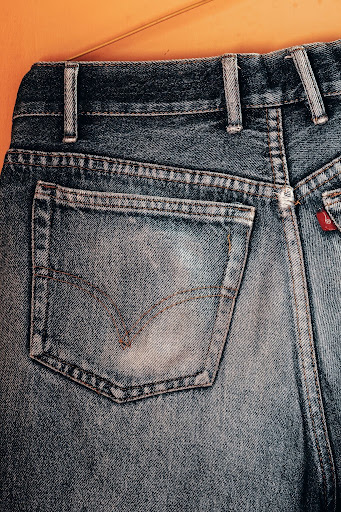
Since 1873, Levi’s has held on to their iconic back pocket design, also known as the ‘Arcuate’ design. It is a design pattern with two rows of stitches that together make a seagull-like shape. This design pattern is an identifiable feature of Levi jeans. Other denim brands have various back pocket designs, or ‘back pocket signatures’. They are decorative, as well as functional, as they also can work to secure the pocket lining. In 2007, Levi sued Abercrombie & Fitch (‘Abercrombie’) for trademark dilution of the ‘Arcuate’ design in the district court. Abercrombie’s back pocket design, known as the ‘Ruehl’, is a design pattern with one row of stitching shaped in a seagull-like shape and shows the infinity sign at the centre of the ‘seagull’. In the 2007 district court trial, the court ruled in favour of Abercrombie. However, Levi argued that the district court had erred in its application of the law, and Levi appealed to the United States Court of Appeals for the Ninth Circuit. The appeal case was argued and submitted on June 16th 2010, and the Ninth Circuit provided its ruling on February 8th 2011.
This case study sets out the arguments both parties presented to the courts, the outcome, and the impact this had on trademark law.
Levi v. Abercrombie: An Overview
- Dilution-by-blurring. Levi sued Abercrombie for their ‘Ruehl’ design by claiming dilution-by-blurring. This means Levi argued that the ‘Ruehl’ design weakens Levi distinctiveness or harms its reputation.
- Statute: Trademark Dilution Revision Act of 2006 (‘TDRA’). Under this statute, famous trademarks are protected from losing their unique distinctiveness.
- Case Law: PerfumeBay.com Inc v eBay (2007). This case is one of several cases from the appellate court where the TDRA’s application was conducted, where the accused mark required an ‘identical or nearly identical’ design to the plaintiff’s mark.
Levi’s Argument: Let’s stick to statutes
Levi based their argument on the plain language of the TDRA 15 U.S.C. 1125(c). Taking a look at the plain language of the TDRA, Levi argued that, for a dilution claim a design does not require to be substantially similar before the district court balances the dilution factors listed in 1125(c)(2)(B). It therefore argued that a ‘degree of similarity’ is required as one of several factors the court must balance in order to determine whether dilution has occurred.
Abercrombie’s Argument: Let’s consider the case law
In contrast to Levi, Abercrombie did not base its argument on the language of the statute. In fact, they based their argument on the case law of the appellate court. It uses evidence from various cases on how the court had historically applied the TDRA. Abercrombie asserted that the court had determined that the junior mark must be ‘identical or nearly identical’ to that of the senior mark, in order for a successful claim of trademark dilution. Abercrombie asserted the court did this in three cases: in Perfumebay.com Inc. v. eBay (2007), Jada Toys Inc. v. Mattel (2008), and Visa International Service Association v. JSL Corp (2010).
FLJ Insider Pro is open: live fashion law jobs and internships, five career guides and two roadmaps. Early bird USD 12/month. See what's inside
The ‘identical or nearly identical’ requirement had been developed through the circuit, with its origin tracing back to Playboy Enterprises Inc. v. Welles (2002). In this case, case law was applied from the Eighth Circuit’s Luigino case. In this case, the court held that ‘to support an action for dilution-by-blurring, ‘the marks must be at least similar enough that a significant segment of the two target groups of customers sees the two marks as essentially the same’.
What was the outcome?
The appellate court, the Ninth Circuit, held that the district court’s analysis of a dilution-by-blurring was faulty. It held that this was an outdated test in comparing the designs. It held that the TDRA, in its plain language, does not require the marks to be ‘identical or nearly identical’ for a dilution-by-blurring claim. Under the TDRA, a degree of similarity is required as one of several factors a court must balance when evaluating a claim for trademark dilution.
In its analysis, the court looked towards Congress’s rewriting of 15 U.S.C 1125(c). The TDRA rewrote this section of the 1995 Federal Trademark Dilution Act. The court believed that the rewriting was ‘significant’, as it suggested that ‘Congress did not want to be tied to the language or interpretation of prior law’, but rather ‘craft a new approach’ to dilution-by-blurring claims.
The court reversed the district court judgment and remanded the case to the lower court.
Impact on trademark law: Defining dilution
This decision, affirming the plain language in the TDRA, resets the definition of dilution. Despite an ancestry of case law applying the TDRA with a requirement for ‘identical or nearly identical’, the court took a U-turn decision. This decision suggests that the U.S. federal courts may be moving towards a uniform application of the TDRA.
This decision concurs with another appellate court case. In the Second Circuit, Starbuck Corp. v. Wolfe’s Borough Coffee Inc. (2009), held that near or exact identity did not survive the enactment of the TDRA. Since two cases in the appellate courts have affirmed that the ‘identical or nearly identical’ standard is inapplicable, this standard will likely be difficult to challenge.
FLJ has conducted case analysis on a recent dilution-by-blurring case in adidas Opposes E-Scooter Maker Infinite Machine’s Three-Rectangle Logo, and provides a guide to the statutes that govern dilution in The Lanham Act Explained for Fashion Brands.
This case study is for general information as of October 2026 and is based on commentary by law firms, commentary by lawyers, and court reports. It is not legal advice.
Author: Noreen Khan

Noreen undertook her Law LLB from the University of Manchester. In her time as a student Noreen was Editor-in-Chief of The Manchester Tab, an online student magazine. Bringing her enjoyment of journalism and law together, Noreen is excited to be writing for the Fashion Law Journal. Noreen enjoys investigating IP disputes, supply chain, and sustainability in fashion.
FASHION LAW JOURNAL INSIDER
Join designers, brand founders and fashion lawyers who get the biggest brand battles, IP fights and career moves in fashion law, straight to their inbox.