







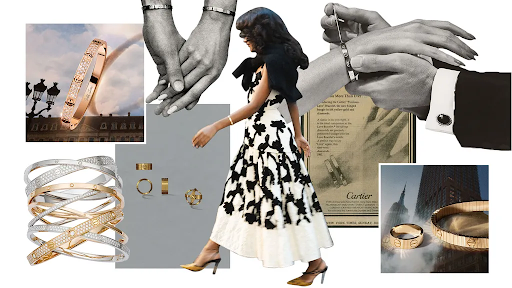
Locked in love, wrapped in light— Cartier’s timeless creation reflects the beauty of devotion and whispers the language of forever.
“A bracelet that speaks of love now tells a story of legal protection.”
In 2025, Cartier’s world-famous “LOVE” bracelet became the centre of a judicial proceeding when Société Cartier International AG took legal action against the British Jewellery brand Goussin Ltd. for trademark infringement and unfair competition. However, the Judicial Court of Paris ruled in favour of the luxury brand Cartier, awarding damages and permanently barring Goussin from using the term ‘Love’ as a brand identifier. Beyond Cartier’s victory, this case serves as an eye-opener for emerging brands—a reminder that the law values originality and protects creative innovation. It highlights the importance of intellectual property that can prevent imitation and preserve the unique attributes of your brand, which is essential for long-term success in the luxury fashion market.

The Story Behind The Love Bracelet
One of the most recognisable and timeless pieces of jewellery—the Cartier ‘LOVE’ bracelet — was created by Aldo Cipullo in New York in 1969. It is believed that the design of this iconic bracelet was influenced by Cipullo’s own experience with heartbreak— he became fascinated with the idea of capturing love in a tangible form and something that represented balance. From that longing, Aldo efficiently designed the world-famous ‘LOVE’ bracelet, symbolising modern romance and commitment. This unisex gold jewellery featured a distinct screw mechanism intended to be locked onto the wrist and could only be opened with a small screwdriver—often kept by one’s partner.
Aldo challenged traditional jewellery norms by creating this minimalist yet bold bracelet intended for constant wear, rather than for formal occasions. However, before becoming Cartier’s most celebrated creation, the bracelet was actually rejected by Tiffany & Co. Luckily, Cartier saw what Tiffany couldn’t— and the rest is the history of luxury fashion. Over 50 years after its launch, the ‘LOVE’ bracelet has been spotted on the wrists of many royals and celebrities, including the Duke and Duchess of Sussex, Angelina Jolie, Jennifer Aniston, Justin Bieber, and Kylie Jenner, among many others. Of course, when something becomes this remarkable, it also becomes a magnet for imitation— and that’s exactly how Cartier’s ‘LOVE’ bracelet became a subject of legal protection.
The Lawsuit: Cartier’s Claims
In December 2021, Cartier discovered that a UK-based jeweller, Goussin LTD., was allegedly marketing and selling bracelets using the term ‘LOVE’ and a design identical to Cartier’s highly recognised bracelet. Cartier’s legal team sent a formal notice to Goussin, demanding that it cease the use of the word ‘LOVE’ in its bracelets, but the notice went unanswered.
In September 2022, Cartier filed a lawsuit before the Paris Judicial Court (Case No. RG 22/10833), accusing Goussin of trademark infringement— by offering bracelets online under the name ‘LOVE’, through its websites, without permission and unfair competition— for creating a risk of misleading the customers about the origin and quality of its product.
Cartier further argued that Goussin was purposely selling bracelets under the same name and a similar appearance, as he was maliciously making a profit by taking advantage of Cartier’s global reputation. In addition, Goussin made false statements on its website, claiming that its bracelets were “18k gold-plated” and “Made in France.” These claims led buyers to believe that Goussin’s products were associated with Cartier’s luxury pieces. Such actions harmed Cartier’s deep-rooted prestige in the luxury market.
Goussin’s Defence
In response to Cartier’s lawsuit, Goussin unapologetically sold at much lower prices, targeting a completely different audience from within the jewellery industry—symbolising sentiments and emotions, and therefore no single brand should have a monopoly over such a generic term. According to Goussin, customers purchased bracelets that read ‘LOVE’ simply because they are purchased as a demonstration of feeling, rather than because they believe they are authorised by Cartier. He further argued that they are authorised and are sold at relatively much lower prices, targeting a completely different audience than Cartier’s elite clientele. The jeweller explained that it did not intend to mislead customers, and that the marketing statements on its website—such as “Made in France” and “18K gold-plated” — were meant to describe the quality of the product, not to imitate Cartier’s ‘LOVE’ collection. Goussin eventually claimed that if Cartier’s interpretation were accepted, it would unreasonably restrain other jewellery designers from articulating universal emotions like trust, care, friendship and love.
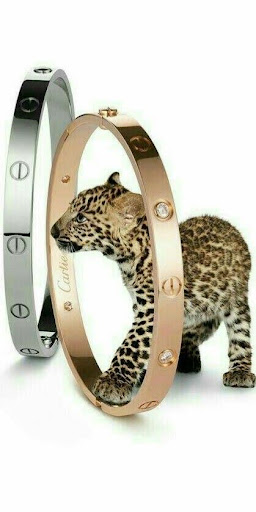
(Image Credits: Pinterest)
Final Verdict
In March 2025, after reviewing all the evidence and hearing both parties, the Paris Judicial Court delivered its judgment, ruling in favour of Cartier, protecting the legendary ‘LOVE’ bracelet from imitators.
Additionally, the Court found Goussin guilty of unfair competition for making false statements in its advertising, which could easily lead customers to believe that a similar-looking bracelet was not descriptive, but rather an attempt to benefit from Cartier’s strong worldwide reputation. Besides that, the Court found Goussin guilty of unfair competition as he made false statements in its advertising, which could easily lead customers to think the products were connected to Cartier’s collection.
Although Goussin’s products were low-priced, the visual similarity between its bracelet and Cartier’s ‘LOVE’ bracelet created a likelihood of confusion among consumers. Therefore, the court prohibited the company Goussin LTD. from using the term ‘LOVE’ as a trademark, label, or brand name for the sale of any jewellery product, whether physical or online, in France. The Court further ordered Goussin LTD. to pay a lump sum of EUR 23,950 as damages to Cartier International AG for trademark infringement, moral harm and unfair competition.
Conclusion
The Cartier v. Goussin case is more than just a courtroom battle over a bracelet; it is a powerful reminder that originality prevails and creativity is worth protecting. Cartier’s triumph rings a bell for emerging fashion brands and daring start-ups—to register inventions early to protect their designs and establish their own identity. The verdict fortifies the icon of luxury—Cartier’s ‘LOVE’ bracelet — and once again highlights the growing importance of intellectual property rights in the evolving dynamics of fashion law.
Reference
“Cartier Wins LOVE Bracelet Case in Paris.” Lux Juris, 16 September 2025, Accessed 31 October 2025.
Author: Taniya Gusain

Taniya Gusain is an LLM candidate in Intellectual Property Rights with a research focus on fashion law and brand protection. She aspires to pursue a career as a fashion lawyer, contributing to this evolving field and engaging with the legal complexities of the global fashion industry.









Insightful analysis of the Cartier v. Goussin case clearly demonstrates the practical importance of trademark protection in fashion law
Beautifully written and thoroughly researched. You have captured both the romance behind Cartier’s LOVE bracelet and the legal significance of the case with clarity and insight. A compelling read that highlights why intellectual property truly matters in luxury fashion