

Blockchain technology has completely changed how people collaborate, trade, and plan. The Decentralized Autonomous Organization (DAO) is one of the most significant technological advancements in recent years brought about by the rise of the Web3 area. A DAO is essentially a kind of online organization that uses smart contracts driven by blockchain technology.
Decentralization highlights the shortcomings of existing legislation while providing advantages like greater transparency, democracy, and international cooperation. The idea of a DAO challenges the fundamental tenet of IP laws, which is that known authors may have rights over their works. This is because creators may act in groups and remain anonymous.
By analyzing the problems with copyright, trademarks, and patents from within decentralized organizations and considering whether existing laws can support decentralized innovations, the author of this paper examines the capacity of DAOs to hold intellectual property.
What is a DAO?
Vitalik Buterin, who introduced the concept of Ethereum, described autonomous organizations as:
FLJ Insider Pro is open: live fashion law jobs and internships, five career guides and two roadmaps. Early bird USD 12/month. See what's inside
“A long-term smart contract that contains the assets and encodes the bylaws of an entire organization.”
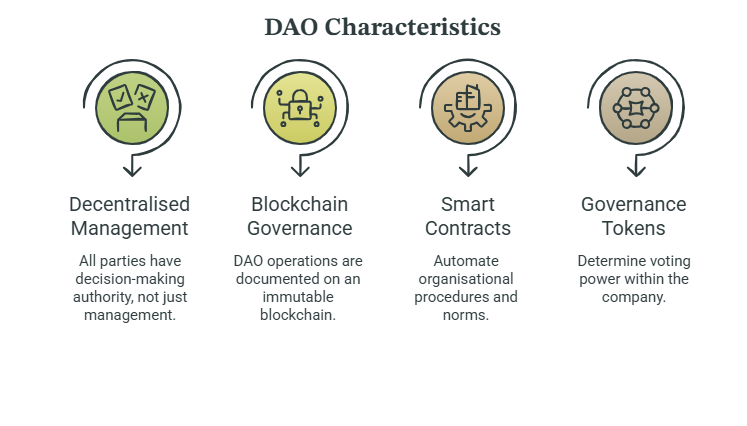
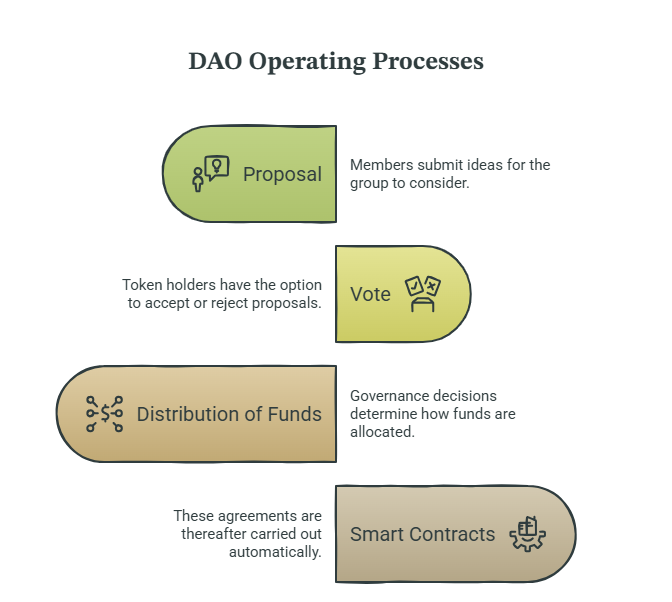
Decentralised autonomous organisations, according to the US Department of the Treasury, are systems that operate according to rules that have been encoded into smart contracts and where decisions are reached by member consensus through voting.
DAO X Intellectual Property Rights
DAOs are starting to produce highly valuable intellectual property. In contrast to previous blockchain initiatives that solely produced bitcoins, current DAOs produce creative and intellectual properties like:
- Blockchain protocols;
- AI systems and datasets;
- software and applications; artwork
- and NFTs; brands and logos.
This situation has been further exacerbated by the rise of the creative economy.
These days, societies produce goods whose economic worth is mostly derived from defending their intellectual property rights. However, the cross-jurisdictional nature of contributions and the usage of pseudonyms complicate ownership concerns. Intellectual property systems assume that ownership can be divided through the employment or contractual relationship, but in many cases, this is not possible within DAOs.
DAO X Copyright
Works with an identified creator are often protected by copyright laws. This applies to the Indian Copyright Act of 1957 as well as to comparable international laws. DAOs, on the other hand, typically comprise a large number of people performing a variety of tasks, including coding, designing, editing, fundraising, and governance.
There are three crucial enquiries to make:
- Is the author the DAO?
- Are the individuals involved co-authors?
- Do token holders have ownership rights only by taking part in governance?
It may be difficult to designate the DAO as an “author” if the jurisdiction in which it operates does not see it as having legal personality. Copyrights, patents, and trademarks must be registered in the name of an individual or a legal entity in accordance with Indian law. Copyright ownership does not necessarily follow token ownership.
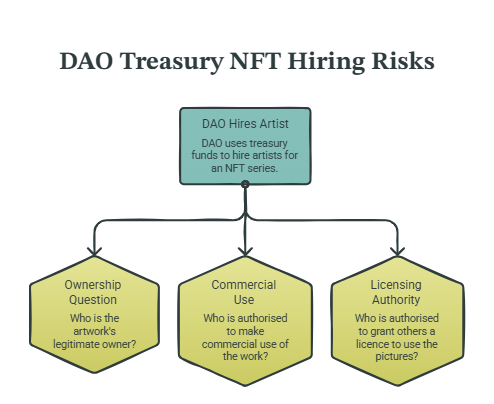
Whether or not the project is funded by the DAO, artists may retain their copyrights in the absence of explicit contracts.
DAO X Trademark
Can a DAO File a Trademark Application?
Trademarks are used to maintain goodwill and create a brand identity. However, when the question is about DAO X Trademark, DAOs are dealing with a number of issues:
- No Legal Personality: In many jurisdictions, DAOs are not regarded as legal entities.
- Trademark Protection and Enforcement: The question of who owns the trademark arises.
- Conflicts Among Token Holders: Their opinions on licensing and growth may differ.
For instance
Imagine that the DAO develops a successful brand and logo and gains international recognition for it. The image below recognises the attached challenges.
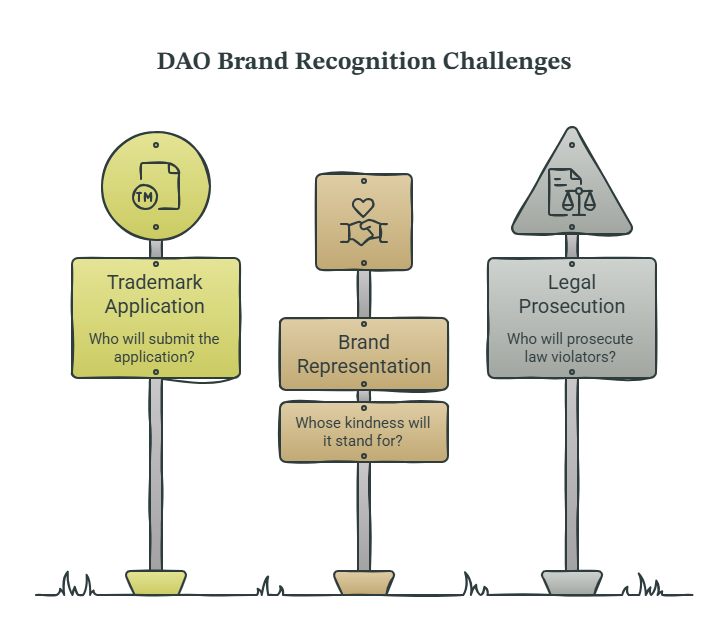
Since suits can only be filed by juridical persons, who cannot be DAOs that operate outside of any legal wrapper, India’s current legal system does not provide a simple answer.
The trademark issue is just one of several issues that underscore the DAO’s paradox: although DAOs have transformed how communities create value, regulations still demand centralisation when it comes to ownership and liability.
DAO X Patent
The largest obstacle to putting a DAO into practice appears to be the problem of patent laws. This is due to the fact that natural individuals must be acknowledged as the inventors in the majority of countries. The Indian Patents Act of 1970, as well as the patent laws of the United States and the European Union, stipulate that an invention can only be invented by those who were involved in its conceptualisation. After that, ownership might be given to any other organization.
DAO-Specific Problems
Among the issues raised by DAOs are:
- Collective creation: Many people work together to accomplish something.
- Anonymous creators: They employ blockchain identities that are anonymous.
- Jurisdictional issues: Patents may be handled differently in several jurisdictions.
This makes it difficult to define proprietors, inventors, and the applicable laws.
Example of a Scenario
Let’s look at a DAO that collaborates to create a novel blockchain security system. Questions that arise are shown below
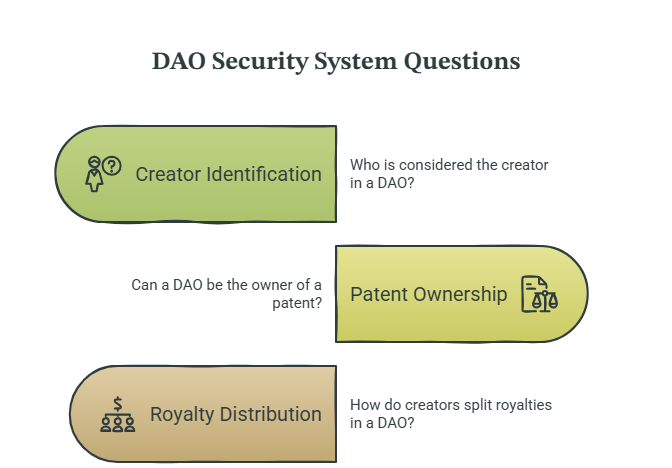
Obtaining a patent becomes nearly impossible in situations when it is challenging to identify the contributors. It is difficult to transfer rights to an entity like a DAO that has no legal status, even if the creator can be located. As a result, it is evident that DAOs transfer patents to corporations, foundations, or other entities.
Legal Personality Issues
The main issue raised by DAOs’ ownership of intellectual property is their lack of legal identity. This indicates that the entity is able to enter into contracts, own property, file lawsuits, and be sued. Traditionally, the law has recognised the following entities: Businesses; Partnerships; Limited Liability Partnerships (LLPs).
However, because DAOs are mostly made up of tokens and smart contracts, they typically have little legal standing.
Why is legal personhood crucial to intellectual property ownership?
In the absence of legal personality, it becomes challenging to register intellectual property rights under its name. It might be impossible to prosecute the violators. It is difficult to enforce licence agreements. The question of liability remains unanswered.
Decentralised organisations present “a huge challenge for legal systems,” according to the Blockstand Report, because these corporate governance ideas are unable to adjust to such entities. Furthermore, participants may be subject to infinite responsibility because of the absence of legal recognition. Legal experiments, however, demonstrate the willingness to adapt solutions to this issue.
Possible Solutions
Conflicts arising from the use of a decentralized framework in conjunction with conventional intellectual property frameworks have been addressed in a number of ways. Using DAO legal wrappers, where DAOs function through entities like associations, foundations, or limited liability companies, is one way to do this. In addition to giving members limited liability protection and an additional degree of regulatory certainty, this would enable DAOs to manage their intellectual property holdings. However, by injecting centralization in some way, this approach would undermine the DAO’s decentralization. The alternative approach uses smart contracts to manage royalties and licensing.
However, among the drawbacks of smart contracts are the ambiguity surrounding their legality in some jurisdictions and their inability to handle unforeseen circumstances that will inevitably occur. Additionally, DAOs may incorporate community agreements pertaining to intellectual property rights in order to determine ownership rights, revenue sharing arrangements, and enforcement rights before the IP is produced. Hybrid methods of governance are another way to guarantee that traditional IP laws and decentralized systems coexist together. Decentralization is combined with a recognizable organization that focuses on particular facets of IP law and governance in hybrid models.
Conclusion
The development of Web3 infrastructure is expected to alter the relationship between DAOs and intellectual property regulations. Growing degrees of decentralized cooperation, the development of DAOs powered by AI, and the participation of foreign participants may give rise to new issues with authorship, inventorship, ownership, and IP rights enforcement. Current copyright, trademark, and patent systems can not account for anonymous and blockchain-based communities governed by smart contracts because they assume identifiable authors and formally registered entities. Legal wrappers, contribution agreements, and hybrid governing systems may offer some short-term answers, but they don’t deal with the fundamental cause of the problem.
Refrences
- Blockstand, An Overview of Decentralised Autonomous Organisations (DAOs): Benefits and Challenges (2024).
- V.C. Mathews & Mansha Bhatia, IP Rights in the Emerging World of DAOs in India, Fox Mandal (Aug. 20, 2024), https://foxmandal.in/ip-rights-in-the-emerging-world-of-daos-in-india/.
- Drisika Bhutani, Smart Contracts, Big Impact: The Rise of DAOs and Their Legal Implications, C&C (Mar. 18, 2025), https://www.candcip.com/single-post/smart-contracts-big-impact-the-rise-of-daos-and-their-legal-implications.
- Monika Zalnieriute, Decentralized Autonomous Organizations (DAOs) and the Disruption of Corporate Governance and Public Governance, 23 J. Info. Commc’n & Ethics Soc’y (2025), https://doi.org/10.1080/13600834.2025.2461949.
- Arina Lobach, The Legal Status and Regulation of Decentralized Autonomous Organizations (DAOs) in Private International Law, ResearchGate (2025), https://www.researchgate.net/publication/397696808_THE_LEGAL_STATUS_AND_REGULATION_OF_DECENTRALIZED_AUTONOMOUS_ORGANIZATIONS_DAOS_IN_PRIVATE_INTERNATIONAL_LAW.
- The Copyright Act, No. 14 of 1957, INDIA CODE (1957).
- The Patents Act, No. 39 of 1970, INDIA CODE (1970).
- The Trade Marks Act, No. 47 of 1999, INDIA CODE (1999).
- Wyo. Stat. Ann. §§ 17-31-101 to -115 (2021).
- Satoshi Nakamoto, Bitcoin: A Peer-to-Peer Electronic Cash System (2008), https://bitcoin.org/bitcoin.pdf.
- Vitalik Buterin, A Next-Generation Smart Contract and Decentralized Application Platform, Ethereum White Paper (2014), https://ethereum.org/en/whitepaper/.
- U.S. Dep’t of the Treasury, Illicit Finance Risk Assessment of Decentralized Finance 22–24 (2023), https://home.treasury.gov/system/files/136/DeFi-Risk-Full-Review.pdf.
FASHION LAW JOURNAL INSIDER
Join designers, brand founders and fashion lawyers who get the biggest brand battles, IP fights and career moves in fashion law, straight to their inbox.