

The 1980s dressed for the boardroom and partied like the stock market would never fall. Shoulders grew, hemlines climbed, gym clothes went out to lunch and a logo on a bag became the point of buying it. That last shift had a side effect the decade’s lawmakers could not ignore: once people paid for the monogram rather than the leather, copying the monogram became a business too. This guide walks through what 1980s fashion actually looked like, who built the power suit, how logomania took hold, and why the United States finally made trademark counterfeiting a federal crime in 1984. It also covers the other late 1980s laws and cases, in the US, UK and EU, that fashion brands still rely on.
Short answer: 1980s fashion was defined by power dressing (broad padded shoulders, tailored jackets, Armani and Donna Karan), fitness wear worn as streetwear, hip hop style and logo-covered luxury goods. As logos became the product, fakes boomed. The US responded with the Trademark Counterfeiting Act of 1984, enacted on 12 October 1984, which made trafficking in counterfeit goods a federal crime.
Key takeaways
- Power dressing was the decade’s signature: TV’s Dynasty (first aired 1981) and Giorgio Armani’s soft-shouldered suits, seen in American Gigolo (1980), set the template.
- Logos moved from the lining to the outside. Karl Lagerfeld’s arrival at Chanel in 1983 and the formation of LVMH in 1987 turned house symbols into the main asset.
- The Trademark Counterfeiting Act of 1984 created the federal crime in 18 U.S.C. § 2320 and gave brand owners ex parte seizure orders and enhanced damages.
- Late 1980s laws still shape fashion: K mart v. Cartier (1988) on grey goods, US intent-to-use filings (from 1989), UK unregistered design right (1988) and the EU’s first Trade Marks Directive (1988).
What did 1980s fashion look like?
Bigger was better. The Fashion Institute of Technology’s history of the decade picks out padded shoulders and bold accessories as the defining features, with power dressing growing as more women moved into male-dominated workplaces. Around that core, several looks ran in parallel:
- Power dressing. Broad shoulders, sharp jackets and statement earrings, popularised by Dynasty, which first aired in 1981. Thierry Mugler, who showed his first collection in 1980, pushed shoulders to sculptural extremes by mid-decade.
- Fitness as fashion. Flashdance (1983) and Jane Fonda’s workout videos took leotards, leggings and off-the-shoulder sweatshirts onto the street.
- Pop and street. Madonna’s lace, mesh and stacked bracelets in Desperately Seeking Susan (1985) started a youth trend, while Run DMC and the Beastie Boys made tracksuits, gold chains and trainers a New York uniform.
- Royal romance. Princess Diana married in July 1981 in a David and Elizabeth Emanuel gown with giant puffed sleeves and a 25-foot train.
- The avant-garde. Rei Kawakubo of Comme des Garçons and Yohji Yamamoto sent deconstructed, mostly black clothes down Paris runways, a counterweight to all the gloss.
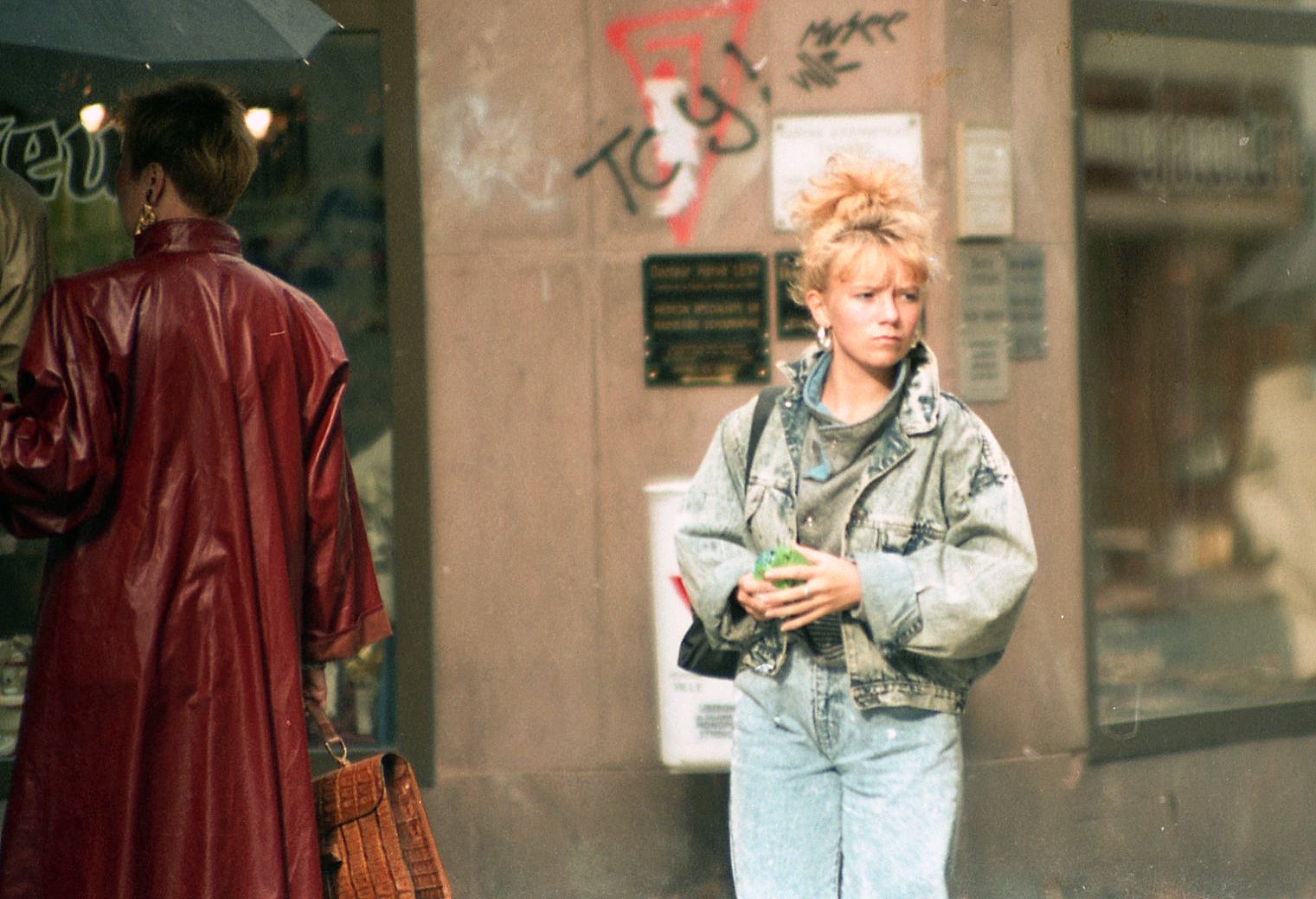
- Denim, washed to death. Acid-wash jackets and high-waisted jeans finished the decade’s casual look, as the featured photograph from Strasbourg in 1987 shows.
If you want the decade before, FLJ’s guide to 1970s fashion and the rise of designer licensing explains how Halston, Pierre Cardin and the designer jeans boom set up the brand economy the 1980s inherited.
FLJ Insider Pro is open: live fashion law jobs and internships, five career guides and two roadmaps. Early bird USD 12/month. See what's inside
Who invented the 1980s power suit?
No single designer, but two names did most of the work. Giorgio Armani, who launched his label with Sergio Galeotti in July 1975, became famous for an unstructured jacket that softened traditional tailoring. When Richard Gere wore his suits in American Gigolo in 1980, the look went global, and in 1982 Armani appeared on the cover of TIME under the headline “Giorgio’s Gorgeous Style”, as the Irish Times recalled in its obituary when he died in September 2025, aged 91.
Donna Karan approached the problem from the other side. Her company was set up in 1984, and her first collection in 1985 was built on “seven easy pieces”: a bodysuit as the base, layered with interchangeable items such as a wrap skirt, a tailored jacket and a cashmere sweater. Looking back, Karan told Fortune that women in offices had been “more or less dressing like men”, and that “those suits were holding us back.” So the power suit both peaked and began to soften in the same decade.
There is a legal footnote here. Neither the padded shoulder nor the cut of a suit could be owned. US copyright law treats clothing as a useful article, so a jacket’s shape is generally free to copy, which is why the fight over 1980s fashion played out over names and logos rather than silhouettes.
How did logomania take over luxury?
The 1970s taught designers that a name could be licensed onto anything. The 1980s taught them that the name itself, printed large, could be the reason to buy. Three shifts made logos the product:
- Chanel reboots its symbol. Karl Lagerfeld became the house’s couturier in 1983, the same year Chanel’s US registration for the CC monogram on clothing was issued (7 June 1983), with handbags following in 1985. FLJ’s history of the Chanel logo shows how the double C became one of the most enforced marks in fashion.
- Monograms as status. Canvas bags covered in house initials, from the LV monogram to Gucci’s GG, turned the pattern itself into proof of purchase.
- Luxury becomes a group business. According to LVMH’s own history, the merger of Moët Hennessy and Louis Vuitton created the group in 1987, and Bernard Arnault has led it since 1989. Brand portfolios, not single houses, would drive the decades that followed.
Sportswear joined in. Run DMC’s 1986 track “My Adidas” is widely credited with leading to one of the first major endorsement deals between a sportswear brand and a music act. Endorsements, like licences, are contracts about the right to use a name and image, a theme that runs straight through to today’s influencer deals.
Why did counterfeiting boom in the 1980s?
When a logo carries most of a product’s value, a cheap bag with a convincing logo carries most of the profit. Industry started organising early: the International AntiCounterfeiting Coalition was founded in 1979 by a handful of companies. At the international level, governments in the GATT trade talks were discussing a proposed agreement to discourage imports of counterfeit goods, and a GATT secretariat paper from January 1985 cited a US International Trade Commission estimate that about 131,000 US jobs may have been lost in the five sectors most exposed to counterfeiting.
The decade’s most famous logo dispute was not a back-street fake operation at all. Dapper Dan opened his boutique on 125th Street in Harlem in 1982 and made custom pieces covered in Gucci, Fendi and Louis Vuitton logos for rappers, athletes and hustlers. He told NPR that when Fendi raided him, “they took everything” and he lost a quarter of a million dollars. Fendi’s anti-counterfeiting lawyer at the time was Sonia Sotomayor, now a US Supreme Court justice, and the shop closed in 1992 under legal pressure, according to the Associated Press. Decades later, after a 2017 Gucci runway jacket drew comparisons with his work, Gucci partnered with him on a 2018 collection and a Harlem atelier. Dapper Dan always called his work “knock-ups”, not knock-offs, which is the same line FLJ examines in dupes vs counterfeits.
What did the Trademark Counterfeiting Act of 1984 change?
Before 1984, US brand owners fighting fakes relied mainly on civil lawsuits under the Lanham Act; there was no general federal crime of trafficking in counterfeit goods. The Trademark Counterfeiting Act of 1984 was enacted on 12 October 1984 as part of Public Law 98-473, a broad crime control package. The US Department of Justice’s criminal resource manual summarises its two halves:
- A federal crime. It created 18 U.S.C. § 2320, which makes it a felony to intentionally traffic, or attempt to traffic, in goods or services while knowingly using a counterfeit mark. Prosecutors can also seek orders to destroy the goods.
- Stronger civil remedies. It amended the Lanham Act so that, in cases of intentional counterfeiting, courts award enhanced (treble) damages and attorney’s fees, and it allowed ex parte seizure orders under 15 U.S.C. § 1116(d), letting a brand owner seize fakes without warning the seller first, provided it shows the seller is likely to hide or move the goods.
The seizure order is the part fashion brands use most. Counterfeit stock can vanish overnight, so the ability to go to court without tipping off the defendant changed enforcement tactics on markets and in warehouses. For how the statute works today, see FLJ’s explainer on the Lanham Act for fashion brands. Congress came back to the problem in the next decade with statutory damages and racketeering liability, covered in FLJ’s sibling guide to 1990s fashion and the logo lawsuits of the decade.
Which other 1980s laws and cases still matter to fashion?
The end of the decade produced a cluster of rules on both sides of the Atlantic that fashion lawyers still cite.
| Year | Law or case | What it did | Why fashion still cares |
|---|---|---|---|
| 1984 | Trademark Counterfeiting Act (US) | Made trafficking in counterfeit goods a federal crime; added ex parte seizures and treble damages | Basis of criminal and civil anti-fake enforcement |
| 1988 | K mart Corp. v. Cartier, Inc. (US Supreme Court, 31 May 1988) | Upheld a Customs rule letting in grey-market goods made by the brand owner or an affiliate, but struck down the exception for goods made abroad by authorised licensees | Grey imports and parallel trade in luxury goods |
| 1988 | Copyright, Designs and Patents Act (UK) | Created UK unregistered design right for the shape or configuration of an article | Protects garment and bag shapes for up to 15 years (10 from first marketing) without registration |
| 1988 | First Trade Marks Directive 89/104/EEC (21 December 1988) | Harmonised national trade mark laws across the European Community | Foundation for EU case law on confusion and exhaustion |
| 1988 | Gucci v. Gucci Shops, Inc. (S.D.N.Y.) | Barred Paolo Gucci, a member of the founding family, from using “Paolo Gucci” as a trademark or trade name; he could still identify himself as the designer of goods sold under another mark, with a disclaimer | Founders and family members can lose the right to brand with their own name |
| 1988, in force 1989 | Trademark Law Revision Act (US) | Allowed intent-to-use applications from 16 November 1989 | Brands can reserve a name before launch |
Sources: US Department of Justice, Cornell Legal Information Institute, legislation.gov.uk, EUR-Lex and the USPTO. The Gucci family dispute is covered in FLJ’s Gucci logo trademark story.
The intent-to-use change sounds dry, but it matters to every young label. The USPTO described the 1988 Act as the most significant set of amendments to the Lanham Act since that statute was first passed: it let applicants with a bona fide intention to use a mark file before trading, then prove use before registration. That is how most new fashion brands now lock in a name before the first collection ships.
What does 1980s fashion teach brands today?
- Logos are easier to protect than looks. A shoulder line was free to copy; a monogram was not. That is still true for most garments in the US.
- Visibility invites fakes. The more a product sells on its logo, the faster counterfeiters follow. FLJ’s 2026 guide to counterfeit goods laws for small designers covers what the 1984 tools look like now.
- Speed beats size in enforcement. Ex parte seizures exist because fakes move faster than lawsuits.
- Yesterday’s infringer can be tomorrow’s collaborator. Dapper Dan’s arc from raid to Gucci partner is a reminder that brand protection and brand culture are not always on opposite sides.
This article is general information on fashion history and the law as of 19 November 2026. It is not legal advice. Historical figures are as reported at the time and are not adjusted for inflation.
Frequently asked questions
What was popular in 1980s fashion?
Power suits with padded shoulders, leggings and leotards worn as streetwear, acid-wash denim, big hair, statement earrings, tracksuits and logo-covered designer bags. Madonna, Princess Diana and Dynasty were among the biggest style influences.
Why were shoulder pads so big in the 1980s?
Broad shoulders signalled authority as more women entered male-dominated workplaces. Television series such as Dynasty and designers including Thierry Mugler exaggerated the shape until it became the decade’s signature.
What is the Trademark Counterfeiting Act of 1984?
A US law enacted on 12 October 1984 that made trafficking in goods bearing counterfeit trademarks a federal crime under 18 U.S.C. § 2320. It also gave brand owners ex parte seizure orders and enhanced civil damages.
Who was Dapper Dan?
A Harlem designer who opened a boutique in 1982 making custom clothing covered in luxury logos. Brands including Fendi took legal action, the shop closed in 1992, and Gucci later partnered with him on a 2018 collection.
When did logomania start?
Logo-covered luxury goods existed earlier, but the 1980s turned them into a mass status symbol, helped by Lagerfeld’s reworking of Chanel from 1983 and the growth of luxury groups such as LVMH, formed in 1987.
Could 1980s designers copyright their clothing designs?
Generally not in the US, where clothing is treated as a useful article. The UK took a different route in 1988 by creating unregistered design right, which protects the shape of an article for up to 15 years.
Featured image: Photo: Phillip Capper via Wikimedia Commons, CC BY 2.0
FASHION LAW JOURNAL INSIDER
Join designers, brand founders and fashion lawyers who get the biggest brand battles, IP fights and career moves in fashion law, straight to their inbox.