
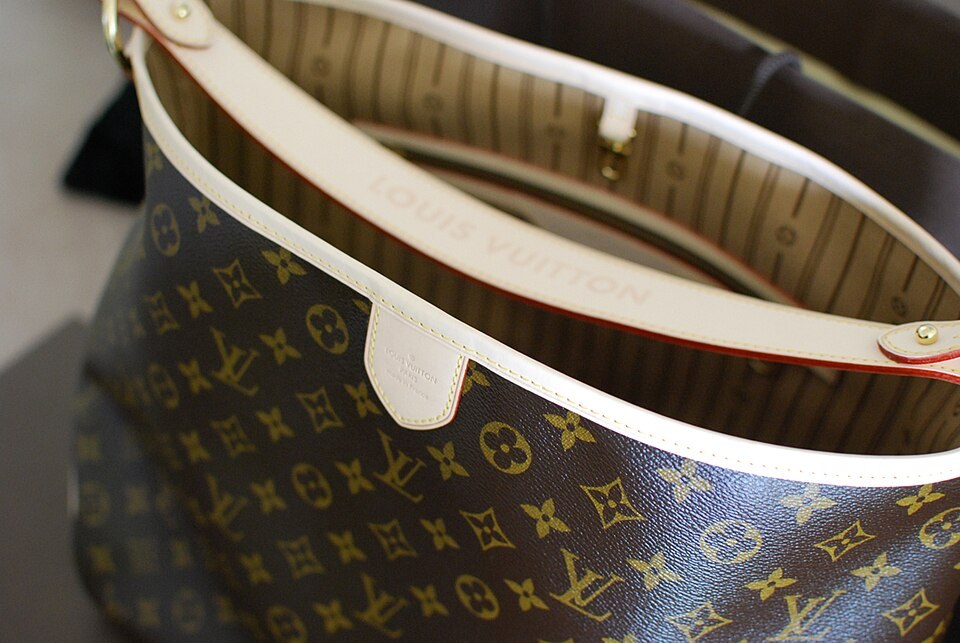
The LV monogram was born as an anti-counterfeiting device. In 1896 Georges Vuitton designed a canvas of interlaced initials and stylised flowers because rivals kept copying the simpler patterns his father had used on trunks. One hundred and thirty years later it still does the job it was made for: it tells people who made the bag, and it gives Louis Vuitton something to sue over. This guide covers where the Louis Vuitton monogram came from, where it is registered and the cases that show how far that protection reaches.
Short answer: The LV monogram is the brown canvas pattern of interlaced “LV” initials and three flower motifs that Georges Vuitton created in 1896 to stop copying. It has been registered in the United States since 1932 and is also protected as an EU trade mark. Courts treat it as a strong, famous mark, but parodies and look-alikes that do not confuse buyers can still win.
Key takeaways
- Louis Vuitton says Georges Vuitton designed the Monogram in 1896 after the earlier Damier canvas of 1888 was copied, naming it in tribute to his father Louis.
- The Monogram canvas is US Registration No. 297,594, filed in April 1931 and registered on 20 September 1932, and it is still live.
- Louis Vuitton has won on dilution and counterfeiting (Hyundai, Akanoc) but lost to parody and dissimilar designs (Haute Diggity Dog, My Other Bag, Dooney & Bourke).
- In Europe the Monogram has been accepted as a reputed mark, while the plainer Damier chequerboard was declared invalid by the EU General Court in 2015.
Where did the LV monogram come from?
Louis Vuitton opened his first shop in Paris in 1854, selling flat-topped trunks covered in a grey canvas. The company’s own heritage timeline reads like a running fight with imitators. “Due to the imitations of the Trianon grey canvas”, it says, the house switched to a striped canvas in 1872. The stripes were copied too. In 1888 Louis and his son Georges introduced the Damier, a brown and beige chequerboard, and Georges registered it with the words “Marque L. Vuitton Déposée” (registered trademark) woven into one of the squares.
That did not work either. In Louis Vuitton’s words: “When the Damier canvas is copied, Georges designs a new pattern, featuring the initials L.V. in tribute to his father.” Louis had died in 1892. The 1896 design paired the interlaced initials with three floral motifs that the company describes as “part botanical, part geometric”, printed in the Damier’s colours. The idea was simple: a pattern built around the founder’s initials is far harder to pass off as generic decoration than stripes or checks.
FLJ Insider Pro is open: live fashion law jobs and internships, five career guides and two roadmaps. Early bird USD 12/month. See what's inside
A coating process developed in the late 1950s made the canvas flexible, and in 1959 the Speedy was remade in Monogram canvas as a handbag. In 2026 the house is marking the Monogram’s 130th anniversary with a collection built around the Speedy, Alma, Neverfull, Noé and Keepall.
Why is the LV monogram such a strong trademark?
A trademark only works if it is distinctive, meaning shoppers see it as a sign of who made the product rather than as mere decoration. Some marks are distinctive from day one (inherently distinctive). Others only become distinctive after years of use teach the public to link them with one company; lawyers call this acquired distinctiveness or secondary meaning.
The LV monogram scores on both counts: it pairs the brand’s initials with unusual shapes, and it has been sold and copied for over a century. When the Second Circuit looked at the Murakami variant in 2006, it called it “a strong mark” that “became famous almost instantly”, while warning that “basic geometric shapes, basic letters, and single colors are not protectable as inherently distinctive.” That explains why the Monogram has fared better than its older sibling.
In Europe the Damier chequerboard has had a rough ride. In 2015 the EU General Court upheld the cancellation of two Damier registrations, brought by the retailer Nanu-Nana, on the basis that a chequerboard is a basic, commonplace pattern and that Louis Vuitton had not proved acquired distinctiveness across the whole EU. FLJ’s analysis of Louis Vuitton’s legal battle over the Damier canvas follows that fight into the national courts. The Monogram faces no such argument.
Where is the Louis Vuitton monogram canvas registered as a trademark?
In the United States the core registration is No. 297,594. The USPTO’s TSDR record shows it was filed on 29 April 1931, registered on 20 September 1932 and renewed most recently in 2023. It covers trunks, travelling bags, handbags, pocketbooks and similar luggage, and it rests on a French registration dated 29 October 1908.
Other registrations sit around it, including No. 1,519,828 for the stylised LV initials (1989) and No. 1,045,932 for the word mark LOUIS VUITTON (1976). Anyone can check these records; FLJ’s guide on how to run a USPTO trademark search explains how.
The same TSDR record shows how hard the mark works. Every time a lawsuit involving a registration is filed in a US federal court, the clerk notifies the USPTO, which logs a “notice of suit”. The record for No. 297,594 lists 136 of them, 49 dated in 2026 alone as of 12 November.
In the EU, Louis Vuitton relies on a figurative Monogram mark registered as EU trade mark No. 000015628, alongside an international registration designating the EU and French national marks. In an April 2024 cancellation decision reported by IPKat, EUIPO found the Monogram had a reputation for trunks, travelling bags, bags and handbags and for women’s clothing, and cancelled a look-alike EU trade mark owned by an individual in Rome because it took unfair advantage of that reputation.
Which court cases shaped protection of the LV monogram?
| Case | Court and year | Issue | Outcome |
|---|---|---|---|
| Louis Vuitton v Dooney & Bourke | 2nd Cir. 2006; S.D.N.Y. 2008 | Was Dooney’s multicoloured DB monogram too close to the Murakami Multicolore? | Injunction refusal partly vacated in 2006; summary judgment for Dooney on all claims in 2008 |
| Louis Vuitton v Haute Diggity Dog | 4th Cir. 2007 | “Chewy Vuiton” dog toys: parody, confusion, dilution | Dog-toy maker won; parody, no confusion, no dilution |
| Louis Vuitton v Akanoc Solutions | 9th Cir. 2011 | Are web hosts liable for counterfeit sites on their servers? | Contributory liability affirmed; damages cut to $10.5m (trademark) and $300,000 (copyright) |
| Louis Vuitton v Hyundai | S.D.N.Y. 2012 | Monogram-style basketball in a 2010 car advert | Summary judgment for Louis Vuitton on dilution by blurring |
| Louis Vuitton v EUIPO (Nanu-Nana) | EU General Court 2015 | Validity of the Damier chequerboard marks | Cancellation for lack of distinctiveness upheld |
| Louis Vuitton v My Other Bag | S.D.N.Y. and 2nd Cir. 2016 | Canvas totes printed with cartoon LV bags | Parody; My Other Bag won; Supreme Court refused review in 2017 |
| Korean reform-service case (2024Da31181) | Supreme Court of Korea 2026 | Remaking owners’ Monogram bags at their request | No infringement where goods return to the owner for private use; remanded |
| Louis Vuitton v Kamad Reworked | Paris Judicial Court 2026 | Upcycled garments made from genuine LV items | Infringement; €920,000 awarded |
| Louis Vuitton v PPE Casino Resorts Maryland | D. Md. 2026 | Casino giveaway bags with a “Live!” monogram | Pending |
What did the courts say about look-alikes and dilution?
Infringement asks whether shoppers are likely to be confused about who made or approved a product. Dilution, available only to famous marks, asks whether a similar mark weakens the famous one’s distinctiveness (blurring) or damages its reputation (tarnishment), even if nobody is confused.
The Dooney & Bourke appeal concerned the Multicolore Monogram, created with Takashi Murakami in 2002 in 33 colours. Dooney followed in 2003 with its own DB monogram in bright colours. The Second Circuit agreed the Multicolore mark was protectable, upheld the refusal of an injunction on federal dilution and sent the infringement claims back. On remand in 2008, Judge Shira Scheindlin granted Dooney summary judgment on every claim, finding the designs too different for likely confusion. A famous pattern does not stop rivals using bright colours and their own initials.
Hyundai lost. Its 2010 “Luxury” commercial for the Sonata, first shown after the Super Bowl, included a one-second shot of a basketball covered in a near copy of the Monogram, with “LZ” in place of “LV”. In a March 2012 opinion, Judge P. Kevin Castel granted Louis Vuitton summary judgment on federal and New York dilution by blurring. Hyundai’s fair use defence failed because its own witnesses said the ad mocked luxury in general, not Louis Vuitton; one executive admitted the design was “borrowing equity from Louis Vuitton”.
When is a parody of the LV monogram allowed?
Parody is where Louis Vuitton has lost most often. Haute Diggity Dog sold plush “Chewy Vuiton” dog toys with “CV” in place of “LV”, mostly for under $20, mimicking a handbag that retailed at $1,190. The Fourth Circuit held that the joke was obvious, so buyers would not be confused, and that “a successful parody might actually enhance the famous mark’s distinctiveness by making it an icon.” The tarnishment claim, based on the idea that a dog might choke on a toy, failed for lack of evidence.
My Other Bag sold cheap canvas totes printed with cartoon drawings of designer bags on one side and “My Other Bag…” on the other. Judge Jesse Furman granted summary judgment to the tote maker in January 2016, observing that “it is better to accept the implied compliment in a parody and to smile or laugh than it is to sue.” The Second Circuit affirmed on 22 December 2016, saying “a parody of LV’s luxury image is the very point of MOB’s plebian product.” The Supreme Court declined to hear the case in October 2017. FLJ has a fuller account of Louis Vuitton v My Other Bag.
There is a caveat. In Jack Daniel’s v VIP Products (2023), the US Supreme Court held that parody escapes dilution liability only if it is not used to designate the source of the defendant’s own goods. “Chewy Vuiton” was arguably the toy’s brand name, so that case might be analysed differently today. FLJ explains the wider shift in when brand parody becomes trademark infringement.
How does Louis Vuitton fight Monogram counterfeits?
A counterfeit is a copy that uses a mark identical to, or substantially indistinguishable from, the registered one, as opposed to a look-alike that merely evokes it. FLJ’s explainer on dupes vs counterfeits sets out the line. Louis Vuitton goes after counterfeit sellers, and also after the businesses that help them reach buyers.
The leading example is Akanoc. Louis Vuitton sent at least 18 notices to San Jose hosting firms and their manager, Steven Chen, about websites selling fakes, and the sites stayed up. A jury awarded $31.5 million on trademarks and $900,000 on copyright. In September 2011 the Ninth Circuit affirmed liability, holding that a host that keeps serving known infringers, and controls the “master switch” that keeps their sites online, is liable. It reduced the damages to single awards of $10.5 million and $300,000, owed jointly by Akanoc and Chen. Buyers are a different matter; FLJ’s guide on whether it is illegal to buy replica bags covers that side.
In 2026 the fight moved to new ground. On 1 June Louis Vuitton sued the operator of Maryland’s Live! Casino over giveaway bags printed with the Monogram flowers and the word “Live!” in place of the initials, as covered in FLJ’s report on the Maryland Live! Casino lawsuit. On 17 September 2026 the Paris Judicial Court ordered upcycling label Kamad Reworked to pay €920,000 for garments made from genuine Louis Vuitton pieces, rejecting exhaustion and sustainability defences (see FLJ’s report on the upcycling case). South Korea’s Supreme Court held in February 2026 that remaking an owner’s Monogram bag for that owner’s private use did not infringe.
What can other brands learn from the LV monogram?
Put something distinctive into a pattern: the Monogram’s initials carry it through challenges that sank the Damier in Europe. Register early and keep renewing. And pick fights carefully: Louis Vuitton’s losses came against jokes and rivals using their own initials, its wins against near copies used to borrow its prestige. Chanel and Gucci have run similar playbooks with their interlocking letters, as FLJ’s histories of the Chanel logo and the Gucci logo show. For how the LV monogram supports pricing power across the group, see FLJ’s guide to LVMH brands, and the Brand Case Study Pack examines how Louis Vuitton, Chanel and Hermès protect their brands.
Frequently asked questions
Who designed the LV monogram and when?
Georges Vuitton, son of the founder Louis Vuitton, designed the Monogram canvas in 1896. Louis Vuitton says he created it after the 1888 Damier canvas was copied and used the initials L.V. in tribute to his father.
Is the Louis Vuitton monogram a registered trademark?
Yes. In the US the Monogram canvas is Registration No. 297,594, registered in 1932 for luggage, handbags and pocketbooks and still live. In the EU it is protected as a figurative EU trade mark, among other registrations.
Can you sell items made from real Louis Vuitton bags?
It is risky. A Paris court ordered Kamad Reworked to pay €920,000 in 2026 for selling garments made from genuine LV items. South Korea’s Supreme Court took a softer line only where a bag is remade for its owner’s private use.
Why did Louis Vuitton lose the Chewy Vuiton case?
The Fourth Circuit found the dog toys were an obvious parody that neither confused buyers nor blurred the famous mark. A 2023 Supreme Court ruling now limits that defence where a parody is used as a brand name.
What is the difference between the Monogram and the Damier?
The Damier, from 1888, is a brown and beige chequerboard; the Monogram, from 1896, combines LV initials with flower motifs. The EU General Court upheld the cancellation of two Damier marks in 2015 for being too basic, a problem the Monogram does not have.
Can a brand use a pattern that looks like the LV monogram?
A near copy invites claims for counterfeiting, infringement and dilution, as Hyundai and Maryland’s Live! Casino found. Dooney & Bourke won with its own DB monogram because the overall designs were different enough to avoid confusion.
Case and registration information is as of 13 November 2026. This article is general information, not legal advice.
Featured image: Photo: Janine from South Korea, United States via Wikimedia Commons, CC BY 2.0
FASHION LAW JOURNAL INSIDER
Join designers, brand founders and fashion lawyers who get the biggest brand battles, IP fights and career moves in fashion law, straight to their inbox.