


Today’s consumerist culture demands thousands of garments every single day. We’ve been sold the idea that staying fashionable calls for a need to constantly renew our wardrobes; trend after trend, haul after haul.
But here’s the question we rarely ask: Where do all these clothes go when we’re done with them? And what happens when we move on from trends faster than brands can anticipate, and they are left with mountains of overproduction?
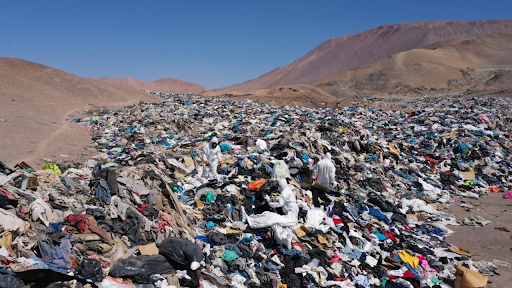
One of those answers lies in the Atacama Desert, now infamous as fast fashion’s graveyard.
The Hidden Cost of Cheap Trends
Between 2002 and 201,4 garment lifespans were cut in half while global clothing production doubled. During the same period, customers increased their purchases by 60%, accelerating the industry’s waste trajectory. Adding to this, a UN report dated 2019 revealed the fashion industry as responsible for 20% of global water waste, a figure that has likely only grown in the years since.
As garments became cheaper and trend cycles accelerated, brands began producing far more clothing than the market could realistically absorb. Fast production models weren’t designed to match supply with actual demand; they were designed to flood customers with options, banking on volume over longevity.
It’s no surprise, then, that around three-fifths of all clothing ends up in landfills or incinerators within a year of being produced. On top of that, 12% of the material used in production is lost and discarded before it even becomes a garment, adding to the industry’s massive waste stream.
This leaves us with textile waste as a global problem, one with serious environmental and public health consequences. This global overflow becomes painfully visible in the Atacama Desert, where an estimated 40,000 tons of discarded clothing, much of it sourced from European and American channels, are dumped every year.
There, the broader costs of fast fashion are exposed: massive dumps of clothes leach dyes and chemicals into the soil and air, while part of the waste is burned, dispersing pollutants that affect air quality and become a threat to respiratory health.
Young Consumers Won’t Look Away
For years, both the media and consumers worldwide ignored this staggering illegal landfill affecting Chile, fueling the industry’s growth. However, in 2021, everything changed. Photographs taken by Martín Bernetti, and published by Agencia France-Presse, started circulating, giving the situation a social media presence.
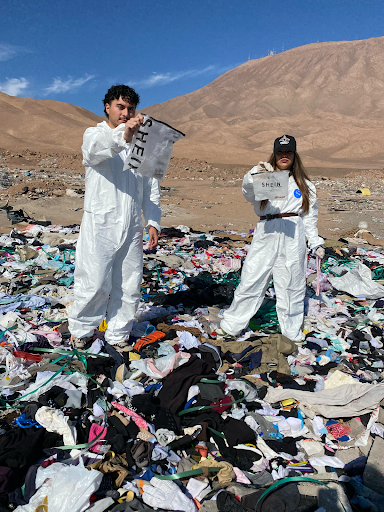
At the same time, the action that the people in Chile had been independently promoting to tackle these issues finally gained international recognition. Their work showcased the work of younger generations, who have led initiatives aimed at reducing textile waste and promoting circularity in the fashion industry.
An important example of the change taking root in Chile is the work led by Desierto Vestido, an NGO that has the mission to educate, raise awareness and promote the circular economy in the textile industry. This labor is executed through different impactful actions, such as teaching in the form of talks and workshops and organizing desert clean-up operations.
Rosario Hevia has also had a notable positive impact through her work. She began with a small project focused on reusing children’s clothes and later opened Ecocitex in 2019. The company produces textile goods made from yarn that comes entirely from damaged or discarded garments. Remarkably, the process requires no water or chemical treatments, therefore being one of the most sustainable and truly circular models in the region.
Another striking private effort emerging from the region is Atacama RE-commerce, a project launched in March, 2025 turning desert’s textile waste into a circular model with a simple but powerful idea: garments dumped in Atacama, many of them brand new and with tags or barely worn, are recovered, cleaned, restored and offered online for free, with customers paying only the cost of shipping. In other words, you’re paying to pull a piece of clothing out of the desert. The initiative not only keeps usable clothes in circulation, but also raises awareness about the environmental cost of fast fashion’s overproduction. Every rescued piece becomes a reminder of the system that put it there, and a small step towards a future where clothes are valued rather than tossed aside.
Justice for the Desert: The Lawsuit Against Textile Dumping
Civilians didn’t just innovate their way around the crisis; they took the issue to court. In 2022, Paulin Silva, a Chilean lawyer, filed a lawsuit against the state of Chile alleging responsibility for the massive textile landfills in Alto Hospicio, Atacama.
This lawsuit finally raises the fundamental question of who can be held accountable for the damage. So, who is legally responsible for the clothing dumps in Atacama? This question still isn’t fully answered; however, according to the ruling issued in September 2025, it is clear that the State bears a significant role in allowing the crisis to unfold.
The ruling ordered the government to prepare a six-month remediation plan that has yet to be presented. Moreover, the State appealed the decision, meaning the court’s ruling is not yet final, and the case remains unresolved.
When Waste Becomes a Legal Issue: The Rise of Textile Regulation
Inevitably, the law had to intervene, and in Chile, that moment finally arrived. Even when the State has not accepted legal responsibility in court, law and policymakers have started to take steps towards a regulation of the textiles entering the country. In 2025, the Chilean government introduced a comprehensive national strategy to confront the country’s escalating textile waste disaster, and named the eradication of illegal textile dumps one of its central goals.
The plan marked a turning point. For the first time, textiles were formally recognized as a priority waste category, placing them under strict monitoring and management requirements.
Building on this, the government announced that textiles will soon be incorporated into Chile’s Extended Producer Responsibility (EPR) framework, a policy that obligates companies to take financial and operational responsibility for the waste their products generate. What this means in practice is that brands will be required to track the garments they bring into the country, report their volume, and contribute to systems for collection, reuse and recycling. The country is still developing clear, detailed policies and aims to have targets in place by 2029. The goal is to shift the burden of textile waste in Atacama away from the nearby communities, which have long absorbed the consequences of overproduction in fashion.
This strategy also seeks to promote and strengthen Chile’s growing circular economy. By supporting repair centers, upcycling initiatives and textile recyclers and including them as EPR fund recipients, policymakers aim to reduce the constant flow of garments, the constant arrival of garments into informal dumps, and create new opportunities for sustainable employment. The government recognized that EPR will deliver a positive social impact by involving informal workers in the circular fashion industry and securing fair work conditions for them. Importantly, Chile’s representatives acknowledge that organizing textile waste is only part of the solution, given that the problem arises from cultural and commercial forces that drive both overproduction and overconsumption.
While the regulatory process is still in its early development stage, the 2025 strategy signals the treatment of these issues as a national priority. Atacama’s textile crisis is no longer viewed solely as an environmental failure. It is now recognized as a legal and systemic issue that calls for a structural change. And although no single policy will delete the contamination and the damage overnight, Chile’s regulatory turn suggests that the era of massive unchecked dumping in the country’s desert is coming to an end.
Fashion’s Future Is Written in the Desert
Atacama serves as a global case study for what happens when overproduction and weak regulation collide. The desert exposes the true cost of a fashion system that is driven by speed, excess and profit built on volume, but it also highlights the rise of young innovators and a growing legal pressure that demands systematic change.
Chile’s emerging policies now serve as a blueprint for other nations facing similar crises. If the industry pays attention, the path being built is unmistakable: a future marked by circularity and transparency. Now, the Atacama Desert stands as both a warning and a global compass, reminding us that fashion’s future depends not only on what we create, but on what we refuse to waste.
References
Bartlett, J. (2025, June 26). Chile targets fast fashion waste with landmark desert cleanup plan. The Guardian. https://www.theguardian.com/world/2025/jun/26/chile-fast-fashion-waste-atacama-desert
EcoCITEX. (n.d.). EcoCITEX. https://www.ecocitex.cl/
Ellen MacArthur Foundation. (2017). A new textiles economy: Redesigning fashion’s future.https://content.ellenmacarthurfoundation.org/m/6d5071bb8a5f05a2/original/A-New-Textiles-Economy-Redesigning-fashions-future.pdf
Ellen MacArthur Foundation. (2024). Pushing the boundaries of EPR policy for textiles.https://circulareconomy.europa.eu/platform/sites/default/files/2024-08/Pushing%20the%20boundaries%20of%20EPR%20policy%20for%20textiles.pdf
Ellen MacArthur Foundation. (2024, September 25). EPR for textiles in Chile.https://www.ellenmacarthurfoundation.org/epr-for-textiles-in-chile
FRANCE 24. (2021, November 8). Chile’s desert dumping ground for fast fashion leftovers.https://www.france24.com/en/live-news/20211108-chile-s-desert-dumping-ground-for-fast-fashion-leftovers
Hevia, R. (2025, July 14). “Everything about recycling started from this vein of social action” [“Todo el tema del reciclaje partió por esta veta de acción social”]. Perfeccionistas, Diario Financiero. https://perfeccionistas.diariofinanciero.cl/rosario-hevia-todo-el-tema-del-reciclaje-partio-por-esta-veta-de-accion-social/
Ministry of the Environment, Chile. (2025). Textiles – Circular economy. https://economiacircular.mma.gob.cl/textiles/
Órdenez, J. (2024, February 22). ¿De quién es la culpa? La demanda contra Chile por los basurales de ropa en el desierto. La Tercera. https://www.latercera.com/que-pasa/noticia/de-quien-es-la-culpa-la-demanda-contra-chile-por-los-basurales-de-ropa-en-el-desierto/Z33D7O562REMJPNPDMGXNAC6UM/
Re-commerce Atacama. (n.d.). Our suppliers. https://www.recommerceatacama.com/suppliers
United Nations Economic Commission for Europe. (2018, July 12). UN Alliance aims to put fashion on path to sustainability. https://unece.org/forestry/press/un-alliance-aims-put-fashion-path-sustainability
Author: Viviana Sofía Chavarría Medrano

Viviana is a law student at the University of Costa Rica (UCR). She is passionate about fashion law and human rights, and how these two fields connect through the legal promotion and oversight of sustainable production in the fashion industry. She loves books, learning, hiking, tennis, and, above all, fashion design.



Amazing article!
This is such an important topic to keep speaking about because it affects us all. I believe that sometimes that’s where the problem begins, because we think that if it doesn’t cause us any harm directly, it doesn’t matter. But I believe that we have more power as a collective, proposing solutions and remembering that we only have one planet Earth and that we have crucial roles into making it a better and healthier place to live.
On the other hand, I loved how the author showcases how the people in Chile are moving together for a cause that should make every one of us concerned.
I believe we should look at Chile’s example, look into our communities, and check if anything like that is happening. That way, we can propose solutions and move towards a better and less polluted future for all.
Few times in life do we have the privilege of encountering someone as remarkable as Viviana. Speaking with her feels like stepping into a kind of Narnia for intellectuals—a place where ideas come alive, critical thinking becomes an adventure, and dialogue turns into profound learning.
Her passion for human rights reminds us, with both strength and sensitivity, that in the world we live in, the human being must remain at the center of each and every public policy. In times when numbers, interests, and circumstances often take precedence, she firmly insists on placing human dignity as both the guiding principle and the ultimate purpose.
I am deeply proud to see Viviana grow—strong and steadfast like a cypress tree—contributing with conviction, scholarship, and character to the Western legal world. Her voice does not merely enrich the debate; it elevates it. Her work does not simply add value; it transforms.
Without a doubt, Viviana is one of those rare individuals who leave a lasting mark—not only for what they know, but for who they are.