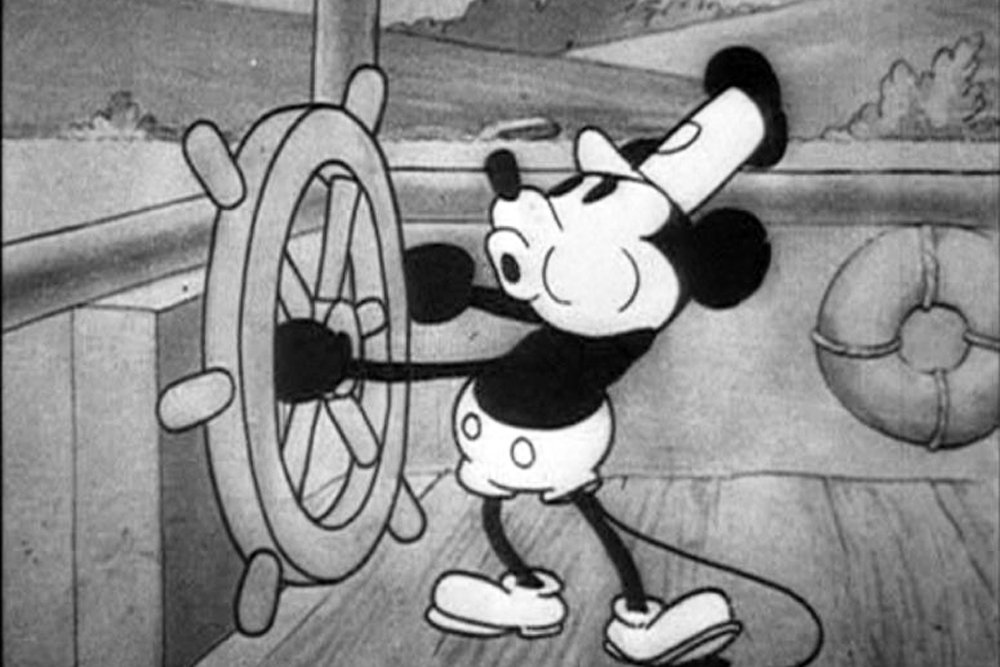
On 1 January 2024, the copyright in Steamboat Willie expired in the United States, and the earliest version of Mickey Mouse became free for anyone to copy. Within days there were horror film trailers, video games and, inevitably, t-shirts. For fashion brands and print-on-demand sellers, the question is simple to ask and harder to answer: if Mickey is in the public domain, can you put him on clothes and sell them? The short version is yes, but only one Mickey, only in some countries, and only if nothing on the product suggests Disney made or approved it. Copyright has lapsed. Disney’s trade marks have not.
Short answer: Only the 1928 Mickey from Steamboat Willie and the silent Plane Crazy is in the US public domain, plus the 1929 and 1930 cartoon versions. Later designs remain under copyright. Disney’s trade marks in Mickey’s image and name are still live, so using him on clothing in a way that suggests Disney is the source or sponsor can still infringe, and the UK and EU position is less settled.
Key takeaways
- Steamboat Willie (1928) entered the US public domain on 1 January 2024; 1929 and 1930 Mickey cartoons followed in 2025 and 2026, but later versions such as the 1940 Fantasia Mickey are still protected.
- Disney only owns the original material it added in later works, so a 1928 Mickey in your own colours is fine, but distinctive later features are not.
- Trade mark law is separate: Disney can still act where a Mickey image or the name “Mickey Mouse” is used on merchandise in a way likely to confuse buyers about source or sponsorship.
- Outside the US, the answer depends on national term rules; the UK’s comparison of terms may help, but Germany and some other countries are treated as exceptions.
What exactly entered the public domain in 2024?
Works published in the US in 1928 got a maximum of 95 years of copyright, a term set by the Copyright Term Extension Act of 1998. The US Copyright Office explains how these terms run in its circular on the duration of copyright. Terms run to the end of the calendar year, so 1928 works expired at midnight on 31 December 2023.
According to the Duke Center for the Study of the Public Domain, what became free was Steamboat Willie and the characters it depicts, Mickey and Minnie, as they appear in that 1928 film. The silent version of Plane Crazy, another 1928 cartoon, entered at the same time; its sound version followed in 2025. The Duke centre’s director, Jennifer Jenkins, notes that the 1998 extension is often called the “Mickey Mouse Protection Act”, but that it passed because of a much broader lobbying effort.
FLJ Insider Pro is open: live fashion law jobs and internships, five career guides and two roadmaps. Early bird USD 12/month. See what's inside
The supply of free Mickeys has grown since. On 1 January 2025, a dozen more 1929 Mickey cartoons became public, including The Karnival Kid, in which Mickey speaks his first words (“Hot dogs! Hot dogs!”). Duke’s Public Domain Day 2025 page notes that the 1929 films are also where Mickey first wears his white gloves. On 1 January 2026, nine 1930 Mickey cartoons followed, together with the original Rover, the dog later renamed Pluto.
Which versions of Mickey are still protected by copyright?
Every Mickey from a work that is still in copyright. The best-known example is the Mickey of Fantasia (1940). When Disney released new cartoons, it gained copyright only in the original, creative material it added, not in the 1928 material underneath. Ideas, stock features and trivial changes are not protected at all.
In practice that gives you two rules. First, copy from the public domain source, not from a modern Disney product. A 2020s Disney t-shirt showing a black-and-white Mickey may include newer artwork, layout or colour choices that are still protected. Second, avoid importing features from later films. Duke’s analysis says choosing your own colour scheme is fine and that a single bright colour on Mickey’s shorts is unlikely to be protectable on its own. A distinctive later pose, outfit or facial design is a different matter. FLJ’s guide to copyright infringement in fashion prints, photos and designs explains how courts compare a print with an earlier work.
The name is a separate point. Names of fictional characters are not protected by copyright on their own, but, as the next section shows, “Mickey Mouse” is very much protected as a trade mark.
Why do Disney’s trade marks still matter?
Copyright protects creative expression for a fixed term. A trade mark protects a sign that tells buyers who made or stands behind a product, and it can last as long as the owner keeps using it and it stays distinctive. Duke notes that Disney still holds trade mark rights in images of Mickey and the words “Mickey Mouse”, with federal registrations covering merchandise such as clothing, backpacks and watches. Even Wikimedia Commons, which hosts the Steamboat Willie frame used at the top of this page as a public domain file, flags it as subject to trade mark restrictions.
Disney said as much when the copyright expired. In a statement reported by ABC News, the company said it would “continue to protect our rights in the more modern versions of Mickey Mouse and other works that remain subject to copyright”, and would “work to safeguard against consumer confusion caused by unauthorised uses of Mickey and our other iconic characters”. ABC also noted that Disney has used a clip from Steamboat Willie in the opening logo of Walt Disney Animation Studios films, which one law professor described as a way of building trade mark value in that sequence.
There is a limit, though. Trade mark law cannot be used to keep an expired copyright alive. In Dastar Corp. v. Twentieth Century Fox Film Corp. (2003), the US Supreme Court refused to read the Lanham Act in a way that would create what it called “a species of mutant copyright law” limiting the public’s right to copy and use works whose copyright has expired. The question in any Mickey dispute is therefore not “does this show Mickey?” but “would buyers think Disney made, licensed or endorsed this product?” That is the familiar likelihood of confusion test, and FLJ’s explainer on trade mark vs copyright for fashion brands sets out how the two regimes differ.
Can you sell Steamboat Willie t-shirts?
You can sell clothing that reproduces or reworks the 1928 Mickey, and many sellers now do. The risk depends on how the image is used. Duke’s analysis draws the line between using Mickey in a new creative work, which does not mislead anyone about who made it, and using Mickey as a brand identifier on the kind of merchandise Disney itself sells, which is where confusion is most likely. Clothing sits right in that zone.
A shirt that uses Steamboat Willie as artwork, credited as a 1928 public domain film still, under your own label, is in a much stronger position than one that calls itself “Official Mickey Mouse”, uses Disney’s typography, or puts a Mickey head on the neck label, swing tag or store logo as if it were your badge. The second set of choices tells buyers who stands behind the product, which is exactly what a trade mark does. FLJ’s piece on merch bootlegging shows how quickly unofficial t-shirts attract trade mark claims, and its article on when brand parody becomes trade mark infringement covers the jokes that do not save a design.
| Element | Free to copy in the US? | Why |
|---|---|---|
| Mickey as drawn in Steamboat Willie (1928) | Yes | Copyright expired on 1 January 2024 |
| Gloved, speaking Mickey of the 1929 cartoons | Yes, from the 1929 films | Entered the public domain on 1 January 2025 |
| Later designs, such as the Fantasia (1940) Mickey | No | New original material is still in copyright |
| Your own colours on the 1928 design | Generally yes | Simple colour choices are unlikely to be protected |
| “Mickey Mouse” as a product or brand name | Risky | Disney trade mark; confusion about source or sponsorship |
| Mickey on labels, tags or as your logo | Risky | Looks like a source identifier, which is what trade marks protect |
Is Mickey in the public domain in the UK and EU?
Not automatically. The UK and EU generally protect works for the life of the author plus 70 years, not for a fixed term from publication, so the US expiry date does not carry over. What can help is a rule known as the comparison of terms. Under section 12(6) of the Copyright, Designs and Patents Act 1988, where a work’s country of origin is not the UK and its author is not a UK national, copyright lasts only as long as it does in the country of origin, capped at the UK term.
Duke’s analysis says that Mickey is not entering the public domain in some countries with life plus 70 terms, but that the 1928 Mickey may be free in the UK and much of the EU, where the shorter US term is applied to American works. It flags Germany and certain other EU states with special rules as exceptions, and stresses that this is not legal advice. FLJ is not aware of a UK or EU court ruling on Steamboat Willie itself. A brand selling Mickey clothing in Europe should get local advice country by country, and should remember that Disney’s UK and EU trade mark registrations are unaffected by any copyright expiry.
What should a fashion brand check before launching Mickey designs?
- Work from a public domain source: a 1928, 1929 or 1930 film frame, not a modern Disney product, restoration or style guide.
- Strip out later features: compare your artwork against post-1930 designs before printing.
- Use your own brand: keep “Mickey Mouse” out of product names, domains and hashtags used as your brand, and never put Mickey on labels or tags as your logo. FLJ explains how to run a USPTO trade mark search to see what is registered.
- Add a clear disclaimer, such as “Not made, licensed or endorsed by Disney”, on the listing and swing tag. Duke suggests a disclaimer as a sensible step, though it will not cure a design that is confusing overall.
- Check each market: the US answer does not travel automatically to the UK, EU or elsewhere.
- Keep records of your source material and design process in case of a takedown notice from a marketplace.
The bigger lesson is one FLJ has explored in the piracy paradox and the public domain in fashion: free material is a creative resource, but in fashion the most valuable rights often sit in brands, not designs.
This article is general information, not legal advice. Copyright and trade mark status differs by country and by work; take advice before launching a product range.
Frequently asked questions
Is Mickey Mouse in the public domain?
Partly. In the US, the Mickey of Steamboat Willie (1928) entered the public domain on 1 January 2024, followed by the 1929 and 1930 cartoon versions in 2025 and 2026. Later versions are still in copyright, and Disney’s trade marks in Mickey remain in force.
Can I put Steamboat Willie on a t-shirt and sell it?
In the US, generally yes, if you copy the 1928 design rather than later versions and do nothing to suggest Disney made or endorsed the shirt. Using “Mickey Mouse” as a product name or Mickey as your logo increases the trade mark risk.
Can Disney still sue over Steamboat Willie merchandise?
Not for copying the expired 1928 work. Disney can still bring trade mark claims if a product is likely to confuse buyers about who made or sponsored it, and copyright claims if a design copies later protected versions of Mickey.
What did Dastar decide?
In Dastar Corp. v. Twentieth Century Fox Film Corp. (2003), the US Supreme Court held that the Lanham Act cannot be used to create “mutant copyright” protection over works whose copyright has expired. It limits how far trade mark law can stop people copying public domain material.
Is Mickey Mouse in the public domain in the UK?
Possibly, but it is not settled. UK law applies a comparison of terms to works from outside the UK, which may mean the shorter US term applies to the 1928 Mickey. There is no court ruling on the point, so take advice before selling in the UK.
Can I call my clothing brand Mickey Mouse?
No. Disney holds trade mark rights in the name “Mickey Mouse” and in Mickey images registered for goods including clothing. Using the name as your brand would very likely confuse buyers about the source, and the copyright expiry has no effect on those trade marks.
Featured image: Image: Walt Disney and Ub Iwerks (Walt Disney Studios), Steamboat Willie, 1928, via Wikimedia Commons, Public domain
FASHION LAW JOURNAL INSIDER
Join designers, brand founders and fashion lawyers who get the biggest brand battles, IP fights and career moves in fashion law, straight to their inbox.