
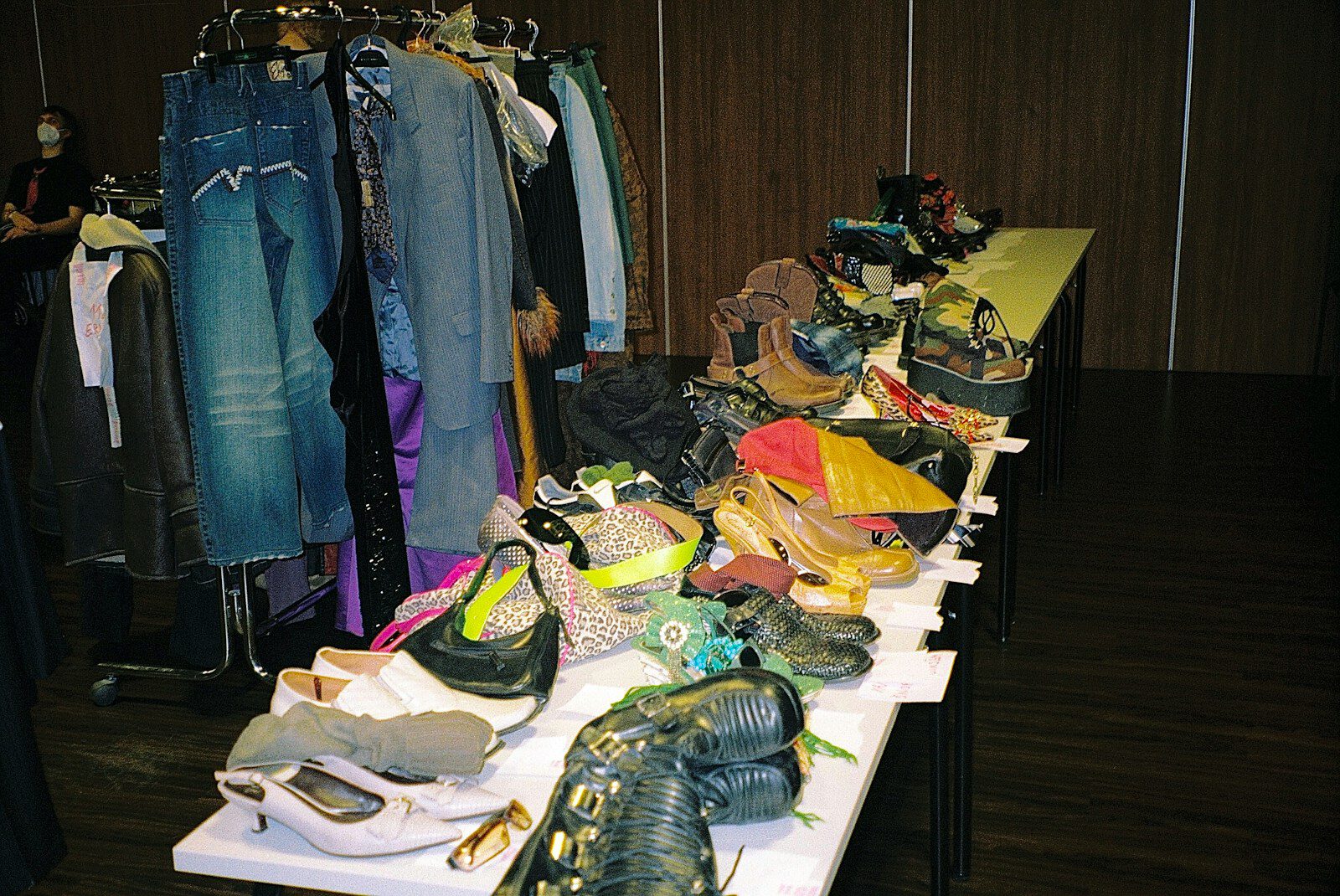
Everybody owns one. A scarf picked up at the airport side curb on the way back home from a bedazzling Euro Summer, a pair of flashy sunglasses that someone’s cousin got instead of a fridge magnet because the souvenirs needed an upgrade, a bag that arrived with an aunt who seemed too pleased with her spotting fake goods that are too good to be true, and paying too little for it. They nestle on bathroom shelves, hang in wardrobes, and find their place between a jumbled make-up drawer. These items are so organically assimilated into the respectable ambience of a household that no one actually would spare a minute to attribute a theoretically dense word like “counterfeit good” to such a ‘harmless’ purchase.
Living with Counterfeit Fashion
The allure of a counterfeited goodie, to many, is undeniable. But the defence is almost vindictive. The justification behind making such a purchase can be observed either in the form of a shrug or a retort. A shrug of “it does not bother me” or simply not being concerned with the general harms of counterfeiting prevalent at the collective level is usually treated as evidence of what the securitization theory rests its premise on. The retort usually takes a more confrontational turn, with usual responses amounting to the indignation of an overbearing mother, and end up with “What’s in it for you?” or perhaps, “Why be the whistleblower about such trivialities and the un-endorsed, unpaid flag bearer of hierarchical luxury?”
The intelligent know, and the conscious citizenry that does make counterfeiting such a beloved topic for a rich debate uphold their side, only as far as it is convenient to their clandestine aspirations of possessing what the ‘creme de la creme’ stroll in.
Counterfeiting faces a constant paradox, with its detriments, which are very real, and on the flip side, the sheer abundance of marketplaces flooded with such goods. As Wæver simply explains, it is by labelling something a security issue that it becomes one (Wæver 2004: 13). This divergence births two issues. The first is the actual threats of counterfeited fashion, and the second, of disproportionate responses.
FLJ Insider Pro is open: live fashion law jobs and internships, five career guides and two roadmaps. Early bird USD 12/month. See what's inside
Is Counterfeiting a Security Threat?
If fitted in the context of securitization, counterfeiting emerges as a menace greater than its original size. The listed harms seem to penetrate into personal, societal, and global arenas and are far more worthy than a shrug of exasperation. The OECD and EUIPO put global trade in counterfeit and pirated goods at around USD 467 billion in 2021, roughly 2.3 per cent of world trade. Europol and the EUIPO have documented the links to organised crime in some detail: the same networks, the same routes, often the same money. Forced and child labour turn up in these supply chains over and over. This deserves saying plainly, since what follows could easily be mistaken for indifference. Counterfeiting turns out to be a great malignancy, and the people determined to fight the cause aren’t just inventing caseloads.
The quandary seeps in when the data is unable to justify either the shrug or the retort. The woman with the fake simply weighs the inconvenience of explaining her teenage aspirations of possessing a designer item, decides it’s not worth her time, and simply shrugs in indifference. The retort, on the other hand, is aimed at identifying the personal stake, and a figure of billions, however accurate, completely misses the point.
How a Luxury Bag Signals Status
Take mental notes on the workings of a luxury bag. Very little of it unfolds in the hand. It happens at about four feet, across a restaurant or a departure lounge, in the second it takes a stranger to read the monogram, the hardware, the silhouette, and the unspoken enigma the bag seems to attribute to its elegant bearer. The bag’s sanctity is at the mercy of this readability. Everything else, the hand-embroidered weave, the exquisite leather, the beeswax- coated linen thread, exists to support its sovereignty.
A bad fake poses no real danger to this status-attributing phenomenon. It simply reads as a fake from four feet, a desperate attempt to feel better, and being fashionable from six, and at eight, it is symbolic of a hopeless case of social climbing gone wrong. However, a good fake is a treacherous node. Once a convincing copy is on the rounds, the stranger can no longer be sure of their keen observational skills that are so adept at noticing logos, and the elegant bearer is left astray amidst the illegibility of luxury. She is now carrying something that might be mistaken for a fake, and which, socially speaking, sits uncomfortably close to carrying one. A good fake makes the real one unreadable. The tragic streak is that her bag may be very well made, as it was the day she, so fondly, bought it, but nobody can read it with confidence.
The Hidden Harm
Perhaps, this is the harm that often slides away unmentioned and undeliberated. The ongoing debate does talk about crime and consumer safety, but what the enforcement truly guards is the ability of an object to announce its presence without having to say it out loud. Measured on this scale, the response does make sense. The raids, the seizures, the wide-scale unveiling operations accompanied by the vocabulary of threat are equivalent to it, because what’s at stake is the entire sorting mechanism of luxury. Disproportion only creeps in when the response is placed adjacent to the official harms listed, which were only a fraction of the issues being protected. This glaring mismatch forms the cornerstone of a naive interpretation of counterfeiting just as a securitized issue. The peril was real all along. It simply couldn’t be digested by modern-day all-appeasing posters.
Putting your hand on a steaming kettle might prove to be a better option than saying this out loud. A maison cannot run its campaign based on the assumption that its affluence will be guarded by the common man, and no government is going to fund a customs officer to preserve a social ranking. So the propensity for harm gets relocated to somewhere it can be voiced, which, precisely, is the buyer. The person with the fake becomes the picture of aspirations fulfilled by immoral doings. Upon skimming through the literature on counterfeit purchase, one does come across a vocabulary thick and laden with such character words. Remarkably few of them point to actual crime.
There is a study often cited as proof. In 2010, Francesca Gino, Michael Norton and Dan Ariely gave participants real Chloé sunglasses and told some of them the glasses were fakes, and those who believed they were wearing counterfeits went on to cheat more. The truth of the matter was that every pair in the experiment was genuine. The mere label was enough to make the wearer the suspect.
What’s In It For You?
We stand, yet again, at the retort. “What’s in it for you?” might be the best-posed question in the entire literature surrounding counterfeiting. She has spotted that the person enquiring about the legitimacy of the purchase might have something bigger at stake, and it is not the usual vices of counterfeiting. It is the value of looking expensive. The woman with the fake bag gets there in five words, faster than any campaign ever could. And what’s truly in it for her is a verdict on her character attribution and perhaps a session of moral reprimand. The woman carrying the real bag is never asked anything at all. It seems paying full price is in the Roman sense, a solutio: the debt is discharged, and nobody asks what it bought.
FASHION LAW JOURNAL INSIDER
Join designers, brand founders and fashion lawyers who get the biggest brand battles, IP fights and career moves in fashion law, straight to their inbox.