
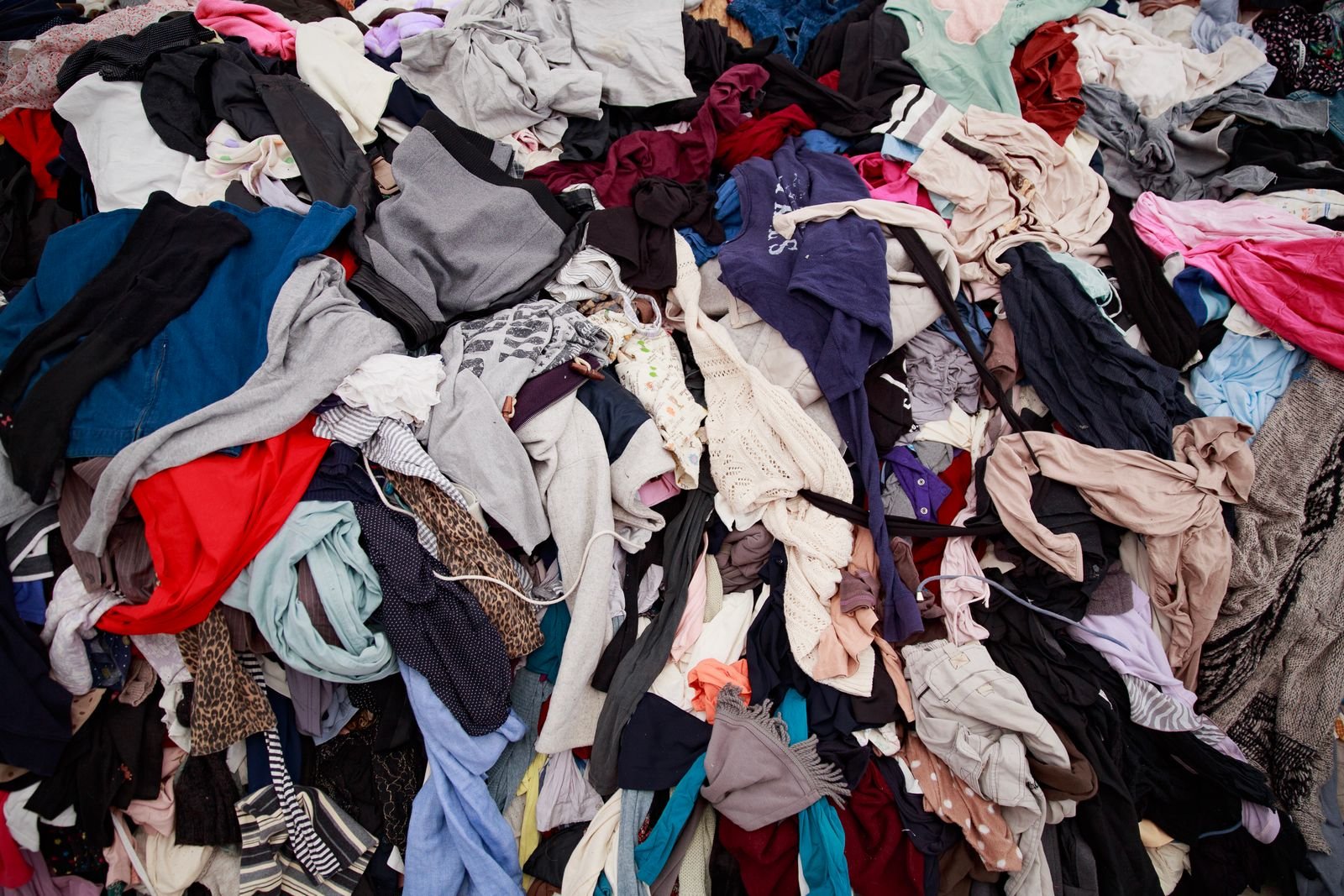
California is the first US state to make clothing brands pay for what happens to their products after customers throw them away. Its Responsible Textile Recovery Act of 2024, better known as SB 707, applies extended producer responsibility to apparel and household textiles, and the first hard deadline has already passed: every covered producer had to join the state’s approved producer responsibility organisation by 1 July 2026. This guide explains who counts as a producer, what the law requires and when, what brands are paying now and what they are likely to pay later, the penalties, and where other US states stand.
Short answer: Extended producer responsibility for textiles makes the brand owner, or the next business in line, fund the collection, repair, reuse and recycling of clothing it sells. In California, producers with at least $1 million in global turnover had to join Landbell USA by 1 July 2026, currently pay a flat $1,000 a year, and will move to per-item, eco-modulated fees once a plan is approved.
Key takeaways
- Governor Gavin Newsom signed SB 707 on 22 September 2024. It covers clothing, footwear, handbags, backpacks and household textiles such as bedding, towels and curtains.
- CalRecycle approved Landbell USA as the sole producer responsibility organisation on 27 February 2026, and producers had to join it by 1 July 2026.
- Producers with less than $1 million in annual aggregate global turnover, and sellers of only second-hand goods, are exempt.
- CalRecycle can impose administrative penalties of up to $10,000 a day, or $50,000 a day for intentional or knowing violations.
What is extended producer responsibility for textiles?
Extended producer responsibility, or EPR, shifts the cost of managing products at the end of their life from taxpayers onto the companies that put them on the market. It is long established for packaging, batteries and electronics. Textile EPR applies the same idea to clothes and home textiles: producers pay into a collective organisation that funds collection, sorting, repair, resale and recycling.
Europe moved first: France has run textile EPR since 2008, and every EU member state must have a scheme by April 2028, as FLJ explains in its guide to textile EPR under the revised Waste Framework Directive. For the wider picture, see FLJ’s explainer on circular fashion. This article stays with the United States.
FLJ Insider Pro is open: live fashion law jobs and internships, five career guides and two roadmaps. Early bird USD 12/month. See what's inside
What does California SB 707 cover?
The Act, now part of the California Public Resources Code with its key definitions in section 42984.3, applies to “covered products”, meaning apparel and textile articles. The bill text lists what counts. Apparel includes undergarments, shirts, trousers, skirts, dresses, suits, leggings, athletic wear, swimwear, formal wear, school and sports uniforms, footwear, handbags, backpacks, knitted and woven accessories, jackets, coats and ski trousers. Textile articles include blankets, curtains, fabric window coverings, towels, tapestries, bedding, tablecloths, napkins, linens and pillows.
Some products are left out: protective equipment, clothing for the US military, reusable incontinence products, reusable period products regulated by the Food and Drug Administration, and products already covered by California’s separate mattress, carpet and electronic waste schemes. Single-use items such as wipes and paper towels are also excluded.
Who counts as a producer under SB 707?
The definition in section 42984.3 works as a ladder. You move to the next rung only if nobody in California fits the one above it.
- First: the person who manufactures the product and owns or licenses the brand or trade mark it is sold under.
- Second: the brand or trade mark owner or, if the owner is outside California, its exclusive licensee, whether or not the mark is registered.
- Third: the importer that brings the product into California for sale.
- Fourth: the distributor, retailer or wholesaler that sells it in or into the state.
A sale happens in California if the product is delivered to a consumer there, so a brand in New York, London or Milan that ships to Los Angeles is caught. The risk for retailers is the bottom rung: if a foreign label has no California presence and no importer steps in, the store selling it can become the producer. The Act lets businesses agree who takes on the producer’s duties.
There are two exemptions. Sellers of only second-hand products are not producers. And a seller with less than $1 million in annual aggregate global turnover is excluded; the figure is adjusted for inflation and counts the whole corporate group, so it is not a California sales test.
Who is the approved PRO, and is it under legal challenge?
CalRecycle chose Landbell USA, part of the Germany-based Landbell Group, on 27 February 2026, over two rivals, the Textile Renewal Alliance, which was backed by the American Apparel & Footwear Association (AAFA) and retail groups, and the Circular Textile Alliance.
AAFA then sued. In American Apparel & Footwear Association v California Department of Resources Recycling and Recovery, filed in Sacramento County Superior Court, it argued that Landbell does not meet the Act’s requirements for an approved organisation. The court issued a tentative ruling on 6 August 2026 refusing a preliminary injunction, finding the claimed harms speculative and that halting the programme would disrupt the statutory deadlines, as Jones Day reported. Just Style later reported that the injunction was denied on 17 September 2026 and that the underlying challenge is set for hearing on 12 March 2027. Until a court says otherwise, joining Landbell is the only way to comply.
What must producers do, and when?
Most of the work falls on the organisation, but producers must join, pay, report and keep records. The timeline below comes from the statute and CalRecycle’s textile EPR page.
| Date | What happens | Who |
|---|---|---|
| 27 February 2026 | Landbell USA approved as the PRO | CalRecycle |
| 1 July 2026 | All covered producers must join the PRO; producers that become covered after 1 January 2030 have 90 days | Producers |
| 1 March 2027 | Statewide needs assessment submitted to CalRecycle | PRO |
| No earlier than 1 July 2028 | CalRecycle regulations take effect | CalRecycle |
| 30 days after regulations | List of brands sold into California filed, then updated every 15 January | Producers or PRO |
| 12 months after regulations | Full stewardship plan submitted; CalRecycle posts its first list of compliant producers | PRO and CalRecycle |
| 1 July 2030 | Plan must be approved, and every producer must be covered by it | PRO and producers |
| 2031 | Plan fully implemented, within 12 months of approval | PRO |
CalRecycle is still writing the rules. It held informal workshops on 13 August and 29 September 2026, covering definitions, online marketplaces, collection and producer identification, and a third is set for 12 November 2026.
How much will brands pay?
For now, very little. Landbell USA charges a flat annual registration fee of $1,000 for the 2026 to 2027 cycle, which runs from 1 July 2026 to 30 June 2027. That money helps fund the needs assessment, which will estimate what California actually needs in collection points, sorting capacity and recycling.
The real costs come later. The statute requires the organisation to fund the whole programme, including CalRecycle’s own regulatory costs, and to spread those costs among producers using a “per unit eco-modulated fee” that reflects California sales volumes and the cost of managing each type of product. Once a plan is approved, producers pay annual fees that reward design choices supporting reuse, repair and recycling and add “malus” charges for materials and practices that work against the plan. Existing take-back and repair schemes run by a brand can be taken into account.
The plan must carry a five-year budget and six months of reserves, and collection must be free: at least 10 permanent sites per county, or one per 25,000 people if higher, with lower minimums for small counties. Those obligations will drive the fee. No per-item figures exist yet, and none can until the needs assessment and plan are done, so anyone quoting a cost per garment is guessing.
What brands can do now is collect the data that will set their fees. The organisation’s annual report must break down covered products sold into California by fibre type and Harmonized Tariff Schedule number, so producers will need clean unit sales data by product category, fibre composition and destination. FLJ’s guide on how brands reduce textile waste covers the design levers that are likely to earn lower fees.
What are the penalties for non-compliance?
Under section 42984.21, CalRecycle may impose administrative civil penalties of up to $10,000 per day, rising to $50,000 per day where the violation is intentional or knowing. It must weigh factors including the extent of the violation, good-faith efforts to comply and deterrence, and unpaid penalties can be turned into a court judgment.
The statute ties the main penalty exposure for producers that stay outside the system to the plan: a producer that is not participating becomes subject to penalties once a plan is approved or on 1 July 2030, whichever is sooner. That is not a reason to wait. Late joiners will be easy to spot, and the second sanction is commercial rather than financial. From the date a plan is approved, retailers, importers, distributors and online marketplaces may not sell a covered product in California unless its producer appears on CalRecycle’s list of compliant producers. Stock already on shelves before the first list is posted can be sold through.
Records matter too. Producers, retailers and importers must hand over relevant records within 14 days of a request and keep them for five years, and reports are made under penalty of perjury.
What should retailers and online marketplaces check?
Retailers and marketplaces are not usually producers, but the Act makes them gatekeepers: they must monitor CalRecycle’s list and stop selling non-compliant brands once a plan is approved. In practice that means SB 707 warranties in supplier terms and proof of Landbell registration. Retailers selling own-label products, or importing foreign brands with no US entity, should assume they are the producer for those lines.
There is a counterfeiting angle too: every plan must explain how collection sites will identify and reject counterfeit covered products.
Are other US states passing textile EPR laws?
Not yet. There is no federal textile EPR law, and California is the only state with one in force.
New York. Senate Bill S3217, sponsored by Senator Brian Kavanagh, would create an EPR scheme for apparel and textiles modelled on California’s, with recycling targets and a ban on disposing of textiles at solid waste facilities. It was amended and recommitted to the Senate Environmental Conservation Committee on 14 May 2026 and has not passed either chamber.
Washington. House Bill 1420 would have required textile producers to join a single organisation. A substitute bill cleared the House Environment and Energy Committee in January 2026 but stalled in the Appropriations Committee after a hearing on 6 February 2026, and it did not reach a floor vote before the session ended.
Both bills borrow California’s design, so an SB 707 compliance process will travel. FLJ’s fashion legal calendar for 2026 and 2027 tracks the dates, and its earlier piece on the July 2026 US apparel compliance deadlines covers SB 707 alongside the federal changes. The global context, including Chile’s EPR push, is in FLJ’s report on the Atacama textile waste crisis.
What should brands do now?
- Confirm your status. Find your place on the producer ladder for each brand and test the $1 million threshold at group level.
- Register if you have not. Registration with Landbell USA remains open after the 1 July 2026 deadline.
- Fix the paperwork. Agree in writing who carries producer duties for licensed, imported and private-label lines.
- Build the data. Track units sold into California by product type, fibre content and tariff code.
- Design for the fee. Durable, repairable and mono-material products are the ones the eco-modulated fee is meant to reward.
- Watch the rulemaking and the courts. CalRecycle’s regulations and the March 2027 hearing in the AAFA case could change the details.
This article is general information, not legal advice. SB 707 regulations are still being developed; check the current CalRecycle guidance and take advice on your own products and supply chain.
Frequently asked questions
What is extended producer responsibility in fashion?
It is a legal model that makes the company placing clothing or textiles on the market pay for collecting and managing those products when they are thrown away. Producers join a collective organisation that funds collection points, sorting, repair, reuse and recycling, usually through fees linked to how much they sell and how recyclable their products are.
Does SB 707 apply to brands based outside California?
Yes. A sale counts as happening in California if the product is delivered to a consumer there, so out-of-state and foreign brands shipping to California customers are covered. If the brand owner has no California presence, the duty can pass to its exclusive licensee, the importer or, as a last resort, the retailer selling the product.
Is there a small business exemption under SB 707?
Yes. A seller with less than $1 million in annual aggregate global turnover, adjusted for inflation, is not a producer. Turnover is counted across the whole corporate group, not just California sales. Sellers that deal only in second-hand covered products are also exempt, which protects thrift and resale businesses.
How much does it cost to register with Landbell USA?
Landbell USA charges a flat registration fee of $1,000 for the 2026 to 2027 cycle. Per-item, eco-modulated fees based on California sales volumes and product characteristics will only apply once CalRecycle approves a stewardship plan, which must happen by 1 July 2030. No per-item rates have been published.
What happens if a producer misses the 1 July 2026 deadline?
Registration is still open, so the first step is to join. CalRecycle can impose penalties of up to $10,000 a day, or $50,000 for knowing violations, and once a plan is approved retailers and marketplaces may not sell products from producers missing from its compliant list.
Which other US states have textile EPR laws?
None yet. California is the only state with a textile EPR law in force. New York’s S3217 remains in a Senate committee after amendments in May 2026, and Washington’s HB 1420 stalled in the House Appropriations Committee in 2026. There is no federal textile EPR law.
FASHION LAW JOURNAL INSIDER
Join designers, brand founders and fashion lawyers who get the biggest brand battles, IP fights and career moves in fashion law, straight to their inbox.